
Protocols: BrdU Staining and Labeling
Overview
BrdU Staining Experiments 10 Tips for Success Quick Guide | Download PDF
BrdU (5′-bromo-2′-deoxyuridine) is a thymidine analog that has been established as a popular tool in cancer and neuroscience research for determining cell proliferation rates.
Once added to samples, BrdU is incorporated into newly synthesized DNA during replication. BrdU can consequently be detected with anti-BrdU antibodies, such as Rat Anti-BrdU Antibody (clone RF04-2, MCA6143), Human Anti-BrdU Antibody (clone AbD33758kg, HCA320), Mouse Anti-BrdU Antibody (clone Bu20a, MCA2483), and Rabbit Anti-BrdU Antibody (AHP2405) thereby allowing the visualization of proliferating cells.
BrdU Labeling and Immunostaining Protocols
Protocol describing how to BrdU label HeLa cells and detect the incorporated BrdU with the help of rabbit and mouse anti-BrdU antibodies.
BrdU Detection by Flow Cytometry
Protocol highlighting how to detect incorporated BrdU by flow cytometry analysis.
Related Topics
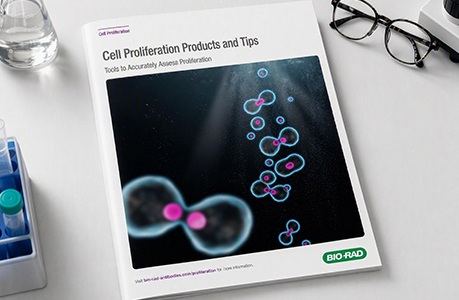
Cell Proliferation Products and Tips
Cell proliferation is a homeostatic process that involves the rapid growth and division of cells. If not properly controlled, it can lead to an unchecked increase in cell numbers, which may result in diseases such as cancer. Therefore, evaluating proliferation is crucial across various scientific fields.
This guide provides the knowledge you need to effectively study cell proliferation in your assays.