
Secondary Antibody Selection Process - Step by Step
Select Your Secondary Antibody
Using the knowledge from the “Experimental design – how-to reference guide” section and your desired application, follow the steps below to discover your ideal secondary antibody.
Select:
- Target species
- Host
- Class and chain (found in the specificity filter)
- Isotype
- Format
- Check before you select – does your antibody need to be cross-adsorbed?
Use the filters to systematically select your requirements and discover the best secondary antibody for your experiment, then download the results.
Secondary Antibodies Range
| Description | Target | Host | Specificity | Format | Isotype | Applications | Code |
|---|
Tips
- When using more than one secondary antibody ensure that they don’t cross react
- When working with some immune tissues or cells that contain a lot of Fc receptors, it helps to choose a F(ab) or F(ab’)2 fragment to eliminate non-specific binding. Alternatively, block Fc receptors via an absorption step, using purified IgG from the host species of your secondary antibody or serum from target cells
- View our IHC tips when using a secondary antibody
Any questions? Let us help, contact our technical support team for advice
Popular Resources
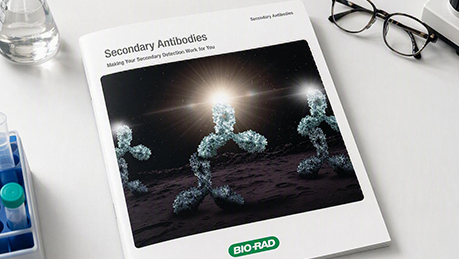
Secondary Antibody Guide
Download or request a free printed copy of Bio-Rad’s new secondary antibody guide. It is easy-to-read and practical, explaining step-by-step what you need to know, what you need to do, and how to do it.
Fundamentals of Secondary Antibodies
Listen to the secondary antibody podcast series to improve your experiments by learning how to choose and use these critical detection reagents.