
Protocol: BrdU Staining of Cells for Cell Cycle Analysis
FC14
BrdU is an analog of thymidine that is readily incorporated into DNA during DNA synthesis. It provides an accurate method of monitoring proliferation and apoptosis. Cells are cultured for a short time with BrdU to allow its incorporation into newly synthesised DNA.
Following fixation and acid treatment to denature the DNA, BrdU incorporation is detected using an anti‑BrdU antibody as a measure of DNA synthesis.
Bio-Rad’s Mouse Anti-BrdU Antibody, clone Bu20a (catalog MCA2483), and Rabbit Anti-BrdU Antibody (AHP2405) are suitable for flow cytometry.
This protocol provides a general staining procedure for use with Bio-Rad reagents. Specific recommendations are provided on product datasheets, and those instructions should always be used in conjunction with the product and batch-specific information provided with each antibody vial. A certain level of technical skill is required for the successful design and implementation of these techniques; these are guidelines only and may need to be adjusted for particular cell types or applications.
Reagents
- Cell culture medium
- Phosphate buffered saline, 10x (PBS) (BUF036A)
- PBS containing 1% bovine serum albumin (PBS/BSA)
- BrdU (Merck, 19-160)
- 70% ethanol in distilled water
- 2 M hydrochloric acid (HCl) containing 0.5% octylphenol ethoxylate (Triton X-100; Merck, TX1568)
- 0.05% (v/v) Tween 20 in PBS
- 0.1 M Na2B4O7, pH 8.5
- Anti-BrdU Antibody (MCA2483 or AHP2405)
- ReadiDrop Propidium Iodide (1351101)
Methods
- Treat suspension cells with BrdU in cell culture medium to a final concentration of 10 μM. Incubate for at least 30 min at 37°C in a CO2 incubator.
- Transfer cells to a 50 mL centrifuge tube and add 10 mL PBS/BSA. Centrifuge at 500 x g for 10 min at room temperature (RT) and discard supernatant.
- Repeat step 2.
- Resuspend cells in 2–5 mL cold (4°C) 70% ethanol. Add dropwise to cell pellet while vortexing. This should ensure fixation of all cells and minimize clumping.
- Incubate for at least 30 min on ice.
- Centrifuge at 500 x g for 10 min and discard supernatant.
- Resuspend cells in 2 mL of 2 M HCl containing 0.5% octylphenol ethoxylate (Triton X-100; Merck TX1568). Incubate for 30 min at RT, preferably on a rocking platform set to 15 rpm.
- Centrifuge at 500 x g for 10 min and discard supernatant.
- Resuspend cells in 3 mL of 0.1 M Na2B4O7, pH 8.5 and incubate for 2 min at RT.
- Centrifuge at 500 x g for 10 min, discard supernatant, and resuspend in RT PBS/BSA + 0.05% Tween 20. Adjust cell concentration to 1 × 10⁷ cells/mL.
- Aliquot 100 μL of the cell suspension into required number of 5 mL tubes.
- Incubate with Anti-BrdU Antibody (MCA2483 or AHP2405) at the dilution determined from a titration experiment or the vendor-recommended dilution. Mix well and incubate at 4°C overnight, avoiding direct light.
- Add 2 mL of RT PBS/BSA. Centrifuge at 500 x g for 10 min at RT and discard supernatant.
- Optional: When using an unconjugated antibody, perform incubation with a secondary antibody. Resuspend cells in 100 μL of PBS/BSA and incubate with the secondary antibody at a dilution determined from a titration experiment or the vendor-recommended dilution for at least 45 min at RT. Wash with 2 mL of PBS/BSA, centrifuge at 500 x g for 10 min, and discard supernatant.
- Resuspend cells in 1 mL of PBS.
- Add 1–2 drops of ReadiDrop Propidium Iodide (1351101) and vortex briefly.
- Acquire samples on a flow cytometer.
Notes
- The optimal BrdU incubation time is dependent on culture conditions and the proliferation profile of your cells and therefore should be optimized for your experiment
- The acid treatment to unwind the DNA may affect surface immunophenotyping. If surface staining is required, using BrdU with DNAse I may be required
- When acquiring cells, select the appropriate laser and filter for propidium iodide and collect data in the linear scale
- Suitable alternative DNA binding dyes to propidium iodide include 7-aminoactinomycin-D (1351102) and Hoeschst 33342 (1351304)
- All antibodies should be titrated prior to use to ensure the optimal concentration is used
Resources
- What is BrdU?
- BrdU in adult neurogenesis research - Part 1
- BrdU in adult neurogenesis research - Part 2
- Measuring proliferation and cell cycle by flow cytometry
Support
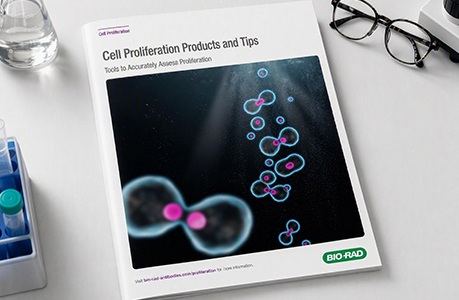
Cell Proliferation Products and Tips
Cell proliferation is a homeostatic process that involves the rapid growth and division of cells. If not properly controlled, it can lead to an unchecked increase in cell numbers, which may result in diseases such as cancer. Therefore, evaluating proliferation is crucial across various scientific fields.
This guide provides the knowledge you need to effectively study cell proliferation in your assays.