
Biological Controls

- On This Page
- Biological Controls
s




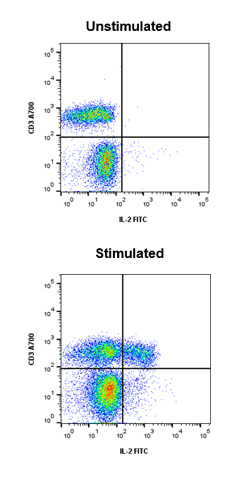
Fig.1. Use of a positive control. Human peripheral blood was stained for IL-2 (MCA1553F) and CD3 (MCA463A700). Cells were gated on lymphocytes, the lymphocytes expressed IL-2 following stimulation with Cell Stimulation Reagent containing Brefeldin A (BUF077A) for 5 hours.
Biological controls are crucial to determine whether your experiment has worked effectively.
In addition to staining and isotype controls, you should also consider biological controls that will enable you to determine staining specificity and experimental limitations.
These controls are important for all staining but are more important for intracellular staining, which can have higher background fluorescence. Controls include known negative samples and known positive samples.
Examples of these are:
- Cells known from the literature to either express or lack expression of the antigen of interest
- Cells where the antigen has been knocked down or out, using RNAi or CRISPR technology to produce a negative cell
- Cells which have been transfected and the antigen is being over expressed to ensure positive staining
For some experiments, such as cytokine release measurement, an unstimulated and fully stimulated sample is important to include to determine both positive results and the dynamic range of fluorescence staining.