
DyLight Dyes for Flow Cytometry and Microscopy
DyLight® Dyes Give You Outstanding Immunofluorescence Results in Flow Cytometry and Microscopy.
- More intense fluorescence and sensitivity than comparable spectral conjugates
- Economical as DyLight dyes require less conjugated antibody to study your cells than FITC and RPE
- Greater photostability than other fluorochromes
- Good stability over pH 4 - 9
- Ideal for immunofluorescence techniques
- Compatible with all common fluorescence detection channels
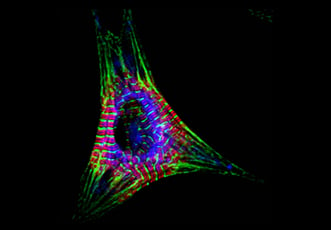
Newborn rat primary cardiac myocytes stained with mouse anti-desmin, detected with goat anti-mouse IgG:DyLight 488 (STAR74D488); rat anti-alpha tubulin detected with goat anti-rat IgG:DyLight 649 (STAR71D649); and rabbit anti-MyBP-C detected with sheep anti-rabbit IgG: DyLight 549.
DyLight dyes are excellent alternatives to Alexa Fluor®, CyDye® and LI-COR® fluorescent dyes. They are primarily suitable for use in immunofluorescence techniques such as microscopy and flow cytometry, and may also be used in ELISA, Western blotting, high throughput screening and other array platforms.
Their absorption and emission wavelengths are compatible with popular fluorescence instrumentation, so you won’t have to change your preferred method of imaging.
We currently offer the following DyLight dyes conjugated to primary antibodies and secondary antibodies, and they are also available for custom conjugations to the antibody of your choice.
| Dye | Excitation max (nm) | Emission max (nm) | Fluorescence color |
|---|---|---|---|
| DyLight 405 | 400 | 405 | |
| DyLight 488 | 493 | 518 | |
| DyLight 550 | 562 | 576 | |
| DyLight 650 | 652 | 672 | |
| DyLight 680 | 692 | 712 | Near IR |
| DyLight 800 | 777 | 794 | Near IR |
DyLight Dyes
| Description | Target | Format | Clone | Applications | Citations | Code |
|---|
Flow Cytometry Basics Guide
Practical advice to get you started in flow cytometry
Keep up to date with recent advances by downloading our popular Flow Cytometry Basics Guide, which not only provides practical advice and best practice examples when planning multicolor experiments, but also a basic overview of all the important flow cytometry principles.
This comprehensive guide is split into nine easy-to-read chapters covering 54 pages, making this ideal for beginners wanting to gain confidence when planning experiments, and can also be used as a teaching aid.