Alexa Fluor Antibody Conjugates
Overview
Alexa Fluor® conjugated antibodies produce outstanding results in flow cytometry, immunofluorescence, and immunohistochemistry experiments.
Part of our flow cytometry dyes range, which also includes StarBright Dyes, Alexa Fluor fluorophores, possesses the following main benefits:
- Brightness — brighter and more fluorescent than conventional dyes
- Photostability — more photostable than conventional fluorophores such as FITC and PE
- pH stability — insensitive to pH changes over a broad range
- Narrow emission spectra — ideal for multicolor and multiplexing experiments
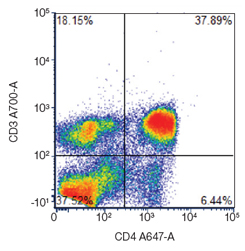
Fig.1. Staining rat lymphocytes. Viable cells were identified by PI (1351101) staining. Rat peripheral blood was stained with CD3 A700 (MCA772A700)
and CD4 A647 (MCA55A647) and gated on lymphocytes to identify T cells. Data acquired using the ZE5 Cell Analyzer.
Technical Features of Alexa Fluor Conjugates
| Fluorophores | Max excitation (nm) | Max emission (nm) | Color |
|---|---|---|---|
| Alexa Fluor® 405 | 401 | 421 | |
| Alexa Fluor® 488 | 495 | 519 | |
| Alexa Fluor® 647 | 650 | 665 | |
| Alexa Fluor® 700 | 702 | 723 | |
| PE-Alexa Fluor® 647 | 496, 546 | 667 | |
| PE-Alexa Fluor® 750 | 496, 546 | 779 |
Please use the filters to sort the attributes in the table below in order to find the antibody that fits your exact requirements. If you need any further assistance please do not hesitate to contact us.
Alexa Fluor Conjugate Products
| Description | Target | Format | Clone | Applications | Citations | Code |
|---|
Flow Cytometry Basics Guide
Practical advice to get you started in flow cytometry
Keep up to date with recent advances by downloading our popular Flow Cytometry Basics Guide, which not only provides practical advice and best practice examples when planning multicolor experiments, but also a basic overview of all the important flow cytometry principles.
This comprehensive guide is split into nine easy-to-read chapters covering 54 pages, making this ideal for beginners wanting to gain confidence when planning experiments, and can also be used as a teaching aid.