
Fixable Cell Viability Assays

s



VivaFix Fixable Cell Viability Assays
VivaFix Cell Viability Assays enable researchers to accurately discriminate between live and dead cells in both fresh and fixed samples.
Exclusion of dead cells in flow cytometry and cell sorting experiments is critical to prevent false positives.
Dead cells have high autofluorescence and bind to antibodies nonspecifically, leading to inaccurate interpretation of the data. In microscopy, cell viability and live:dead cell ratios are parameters that are frequently used to determine cell health.
 Discover how VivaFix Dyes can be easily incorporated into multiplexing panels.
Technical note:
Validated Method to Measure Multiple Parameters in Stimulated Human Peripheral Blood Mononuclear Cells Using StarBright™ Dye–Conjugated Antibodies, CytoTrack Cell Proliferation Kits, and VivaFix Cell Viability Assays.
Key Benefits of VivaFix Cell Viability Assays
- Easy to use
-
Wide range of dyes to easily fit with other dyes and fluorophores when multiplexing
- Excited by the five main laser lines, 355, 405, 488, 561, and 640 nm lasers, and can be detected by most instruments
- Cells stained with VivaFix Dyes can be fixed with a range of fixatives without loss of signal
- Suitable to use with intracellular staining protocols when cells are fixed and permeabilized
- Large difference in fluorescent intensity between live and dead cells allowing clear identification of populations
- Suitable for a wide range of applications including flow cytometry, both conventional and spectral, cell sorting, and microscopy
How They Work
VivaFix Dyes covalently bind to free primary amines, which in live cells are present on the cell surface. When the membrane is compromised, as seen in dead and dying cells, the dyes permeate the cells and react with intracellular primary amines as well as those on the cell surface. Therefore, a greater level of fluorescence can be detected in dead cells, allowing dead cells to be easily distinguished from live cells (Figure 1).
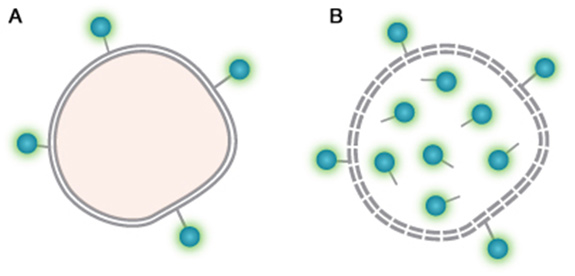
Fig. 1. VivaFix Cell Viability Assay chemistry. A. Live cells with VivaFix Dye bound to surface primary amines. B. Dead cells with VivaFix Dye bound to surface and intracellular primary amines.
Extensive Range
VivaFix Dyes are available with different spectral profiles (Figure 2 and Table 2) that simplify the process of selecting the most suitable dye for a flow cytometry or microscopy experiment. This flexibility of choice is especially important when designing high-plex panels for flow cytometry, as it allows for optimal dye selection to minimize spectral overlap and ensure accurate, reliable results.

Fig. 2. Excitation and emission profiles of VivaFix Dyes. Excitation profiles are shown by the dotted lines and emission profiles by the solid histograms.
Bright Dyes with Clear Separation of Live and Dead Populations
VivaFix Cell Viability Assays use bright dyes to give clear separation of populations. Figure 3 shows data from a flow cytometry experiment using Jurkat cells stained with VivaFix Dyes at the optimal amount, as determined by titration experiments.

Fig. 3. Jurkat cells stained with VivaFix Dyes. Jurkat cells were stained with VivaFix Dyes at the optimal concentration. Plots show unstained unheated cells (grey), stained live unheated cells (open histogram), and dead heated cells (solid histogram). Cells were fixed with Fixation Buffer (BUF071) prior to acquisition, with the exception of cells stained with DAPI. Data were acquired on a ZE5 Cell Analyzer.
Titration of VivaFix Dyes
Performing titrations for viability dyes is vital to determine the optimal staining concentration. The same method can be used as for titrating antibodies. The optimal concentration will vary between cell types and cytometers. For example, in Figure 4, the optimal amount used to stain lymphocytes in human peripheral blood is lower than the optimal amount for Jurkat cells, a T cell human cell line.

Fig. 4. Optimal staining concentration varies with cell type. Lymphocytes from human peripheral blood and Jurkat cells were stained with VivaFix 547/573 Dye (1351116). Plots show unstained unheated cells (grey), stained live unheated cells (open histogram), and dead heated cells (solid histogram). Cells were fixed with Fixation Buffer (BUF071) prior to acquisition. Data were acquired on a ZE5 Cell Analyzer.
VivaFix Cell Viability Assays Are Suitable for Conventional and Spectral Flow Cytometry
VivaFix Dyes are ideal for use in full spectral cytometry as well as conventional cytometry. They exhibit minimal cross laser excitation with narrow excitation peaks, resulting in low spillover and spreading in multiplexing panels.

Fig. 5. Spectral profiles of VivaFix Dyes on a 5-laser ID7000 spectral cytometer (Sony Biotechnology). Jurkat cells were stained with VivaFix Dyes and fixed with Fixation Buffer (BUF071) prior to acquisition.

Fig. 6. Spectral profiles of VivaFix Dyes on a 5-laser Cytek Aurora (Cytek Biosciences). Jurkat cells were stained with VivaFix Dyes and fixed with Fixation Buffer (BUF071) prior to acquisition.
Fixable by a Range of Fixatives
Cells stained with VivaFix Dyes can be fixed in a range of common fixatives with little effect on brightness as shown in Figure 7 for VivaFix 410/450 and 498/521.

Fig. 7. VivaFix Cell Viability Assays are fixable in a range of reagents with no loss in brightness. Jurkat cells were stained with VivaFix 410/450 Dye (1351112) at 1:2,000 or VivaFix 498/521 Dye (1351115) at 1:15,000 and acquired fresh or post-fixation with different fixatives, including Bio-Rad’s Fixation Buffer (BUF071). Plots show unstained unheated cells (grey), stained live unheated cells (open histogram), and dead heated cells (solid histogram). Data were acquired on a ZE5 Cell Analyzer.
Ideal for Use in Immunophenotyping Panels in Flow Cytometry
The large range of different formats gives the flexibility to choose one that will fit with new or existing immunophenotyping panels in both conventional and full spectrum cytometry. Excluding dead cells during analysis improves multiplexing data as false positives, due to nonspecific binding and autofluorescence of dead cells, are removed. An example of using Vivafix 547/573 in human peripheral blood stained with a 6-plex panel (Table 1) containing StarBrightTM Dye–conjugated antibodies, is shown in Figure 8.
Analyzing the same panel without the dead cell exclusion gate gives unexpected additional nonspecific cell populations, as shown in the red circles on Figure 9. This highlights how the exclusion of dead cells can improve data quality in flow cytometry.
Table 1. Reagents used for multiplexing panel. SBB, StarBright Blue; SBR, StarBright Red; SBUV, StarBright UltraViolet; SBV, StarBright Violet.
Marker / Dye |
Format |
Catalog |
|---|---|---|
|
VivaFix Cell Viability Assay |
547/573 |
|
|
CD3 |
SBV440 |
|
|
CD4 |
SBV515 |
|
|
CD8 |
SBB765 |
|
|
CD14 |
SBUV400 |
|
|
CD19 |
SBR670 |

Fig. 8. Multiplexing panel performed on human peripheral blood. Cells were fixed in Fixation Buffer (BUF071) after staining. Data were acquired on a ZE5 Cell Analyzer. SBB, StarBright Blue; SBR, StarBright Red; SBUV, StarBright UltraViolet; SBV, StarBright Violet.

Fig. 9. Effect of a live cell gate on multiplexing data quality. The multiplexing panel shown in Figure 8 was analyzed with and without a dead cell exclusion gate. SBB, StarBright Blue; SBR, StarBright Red; SBUV, StarBright UltraViolet; SBV, StarBright Violet.
VivaFix Cell Viability Assay Range
Table 2. VivaFix Cell Viability Assay range. Maximum excitation and emission wavelengths, and brightness scores generated from Jurkat cells stained with VivaFix Dyes at the optimal dilution. Scores of 1–5, with 5 the brightest.
Description |
Excitation Max, nm |
Emission Max, nm |
Optimal excitation laser |
Brightness Score (1-5) |
Catalog Number |
|---|---|---|---|---|---|
|
VivaFix 353/442 |
353 |
442 |
355 |
3 |
|
|
VivaFix 410/450 |
410 |
450 |
405 |
4 |
|
|
VivaFix 408/512 |
408 |
512 |
405 |
3 |
|
|
VivaFix 498/521 |
498 |
521 |
488 |
5 |
|
|
VivaFix 547/573 |
547 |
573 |
561 |
3 |
|
|
VivaFix 583/603 |
583 |
603 |
561 |
2 |
|
|
VivaFix 649/660 |
649 |
660 |
640 |
3 |
Related Products
We also offer non-membrane permeable DNA-binding viability dyes, DAPI, PI, and 7-AAD excited by the 355 nm, 488 nm, and 561 nm laser respectively. These allow you to assess the viability of cells when fixing is not required.