
Technical Note: Validated Method to Measure Multiple Parameters in Stimulated Human Peripheral Blood Mononuclear Cells
 Technical note:
Validated Method to Measure Multiple Parameters in Stimulated Human Peripheral Blood Mononuclear Cells Using StarBright™ Dye–Conjugated Antibodies, CytoTrack Cell Proliferation Kits, and VivaFix Cell Viability Assays.
Abstract
Integrating the measurement of multiple parameters in a flow experiment saves time and maximizes the information obtained from each sample, which is crucial when samples are limited. Here, we describe a validated experimental method to simultaneously measure cell proliferation, viability, activation status, and immunophenotype using CytoTrack Kits, VivaFix Assays, and antibodies conjugated to StarBrightTM Dyes.
Introduction
Cell number is one of the factors limiting how many experiments can be performed on a sample, leading scientists to favor assays that provide the most information. Flow cytometry saves time and precious sample by combining different assays into a single experiment that measures several cellular properties simultaneously. This method demonstrates a simple, validated protocol that combines several reagents to measure multiple properties in stimulated human peripheral blood mononuclear cells (PBMCs).
Cell proliferation is a measure of cell health and cell division. Tracking an intracellular protein-binding dye that loses half its fluorescence intensity with each cell division is a simple method in flow cytometry to determine if a cell has proliferated and how many times it has divided. CytoTrack Green, a nontoxic dye with three fluorescence options that covalently binds to intracellular proteins was used. This robust and reliable assay can identify up to ten cell divisions.
Viability assays determine the health of a sample by measuring the percentage of viable and dead cells. Dead cells autofluoresce and bind to antibodies nonspecifically, leading to false-positive signals; data quality can therefore be improved by excluding dead cells. Nonfixable DNA binding dyes such as 4',6-diamidino-2-phenylindole (DAPI) and propidium iodide (PI), or fixable amine binding dyes such as VivaFix, are the most common tools in flow cytometry to identify dead and dying cells. Here, the VivaFix Assay was used, as it is available in seven different fluorescent formats, and the cells can be fixed post-staining.
The narrow excitation and emission profiles of the VivaFix Dyes reduce compensation and spreading compared to DNA binding dyes, improving data quality. In live cells, VivaFix Dyes bind only to cell surface primary amines. In dead cells, the dye permeates the compromised plasma membrane and binds to intracellular primary amines, resulting in higher fluorescence intensity. This allows easy discrimination between live and dead cell populations.
Measuring T-cell activation shows how T cells respond to a stimulus; specifically relevant here is when resting T cells become activated. This parameter was measured in the protocol by incorporating antibodies in the panel against the common T-cell activation markers CD25 and CD69. Additionally, an immunophenotyping panel was used to identify major T-cell types, including naive and memory cells. A combination of antibodies against different cell surface markers was chosen. All the antibodies were conjugated to StarBright Dyes, as they are bright with narrow excitation and emission profiles, providing highly resolved cell populations. In combination, these two assays allow for T-cell–specific proliferation and activation to be identified.
Best practice was followed when performing the assay. For example, a high-quality sample and several controls were used to validate the method and confirm that the results were as expected. Full details of the controls can be found in the Materials and Methods section.
Materials and Methods
T-Cell Stimulation Using CD3/CD28 Bio-Rad Antibodies
12-well plates were coated with 5 µg/ml Anti-CD3 Antibody (Bio-Rad Laboratories, Inc., catalog MCA463EL) overnight at 4ºC. Wells were washed with sterile phosphate buffered saline (PBS). Human PBMCs were added at a density of 1 x 10⁶ cells per well in RPMI containing 10% fetal bovine serum (FBS), 2 ng/ml recombinant human IL-2 (Bio-Rad, PHP042), and 5 µg/ml Anti-CD28 Antibody (Bio-Rad, MCA709EL). As a control, unstimulated cells were cultured in uncoated wells in RPMI and 10% FBS. CytoTrack Green (Bio-Rad, 1351203) was added to cells that were stained with the antibody panel and the CytoTrack Green single-stained sample. Cells were incubated at 37ºC in 5% CO2 for 4 days.
T-Cell Stimulation Using CD3/CD28 T Cell Activator
Human PBMCs were added at a density of 1 x 10⁶ cells per well to 12-well plates in RPMI containing 10% FBS, 2 ng/ml IL-2, and 25 µl/ml ImmunoCult Human CD3/CD28 T Cell Activator (STEMCELL Technologies Inc., 10991). Unstimulated cells were cultured in RPMI and 10% FBS as a control. CytoTrack Green was added to cells that were stained with the antibody panel and the CytoTrack Green single-stained sample. Cells were incubated at 37ºC in 5% CO2 for 4 days.
Staining Protocol
Cultured cells were washed with PBS, and cells to be used for staining with the antibody panel and the VivaFix single-stained control were incubated at room temperature (RT) with the VivaFix 649/660 Cell Viability Assay (Bio-Rad, 1351118 ). After 30 min, cells were washed twice with PBS, resuspended in phosphate buffered saline with 1% bovine serum albumin (PBS/BSA), counted, and added to a 96-well round bottom plate at a density of 1 x 10⁶ cells/well. All cells were blocked in Human Seroblock (Bio-Rad, BUF070B) for 5 min at RT, then incubated for 45 min at RT with the antibody panel (Table 1). For compensation controls, cells were incubated with a single antibody. Fluorescence minus one (FMO) controls for CD25 and CD69 were also acquired; these are panels containing all reagents except CD25 or CD69 antibodies. Following incubation, samples were washed three times in PBS/BSA and resuspended in 100 µl of PBS/BSA. All antibodies were titrated prior to use and used at the optimal dilution.
Panel Design
There are multiple fluorophore options for each antibody/reagent, so there is a large choice of panel permutations. Panel design best practice was followed to generate high-quality data, identifying all cell populations at a high resolution. Bio-Rad’s Multicolor Panel Builder and Fluorescence Spectraviewer tools were used to assist with fluorophore selection. The following points were considered:
- The panel was acquired on a 5-laser ZE5 Cell Analyzer (Bio-Rad, 12004279). The dyes/fluorophores that can be optimally excited and detected were identified along with their relative brightness using Bio-Rad’s Fluorophores and Viability Dyes for Flow Cytometry Guide. All 5 lasers were used, as distributing antibodies and dyes across all available lasers helps minimize spillover and spreading
- Markers that allowed the biological question to be answered were selected, and their antigen density levels were identified. Some of the markers, including CD25 and CD69, have variable expression, depending on cell activation status
- For the antibodies, bright fluorophores were paired with markers with low antigen density or variable expression level, where possible. As the panel was relatively small, all the fluorophores used had a mid-high brightness with scores of 3–5 out of 1–5, with 5 being the brightest. Where possible, best practices were still followed, and the brighter fluorophores were paired with markers with a low antigen density and vice versa
- Spillover and spreading were minimized by distributing dyes and fluorophores across the 5 lasers. Additionally, the selected combination was designed to minimize spillover into the detection filters used for other dyes and fluorophores in the panel. For markers with unknown or variable expression levels, such as CD25, it was important that the fluorophore used had low spread. Therefore, CD25 was paired with SBUV400, which is a bright dye with a tight excitation and emission profile and no spillover or spreading (Supplementary Tables 1 and 2). The spectral profiles of the final fluorophores and dyes can be seen in Figure 1 and the panel can be seen in Table 1
Table 1. Reagents used in the multiplex panel.
| Fluorescence Color | Laser | ZE5 Filter |
Marker/Dye | Fluorophore | Bio-Rad Catalog Number |
|---|---|---|---|---|---|
| 355 | 387/11 | CD25 | SBUV400 | MCA2127SBUV400 | |
| 355 | 670/30 | CD45RA | SBUV665 | MCA88SBUV665 | |
| 405 | 460/22 | CD27 | SBV440 | MCA755SBV440 | |
| 405 | 525/50 | CD3 | SBV515 | MCA463SBV515 | |
| 405 | 720/60 | CD4 | SBV710 | MCA1267SBV710 | |
|
|
488 | 525/35 | CytoTrack Green | N/A | 1351203 |
| 488 | 593/52 | CD8 | SBB615 | MCA1226SBB615 | |
|
|
561 | 577/15 | CD45RO | SBY575 | MCA461SBY575 |
| 561 | 750LP | CD69 | SBY800 | MCA2806SBY800 | |
|
|
640 | 670/30 | VivaFix 649/660 | N/A | 1351118 |
SBB, StarBright Blue; SBUV, StarBright UltraViolet; SBV, StarBright Violet; SBY, StarBright Yellow.
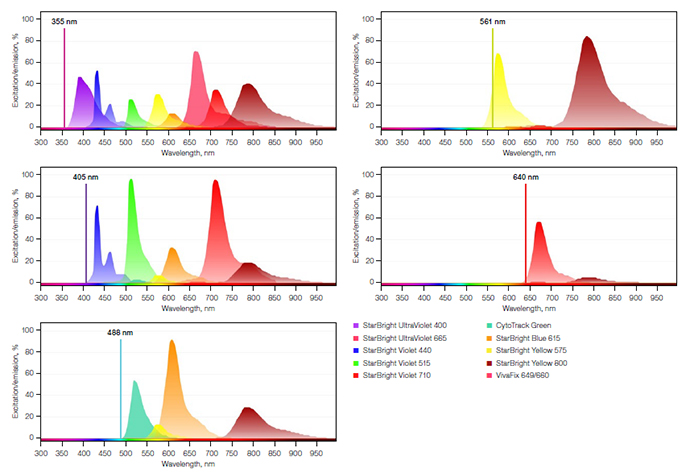
Fig. 1. Fluorophores and dyes used in the staining panel. All antibodies and dyes used in the staining panels were separated into the signal for each laser line. Image generated using Bio-Rad’s Fluorescence Spectraviewer.
Controls
Several controls were included to help analyze and validate the method.
- Unstimulated PBMCs were used as a negative biological control, as little cell division or activation is expected
- Stimulated PBMCs were used as a positive biological control. Clear differences should be seen between stimulated and unstimulated samples with a higher number of cell divisions and cells expressing activation markers in the stimulated population
- Two different cell activation methods were used for comparison and as an additional control to check successful cell stimulation
- FMO controls for CD25 and CD69 were included. Cells were stained with the antibody panel containing all dyes and fluorophores except CD25 or CD69 antibodies. These are important for analysis to help determine the correct gating to identify positive signals
- Single-stained controls were used for compensation during analysis
Data Collection
Stained cells were acquired on a five-laser ZE5 Cell Analyzer. 50,000 cells were acquired for the multiplex panel and single-stained controls. Cells stimulated with CD3 and CD25 antibodies were used for the controls single-stained with CD25, CD69, and CytoTrack Green.
Gating Strategy
Analysis was performed using FCS Express 7 Software (DeNovo Software by Dotmatics). Dead cells were first excluded from downstream analysis by gating on cells that were VivaFix negative. Doublet discrimination was used to identify single cells followed by gating on two cell populations — lymphocytes and monocytes — based on forward scatter area (FSC-A) and side scatter area (SSC-A).

Fig. 2. Full gating strategy of stimulated PBMCs stained with CytoTrack Green, VivaFix, and StarBright Dye–conjugated antibodies. Major lymphocyte populations and markers of activation and cell proliferation were identified. Data were acquired on a ZE5 Cell Analyzer. SBB, StarBright Blue; SBUV, StarBright UltraViolet; SBV, StarBright Violet; SBY, StarBright Yellow.
Results
Validation of the ten-color panel ensured all cell lineages and markers could be identified. Major T-cell populations were clearly identified from the live single cells. Various subsets within these lineages were also clearly distinguished. The data in Figure 2 show the full gating strategy of PBMCs stimulated with CD3 and CD28 antibodies. Plots are also shown for CD25 and CD69 FMO panels from the same cells. The spillover and spreading matrices are shown in the Appendix (Supplementary Tables 1 and 2).
To determine if cells were effectively stimulated, comparisons were made between unstimulated samples and samples that were stimulated by two different methods: coating with CD3 antibody and incubating with anti-CD28 and IL-2, or coating with CD3/CD28 T Cell Activator and IL-2 (the latter is also an antibody-based method), as shown in Figure 3. The unstimulated cells showed little proliferation over the 4 days in culture, with one cell division detected. In the stimulated cells, five divisions could be seen. As expected, the unstimulated T cells showed no CD25 expression and had a higher percentage of naive CD4+ and CD8+ cells, with little CD69 expression. Both stimulation methods were effective; however, more cells were seen in a later division, with a higher percentage of cells expressing CD25 and CD69 when using CD3, CD28, and IL-2 antibodies, suggesting a more effective T-cell stimulation with this method.
A deeper investigation of the data revealed information about the proliferation and activation of different T-cell populations. First, the rate of proliferation of lymphocytes, CD3– cells, CD3+ T cells, and CD4+ (T helper) and CD8+ (T cytotoxic) cells was compared (Figure 4). After gating on each population, the percentage of cells in each cell division was determined using the CytoTrack Green dot plots. In the lymphocyte gate, the CD3+ cells underwent more cell divisions compared to the CD3– cells (including non–T cells; the major populations being B cells and NK cells). This outcome was expected, as the stimulation uses T-cell activators. Differences were observed between the T-cell CD4+ and CD8+ subpopulations, with a larger percentage of CD8+ cells in the later cell divisions. A greater expansion in the number of CD8+ cells compared to CD4+ cells was also observed. This correlates with peer-reviewed data reporting that CD8+ cells proliferate at a faster rate compared to CD4+ cells following T-cell activation (Seder and Ahmed 2003).
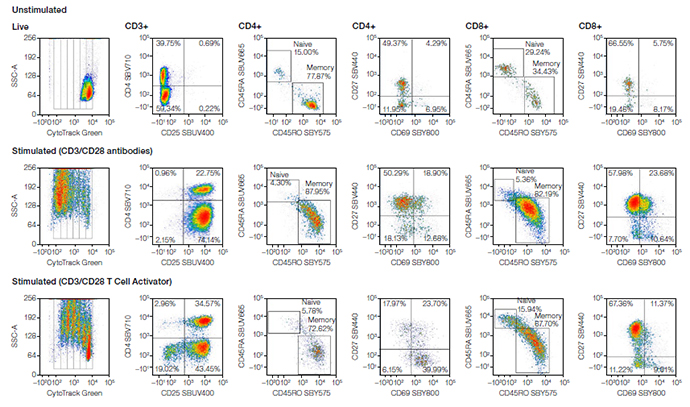
Fig. 3. Comparison plots of unstimulated and stimulated PBMCs stained with CytoTrack Green, VivaFix, and StarBright Dye–conjugated antibodies. Major lymphocyte populations, activation markers, and cell proliferation were identified. There is a clear activation of the stimulated cells compared to the unstimulated cells. Data were acquired on a ZE5 Cell Analyzer. SBUV, StarBright UltraViolet; SBV, StarBright Violet; SBY, StarBright Yellow.

Fig. 4. CD8+ T cells have a faster rate of division compared to CD4+ T cells following activation. A, dot plots showing CytoTrack Green staining profiles in all lymphocytes, and in CD3–, CD3+, CD4+, and CD8+ populations. Gates show each cell division. B, percentage of cells in each cell division of the plots in A. PBMCs were stimulated using CD3 and CD28 antibodies. Data were acquired on a ZE5 Cell Analyzer. (■), lymphocytes;
(■)
, CD3– cells;
(■)
, CD3+ cells;
(■)
, CD4+ T helper cells;
(■)
, CD8+ T cytotoxic cells.

Fig. 5. Changes in naive and memory T-cell percentages and T-cell activation markers as cells divide following cell stimulation. The percentage of CD3+, CD4+, and CD8+ cells expressing CD25, CD69, CD45RA (naive marker), and CD45RO (memory marker) was measured in unstimulated and stimulated cells in each cell division. A, example dot plots for CD3+ cells. B, graphs showing data for CD3+, CD4+, and CD8+ T cells. PBMCs were stimulated using Bio-Rad’s CD3 and CD28 antibodies. Data were acquired on the ZE5 Cell Analyzer. SBUV, StarBright UltraViolet; SBY, StarBright Yellow;
(■)
, CD3+ cells;
(■)
, CD4+ T helper cells;
(■)
, CD8+ T cytotoxic cells.
As several markers were included in the immunophenotyping panel, further information was gathered by looking at the cells in each cell division. As cells divided, the number of CD25+ cells steadily increased, whereas the number of CD69+ cells rapidly increased after one cell division, followed by a decline (Figure 5A). Changes were similar across CD3+, CD4+, and CD8+ cell populations (Figure 5B). Results here matched published data; CD69 is an early T-cell activation marker that plays a role in T-cell proliferation and survival. It increases rapidly after activation, followed by a steady decline back to basal levels. CD25, in contrast, is a late T-cell activation marker, important for the cellular response to activation.
The percentage of naive (CD45RA+) and memory (CD45RO+) T cells was also measured at each cell division (Figure 5B). As cells divided, a larger percentage of the cells became memory T cells. This result was expected, and it correlates with published data, validating the protocol. CD45RO is expressed on T cells that have encountered antigens, or in this case antigen-independent stimulation by CD3 and CD28 antibodies, which activates the T-cell receptor complex and mimics stimulation by antigen-presenting cells (Trickett and Kwan 2003).
Conclusions
A ten-color panel was successfully designed to identify activated T cells and measure proliferation and cell activation in human PBMCs. Major observations included:
- The staining protocol demonstrated how multiple reagents perform well together. CytoTrack, VivaFix, and StarBright Dye–conjugated antibodies were all used effectively in the same experiment to generate high-quality data
- The antibody panel was stained in PBS and BSA; no special buffer was required
- The panel showed a high cell resolution. All populations were clearly identified with low spillover and spreading
- The antibodies used gave bright signals. All the antibodies with a bimodal signal (distinct positive and negative populations) exhibited clear separation between the 2 populations
- CytoTrack Green identified multiple cell divisions — 5 over the 4 days in culture during this experiment
- Both methods of cell stimulation were effective. CD3/CD28 antibodies gave a higher number of activated cells that underwent more divisions compared to cells activated with a T-cell activator reagent
- CD3, CD4, and CD8 immunophenotyping markers allowed specific information to be determined for T-cell populations. The CD8+ (T cytotoxic cells) subpopulation showed a faster rate of cell division compared to the CD4+ subpopulation (T helper cells)
- Cells in each cell division, detected using CytoTrack Green, could easily be gated, determining cell division–specific information. As expected, the percentage of naive cells decreased, and memory cells increased as cells divided. Changes in the number of cells expressing the activation markers CD28 and CD69 were clearly identified. Cells expressing CD69 decreased, and a small increase in the number of CD25+ cells was seen with each cell division
References
- Seder RA and Ahmed R (2003). Similarities and differences in CD4+ and CD8+ effector and memory T cell generation. Nat Immunol 4, 835–842
- Trickett A and Kwan YL (2003). T cell stimulation and expansion using anti-CD3/CD28 beads. J Immunol Methods 275, 251–255
Appendix
Supplementary Table 1. Spillover matrix.

Values represent the amount of spillover for each fluorophore. The rows show the fluorophore, whereas the columns display the signal present in each detector. Colors progress from green, to white, to red as more spillover is present. Green indicates no or low spillover, and red indicates more spillover is present between the two fluorophores. SBB, StarBright Blue; SBUV, StarBright UltraViolet; SBV, StarBright Violet; SBY, StarBright Yellow.
Supplementary Table 2. Spreading matrix.

Values indicate the spillover spreading (SS) amount for each fluorophore into all detectors. The rows show the fluorophore-donated SS, whereas the columns display the detector-collected SS. Colors progress from green, to white, to red as more spreading is present. 0–4 indicates no or low spreading, >6 indicates significant spread. SBB, StarBright Blue; SBUV, StarBright UltraViolet; SBV, StarBright Violet; SBY, StarBright Yellow.