
Flow Cytometry — Immunophenotyping in Dogs
Immunophenotyping in Dogs
Immunophenotyping by flow cytometry is a key technique in immunology and clinical diagnostics. This application identifies and characterizes cells based on the proteins they express. Flow cytometry delivers simultaneous analysis of multiple markers, limited by the range of antibodies, conjugates, and capabilities of the flow cytometer.
There are situations where immunophenotyping of dog samples helps to gain an accurate picture of the animal’s immune competence.
Diseases specific to dogs
- Lymphopenias, often seen postoperatively (Hamouzová et al. 2023)
- Inflammatory diseases (Haas et al. 2014, Agulla et al. 2024)
- Leishmaniasis (Meazzi et al. 2022, Matralis et al. 2023)
Research using dogs as model animals
- Immunosenescence (Withers et al. 2018)
- Gut-associated lymphoid tissue (GALT) studies (Agulla et al. 2024)
- Leukocyte adhesion deficiency (Bauer et al. 2004)
However, immunophenotyping is most commonly performed when diagnosing dog leukemia. Best practice tends to be fine-needle aspiration of affected nodes followed by cytologic evaluation, immunophenotyping, and/or polymerase chain reaction (PCR) for T or B cell antigen receptor rearrangement. This article will focus on immunophenotyping in the diagnostic workflow.
Immunophenotyping Panels
Basic Dog Panel
The most basic flow cytometry assay panel is to measure total, helper, and cytotoxic T cells. This can be achieved by detecting CD3, CD4, and CD8 cell surface antigens. An example of this panel can be seen in Table 1 and with experimental data in Figure 1. Here the ready-to-use triple color reagent (TC014) has been used, detecting T cells (CD3), helper T cells (CD4), and cytotoxic T cells (CD8). Dog neutrophils express CD4 and, in contrast to other species, dogs can have CD4+CD8+ cells in the peripheral circulation.
Table 1. List of markers and antibodies used in the triple color reagent.
Specificity |
Description |
Clone |
Fluorophore |
Product Code |
|---|---|---|---|---|
|
CD3 |
Mouse Anti-Dog CD3:FITC |
CA17.2A12 |
FITC |
|
|
CD4 |
Rat Anti-Dog CD4:RPE |
YKIX302.9 |
RPE |
|
|
CD8 |
Rat Anti-Dog CD8:Alexa Fluor 647 |
YCATE55.9 |
Alexa Fluor 647 |
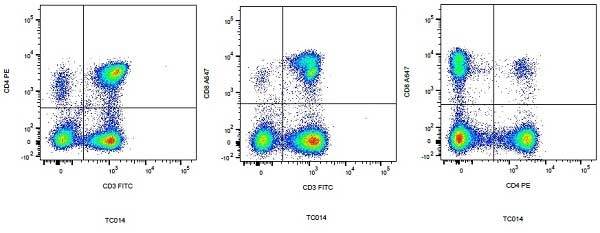
Fig. 1. Analyzing T cell subpopulations in red cell lysed dog blood gated on mononuclear cells. TC014 identified CD3+CD4+ helper, CD3+CD8+ cytotoxic, or single CD4+ and CD8+ T cell subpopulations. A647, Alexa Fluor 647; FITC, fluorescein isothiocyanate; PE, phycoerythrin. Data were acquired on the ZE5 Cell Analyzer.
Intermediate Dog Panel
A five-color panel would allow the detection of different immune cell types; CD3, CD4, and CD8 to measure T cells, CD21 to detect B cells, and CD14 for monocytes. This could be achieved with the antibodies listed in Table 2. The anti-human CD14 antibody used in this flow cytometry panel, clone TÜK4, is likely the most renowned and published cross-reactive antibody used in veterinary immunophenotyping. It has demonstrated reliable and repeatable staining across several vet species.
Table 2. List of markers and antibodies used in the intermediate dog flow panel.
Specificity |
Description |
Clone |
Fluorophore |
Product Code |
|---|---|---|---|---|
|
CD3 |
Mouse Anti-Dog CD3:FITC |
CA17.2A12 |
FITC |
|
|
CD4 |
Rat Anti-Dog CD4:RPE-Cy7 |
YKIX302.9 |
RPE-Cy7 |
|
|
CD8 |
Rat Anti-Dog CD8:Pacific Blue |
YCATE55.9 |
Pacific Blue |
|
|
CD21 |
Mouse Anti-Canine CD21:Alexa Fluor 647 |
CA2.1D6 |
Alexa Fluor 647 |
|
|
CD14 |
Mouse Anti-Human CD14:StarBright Violet 515 |
TÜK4 |
StarBrightTM Violet 515 |
|
|
DAPI |
PUREBLU DAPI |
DAPI |
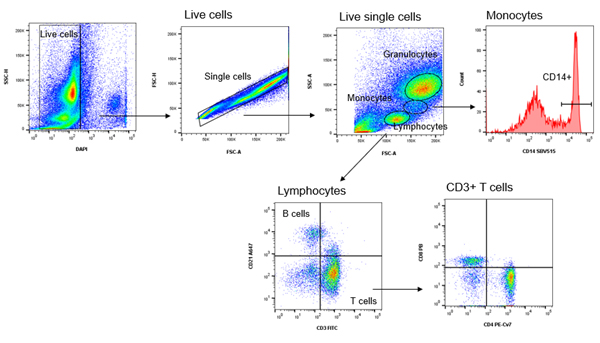
Fig. 2. Characterization of key dog immune cell populations. Major lymphocyte, monocyte, and granulocyte populations were identified. The T cell population was further analyzed for T cytotoxic and T helper cells. A647, Alexa Fluor 647; DAPI, 4′,6-diamidino-2-phenylindole; FITC, fluorescein isothiocyanate; PB, Pacific Blue; PE, phycoerythrin; PE-Cy7, phycoerythrin-cyanine7; SBV515, StarBright Violet 515. Data were acquired on the ZE5 Cell Analyzer.
Advanced Dog Panel
Should extended immunophenotyping be required the antibody panel described in Table 3 makes it possible to build a one-tube analysis panel for profiling T, B, and NK cells as well as monocytes and granulocytes. It uses Bio-Rad’s StarBright Dyes — an innovative range of dyes for flow cytometry that delivers world-leading sensitivity, stability, and reproducibility.
This panel (Figure 3) sequentially defined T cells by analyzing CD5+ lymphocytes with CD3 followed by identification of CD4+ helper and CD8+ cytotoxic T cells, while B cells were detected with CD21. CD94 revealed the natural killer (NK)/NKT cell population. Neutrophils within the granulocyte population were characterized using CD4 and CD18. Monocytes were confirmed by staining major histocompatibility (MHC) II high-expressing cells with CD14 and CD18. CD18 was conjugated to PE-Cy7 using the LYNX Rapid RPE-Cy7 Antibody Conjugation Kit™, which just needs a simple one-step procedure of only 30 seconds hands-on time.
Fluorophores whose emission spectra do not overlap are ideal for building panels of this size and larger, otherwise it may be difficult to detect discrete cell populations. If spillover occurs, compensation values need to be determined. Using a spectraviewer to review the characteristics of the fluorophores and distributing overlapping fluorophores onto mutually exclusive markers (i.e., CD3 and CD21) will help. Finally, assigning the brightest fluorophores to the lowest expressed markers will make analysis easier; staining index tables can help with that.
Table 3. List of markers and antibodies used in the extended dog flow panel.
Specificity |
Description |
Clone |
Fluorophore |
Product Code |
|---|---|---|---|---|
|
CD3 |
Mouse Anti-Dog CD3:FITC |
CA17.2A12 |
FITC |
|
|
CD4 |
Rat Anti-Dog CD4:StarBright Violet 670 |
YKIX302.9 |
StarBright Violet 670 |
|
|
CD5 |
Rat Anti-Dog CD5:Pacific Blue |
YKIX322.3 |
Pacific Blue |
|
|
CD8 |
Rat Anti-Dog CD8:Alexa Fluor 700 |
YCATE55.9 |
Alexa Fluor 700 |
|
|
CD14 |
Mouse Anti-Human CD14:StarBright Blue 675 |
TÜK4 |
StarBright Blue 675 |
|
|
CD18 |
Mouse Anti-Dog CD18 conjugated to RPE-Cy7* |
CA1.4E9 |
RPE-Cy7 |
|
|
CD21 |
Mouse Anti-Canine CD21:RPE |
CA2.1D6 |
RPE |
|
|
CD94 |
Mouse Anti-Dog CD94:Alexa Fluor 647 |
8H10 |
Alexa Fluor 647 |
|
|
MHCII |
Rat Anti-Dog MHC Class II Monomorphic:StarBright UltraViolet 400 |
YKIX334.2 |
StarBright UltraViolet 400 |
|
|
DAPI |
PUREBLU DAPI |
DAPI |

Fig. 3. Gating strategy on dog peripheral blood to identify lymphocyte, monocyte, and granulocyte populations. Lymphocytes were analyzed to identify T cell populations, including NK/NKT cells, CD4+/CD8+ T cells, and B cells. Granulocytes and monocytes were confirmed by further characterization. A647, Alexa Fluor 647; A700, Alexa Fluor 700; DAPI, 4′,6-diamidino-2-phenylindole; FITC, fluorescein isothiocyanate; PB, Pacific Blue; PE, phycoerythrin; PE-Cy7, phycoerythrin-cyanine7; SBB675, StarBright Blue 675; SBV670, StarBright Violet 670; SBUV400, StarBright UltraViolet 400. Data were acquired on the ZE5 Cell Analyzer.
Support
Should the panels presented above not meet your needs, Table 4 lists the key markers for characterizing dog leukocytes and is a good starting point for planning your analysis setup. To facilitate your panels, Bio-Rad offers a full range of dog-specific antibodies. To pick the optimal combination of markers and fluorophores, Bio-Rad has an online interactive Multicolor Panel Builder that will take into account your flow cytometer. The Flow Cytometry Experiment Planning resources can help you to plan, record, and store your flow experiment.
Table 4. Markers for dog immunophenotyping.
Marker |
Cell Type |
|---|---|
|
T cells |
|
|
T helper cells |
|
|
T cells and a small subset of B cells |
|
|
T cytotoxic cells |
|
|
All leukocytes |
|
|
CD19 |
B cells, including early precursors |
|
CD20 |
Mature B cells |
|
Mature B cells |
|
|
Activated lymphocytes |
|
|
Precursors |
|
|
All hematopoietic cells |
|
|
All leukocytes |
|
|
NK cells |
|
|
Immature/mature B cells |
|
|
Monocytes, histiocytes, lymphocytes |
|
|
TCRαβ |
Most T cells |
|
TCRγδ |
Gamma-delta T cell subset |
Consult Bio-Rad’s Flow Cytometry Explained hub, a one-stop resource for all you need to know about flow cytometry. Key resources include a series of webinars and the Flow Cytometry Basics Guide.
Should these resources not answer your questions, don’t hesitate to contact your regional technical support office or use the Antibody Selection Service to receive technical antibody advice, including immunophenotyping panel help, from Bio-Rad’s scientific staff.
Subscribe to Bio-Rad’s enewsletters to stay up to date on new flow cytometry products and resources.
References
- Agulla B et al. (2024). Peripheral and intestinal T lymphocyte subsets in dogs with chronic inflammatory enteropathy. J Vet Intern Med 38, 1437–1448
- Bauer TR et al. (2004). Leukocyte adhesion deficiency in children and Irish setter dogs. Pediatr Res 55, 363–367
- Haas E et al. (2014). Phenotypic characterization of canine intestinal intraepithelial lymphocytes in dogs with inflammatory bowel disease. J Vet Intern Med 28, 1708–1715
- Hamouzová P et al. (2023). Lymphocyte immunophenotyping in dogs with lymphopenia of common causes. Vet Immunol Immunopathol 261, 110620
- Matralis DT et al. (2023). Intracellular IFN-γ and IL-4 levels of CD4 + and CD8 + T cells in the peripheral blood of naturally infected (Leishmania infantum) symptomatic dogs before and following a 4-week treatment with miltefosine and allopurinol: a double-blinded, controlled and cross-sectional study. Acta Vet Scand 65, 2
- Meazzi S et al. (2022). Gut microbiota and lymphocyte subsets in canine leishmaniasis. Front Vet Sci 9, 868967
- Withers SS et al. (2018). Multi-color flow cytometry for evaluating age-related changes in memory lymphocyte subsets in dogs. Dev Comp Immunol 87, 64–74
Popular Resources

Blog: Sample Preparation in Flow Cytometry — Tips & Tricks
In this blog, we provide tips and advice on generating a high-quality sample for flow cytometry.
Quick Guide: How to Implement an Effective Flow Cytometry Gating Strategy
Download this quick guide to learn how to develop effective flow cytometry gating strategies, avoid common pitfalls such as false positives and missed rare populations, and generate reliable, reproducible data through a systematic approach to panel design and analysis.