
How to Use alamarBlue
Overview
alamarBlue can be used in a wide range of scientific research areas and applications, including experiments involving cell proliferation, cell viability, bioassays for relative cytotoxicity, cytokine assays, cell metabolism studies, drug susceptibility, and toxicology studies.
Sizes Available
alamarBlue can be used for applications such as functional assays, immunofluorescence, and ELISA.
This reagent is offered in two sizes:
Note: Calculations assume 100 µL final volume per well (96-well plate).
Simple and Easy Workflow
Just add the ready-to-use alamarBlue solution to the cells, incubate for at least 1–4 hours at 37°C between pH 6.8 and pH 7.4. Read the fluorescence or absorbance to measure cell respiration as an indicator for proliferation and cytotoxicity.
- Continued growth maintains a reduced environment (fluorescent, red)
- Inhibition of growth maintains an oxidized environment (non-fluorescent, blue)
- Absorbance is monitored at 570 nm and 600 nm
- Fluorescence is monitored at 530–560 nm excitation wavelength and 590 nm emission wavelength
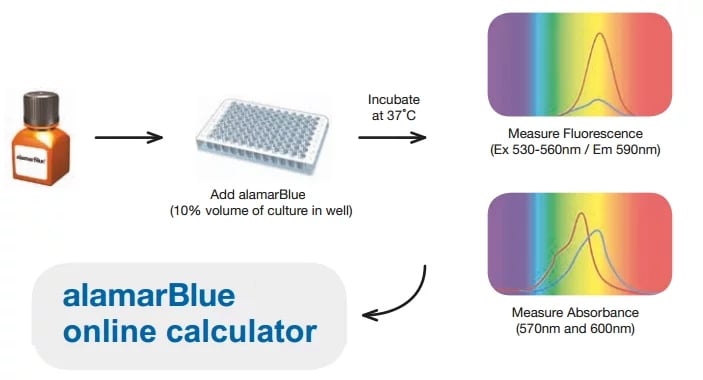
alamarBlue reduction is regularly measured using absorbance, which gives good levels of accuracy for most experiments, and is particularly easy to use. In general, more sensitive readings can be obtained using fluorescence, especially when attempting to measure very small changes in reduction. This is principally because there is little interference from unreduced alamarBlue on the spectra of reduced alamarBlue when measured by fluorescence. However, when measuring by absorption there can be considerable overlap of the oxidized and reduced forms of alamarBlue.
Related Products
Cell Proliferation Products and Tips
Cell proliferation is a homeostatic process that involves the rapid growth and division of cells. If not properly controlled, it can lead to an unchecked increase in cell numbers, which may result in diseases such as cancer. Therefore, evaluating proliferation is crucial across various scientific fields.
This guide provides the knowledge you need to effectively study cell proliferation in your assays.