
Mycoplasma Removal Agent
Prevent & Decontaminate Cell Culture Infection
What is Mycoplasma, and How Does it affect Your Cell Culture?
Mycoplasma are the smallest free living organisms, and are considered to be the simplest parasitic bacteria. They have a size of less than 100nm, with simple genomes, and have simple lipoproteins instead of a solid outer cell wall. They are commonly known to contaminate cell cultures which can influence biological results.
Our Mycoplasma Removal Agent Our Cell Growth Reagents Mycoplasma Removal Agent ProceduresEffects of Mycoplasma on Your Cultures
- Changes cell growth rates
- Causes morphological changes to cells
- Alters cell metabolism
- Causes chromosomal defects
- Reduces cell viability following frozen storage
Given the strong effects that mycoplasma cause within cell cultures, it is recommended that laboratories which routinely use cell culture should regularly test for mycoplasma contamination.
However, it is difficult to test for contamination because some strains of mycoplasma do not grow in vitro and require DNA staining and PCR detection methods. You can detect mycoplasma infections though testing cultures on standardized agar, and identifying the typical “fried egg” morphology after 3-4 weeks.
Therefore, through using a preventative antibiotic such as Mycoplasma Removal Agent (MRA), you can eliminate the chance that your cell culture will be affected, without the need for routine testing. MRA is very easy to use to treat contaminated cultures, simply requiring incubation for a week after addition to cell cultures.
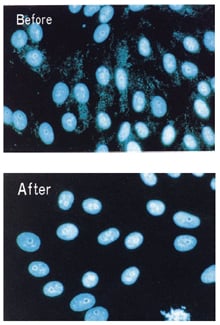
Fig 1. The effect of Mycoplasma Removal Agent (0.5 µg/ml) in the culture media of mycoplasma-infected cells after 1 week.
Features of Mycoplasma Removal Agent
- Very effective at removing mycoplasma from infected cell cultures at a low concentration (0.5µg/ml)
- Shows strong anti-mycoplasma activity against many types of mycoplasma
- Suitable for use to prevent recontamination of the culture with the original mycoplasma
- Can be used to prevent initial infection of cells in culture by mycoplasma
- Non toxic — will not interfere with the viability or function of cells in culture at the recommended concentration
- Very easy to use — simply incubate for a week after addition to mycoplasma-contaminated cell cultures
Mycoplasma Removal Agent is a broad spectrum antibiotic reagent containing a 4-oxoquinoline-3-carboxylic acid derivative which is highly effective at killing and removing mycoplasma from cell cultures. Mycoplasma Removal Agent is a derivative of the quinolone family of antibiotics, developed to combat the widespread problems caused by contamination of cell cultures with mycoplasma through inhibiting mycoplasma DNA gyrase.
It shows strong anti-mycoplasma activity against many types of mycoplasma including Mycoplasma orale, M. arginini, M. hyorhinis and Acholeplasma laidlawii. It is commonly used in tissue culture, where it requires incubation for a week after adding to cell cultures contaminated by mycoplasma.
Mycomplasma Removal Agents
| Description | Target | Format | Clone | Applications | Citations | Code |
|---|
Be the First to Receive Updates on Products and Resources
You'll receive regular communications featuring free lab resources such as application guides, posters, mini-reviews, protocols, practical tips, webinar invitations, special offers, and updates on new research tools and products.
You'll also get our specialist newsletters—including Fab Fragments, Flow. Sorted., and RiVETing—along with news on the latest antibody innovations, such as TrailBlazer™ Antibodies and StarBright™ Dyes.
During sign-up, you can choose your areas of interest so you only receive content relevant to your research, and you can unsubscribe at any time.
