
Consistent Flow Cytometry Staining with StarBright™ Dyes
Why Is Reproducible Data Important?
Consistent and reproducible reagents are essential in any experiment to have confidence in the data being produced. When performing flow cytometry, reproducible staining from both the antibody and the fluorescent dye it is conjugated to is necessary to identify the marker being investigated and to be able to detect changes over time. A reproducible signal, in terms of both intensity and emission, is also important to distinguish between other fluorescent dyes in a multicolor panel.
What Are the Effects of Using Unreliable Reagents?
As with most experiments and antibody-based applications, problems in the quality of data can arise if there is variability with reagents when used. In flow cytometry, changes in fluorescence can lead to inconsistent compensation or unmixing, unreliable data, or even loss of signal altogether.
Tandem dyes can have poor photostability and are prone to uncoupling over time, leading to changes in emission profiles. Some dyes (Brilliant Violet, Brilliant Ultraviolet, Super Bright dyes) require special buffers to avoid unwanted dye interactions during multiplexing.
Furthermore, some dyes are sensitive to fixation (particularly tandem dyes). Fixation can be a real help in time-sensitive experiments, so careful choice and optimized protocols will need to be performed. PFA can quench some dyes, and protein-based dyes such as PE, APC, and PerCP cannot be fixed using protein-denaturing alcohol fixatives as this leads to loss of signal. Multiplexing with these unstable fluorophores can impact data quality in both conventional and spectral cytometry.
StarBright Dye Benefits Give Reproducible Staining
Stability
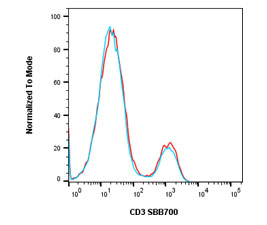
Fig. 1. Stability and within-lot reproducibility. Murine peripheral blood was stained with CD3SBB700 (MCA500SBB700) from two different vials of the same lot, one of which was freshly opened and the other opened and stored for over 12 months at 4ºC. All samples were collected on the ZE5 Cell Analyzer.
StarBrightTM Dyes are stable when stored at 4oC in the dark, as can be seen in Figure 1, where virtually identical staining was observed between fresh and aged antibody staining.
As previously mentioned, photostability is very important to maintain a reliable signal. StarBright Dyes and other fluorophores conjugated to mouse anti-human CD4 were left on the bench under ambient light for up to 14 days.
Many fluorophores lost brightness by day 14, as would be expected. StarBright Dyes show the same or an improvement in stain index stability compared to comparison fluorophores. Furthermore, although signal strength was lost, the emission spectra were maintained, unlike many comparison fluorophores. All the data can be seen on the poster we presented at CYTO 2024.
Buffer Compatibility
Unlike some other dyes, StarBright Dyes demonstrate similar performance with most staining protocols and buffers (see Figure 2), including commercial polymer-dye staining buffers and annexin V buffers, even when multiplexing.
There is no requirement for a special staining buffer to prevent unwanted dye interactions in multicolor panels.
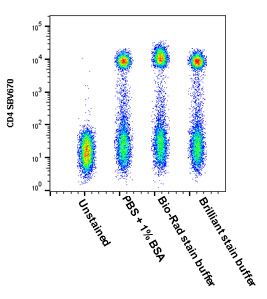
Fig. 2. StarBright Dyes retain their performance in common buffers. Human peripheral blood stained with CD4SBV670 (MCA1267SBV670) in a variety of buffers showing similar performance across buffers. All samples were collected on the ZE5 Cell Analyzer.
In addition, whilst there may be a need for an Fc block depending upon the sample being stained, there is no need for a specific monocyte blocking buffer as is required for some fluorophores.
This can save you money and allows StarBright Dyes to fit effortlessly into your existing protocols and panels.
We have data on StarBright Dye–containing large multicolor panels that have used PBS with 1% BSA as the staining buffer in conventional flow cytometry or Brilliant Buffer as the staining buffer in full spectrum flow cytometry.
Fixation Compatible
The ability to fix samples after staining brings convenience to any flow cytometry experiment. Whether it is to allow acquisition on another day, to allow multiple experiments to be acquired in one session, for intracellular staining, or even for safety concerns, the ability to fix samples can save time and money. StarBright Dyes can be fixed in both PFA-based fixation buffers and alcohol-based fixatives with no loss of signal and minimal changes to the emission spectra (Figure 3).
Not all fluorophores are compatible with fixation. Intranuclear and phosphoflow protocols often contain a denaturing alcohol fixation step which is incompatible with protein-based fluorophores. We would recommend not leaving StarBright Dyes in fixatives for extended periods of time and not exceeding 4% PFA as some reduction in signal may be observed. Further data including spectra after fixation can be seen on the flow cytometry posters we presented at CYTO 2024.
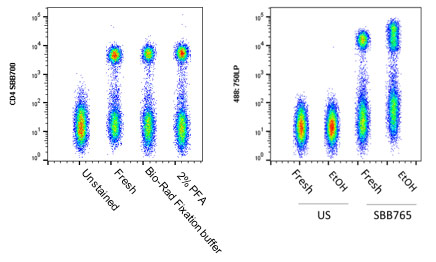
Fig. 3. StarBright Dyes retain their performance after fixation. No loss of performance was observed when samples were fixed with either A, PFA-based or B, alcohol-based fixatives prior to acquisition. PFA, paraformaldehyde; SBB, StarBright Blue. All samples were collected on the ZE5 Cell Analyzer.
Premixing
Preparing master mixes for large flow cytometry panels can be time-consuming, and if multiple samples are to be tested over a period of time, pipetting and human error can lead to differences in the master mixes, resulting in different staining. One way to avoid this is to prepare one master mix which can then be used over a long period of time. This is not possible with some dyes due to dye:dye interactions that can occur. StarBright Dye–conjugated antibodies can be premixed and stored at 4oC for up to 12 months, with no loss of performance or unexpected dye interactions, even in the presence of other common traditional fluorophores. All the data on premixing for conventional and spectral flow cytometry, including a technote, can be found on our premixing StarBright Dyes page.
Conclusions
Interpretation of data is crucial in your experiments and reliable reagents are absolutely essential. Many fluorophores used in flow cytometry, such as tandem dyes, can change their spectral characteristics over time. Furthermore, some dyes are reliant on special buffers, sensitive to fixation, and cannot be stored as a premix, reducing the flexibility a researcher has when performing experiments.
StarBright Dyes are stable over time, can be fixed, do not need a special buffer, and can be premixed, giving you reliability and flexibility when building multicolor panels.
Resources for StarBright Dyes and Flow Cytometry
Latest Resources
See the Truth in Every Band
A practical guide to western blot image integrity, documentation, and data verification.
Bio-Rad Academy — Fundamentals of Flow Cytometry
Enroll in Bio-Rad’s Fundamentals of Flow Cytometry Series, a free, online course that covers the basics of flow cytometry and experimental best practices.