
Technical Note: Ten-Color Porcine Immunophenotyping Panel Incorporating StarBright™ Dye–Conjugated Antibodies
 Technical note:
Highly Resolved Ten-Color Porcine Immunophenotyping Panel Incorporating StarBright™ Dye–Conjugated Antibodies
Abstract
Scientific research using pigs as animal models has increased over the last few years due to their immunological similarities to humans. Although flow cytometry has been instrumental in the identification of porcine immune cells, its application has been limited by the narrow range of fluorophores conjugated to porcine antibodies.
Consequently, it is difficult to build large panels effectively, restricting the amount of quality data obtainable. Here, we present a ten-color immunophenotyping panel to identify porcine T-cell subsets, B cells, natural killer (NK) cells, monocytes, and granulocytes that incorporates new porcine StarBright Dye–conjugated antibodies.
Introduction
Pigs have emerged as a crucial species in scientific research. Their organ systems — including the immune system, cardiovascular system, and skin — closely resemble those of humans. These similarities make pigs an invaluable model for studying vaccine development, as well as a wide range of human and zoonotic diseases.
Flow cytometry enables a researcher to identify multiple cell types using multicolor panels. Advances in porcine research have been made possible by flow cytometry; however, this research has been negatively impacted by the lack of porcine-specific antibodies and fluorophores conjugated to them. Currently, the panel sizes possible limit the number and type of cells able to be identified in a single sample. For example, NK cells are impossible to accurately identify using a four-color panel. To address this issue, Bio-Rad has expanded the porcine antibody range and, crucially, the number of fluorophores they are conjugated to, including novel StarBright Dyes. In this study, we used a ten-color validated panel to identify key porcine immune cell populations, including T cells, B cells, NK cells, monocytes, and granulocytes.
Materials and Methods
Panel Design
For optimal results, panel design best practices should be followed to generate high-quality data.
Bio-Radʼs Multicolor Panel Builder and Fluorescence Spectraviewer tools were used to help with panel design.
- Markers were selected to identify T cells, B cells, NK cells, monocytes, and granulocytes. Antibodies detecting these markers were either raised against porcine antigens or had species cross-reactivity
- The samples were acquired on a ZE5 Cell Analyzer, 5 laser (5-L) with 7 off UV option A (Bio-Rad Laboratories, Inc., catalog 12014135). Bio-Radʼs Multicolor Panel Builder and Fluorescence Spectraviewer helped select suitable fluorophores based on their excitation and emission wavelengths
- The panel was designed to minimize spillover and spread by distributing the fluorophores across the 5 lasers and detectors of the ZE5 Cell Analyzer. Supplementary Tables 1 and 2 show the spillover and spread
- The spreading effect is greater the brighter the fluorescence signal is, so it is best practice to use a dimmer fluorophore for a marker that is present on all cells of interest. CD45 is expressed on all cells of interest in the panel; therefore, an antibody conjugated to a dim fluorophore, Pacific Blue (with a relative brightness of 1), was used
- For detecting cells with markers that vary in expression, such as activation markers, it is advisable to use antibodies conjugated to bright fluorophores. CD25, an activation marker, was therefore detected using an antibody conjugated to StarBright Violet 515, which has a relative brightness of 4
- Heparinized, high-quality fresh blood was stored at 4°C prior to use. A live/dead dye, 4',6-diamidino-2-phenylindole (DAPI), was included to eliminate dead cells and prevent false positives during analysis. The antibodies and live/dead dye used in the panel are shown in Table 1
Table 1. Antibodies and viability dye used in the porcine multiplex panel.
| Target | Fluorophore | ZE5 Cell Analyzer Target Laser: Filter | Bio-Rad Catalog |
|---|---|---|---|
| CD14 | SBUV400 | 355: 387/11 | MCA1568SBUV400 |
| CD45 | PB | 405: 420/10 | MCA1222PB |
| CD25 | SBV515 | 405: 525/50 | MCA1736SBV515 |
| CD3 | SBV610 | 405: 615/24 | MCA5951SBV610 |
| CD16 | SBV670 | 405: 670/30 | MCA1971SBV670 |
| CD4α | FITC | 488: 525/35 | MCA1749F |
| CD8α | SBB700 | 488: 692/80 | MCA1223SBB700 |
| CD21 | PE | 583/30 | MCA5953PE |
| Granulocytes | A647 | 640: 670/30 | MCA2600A647 |
| Viability dye | DAPI | 355: 509/25 | 1351303 |
A647, Alexa Fluor 647; DAPI, 4',6-diamidino-2-phenylindole; FITC, fluorescein isothiocyanate; PB, Pacific Blue; PE, phycoerythrin; SBB, StarBright Blue; SBUV, StarBright UltraViolet; SBV, StarBright Violet.
Staining Protocol and Data Collection
Porcine peripheral blood was treated with Red Cell Lysing Buffer (Bio-Rad, BUF04) to remove red blood cells. White blood cells were then blocked in 10% porcine serum for 5 min at room temperature (RT), followed by incubation at RT for 1 hr with the fluorescent dye–conjugated monoclonal antibodies shown in Table 1. Following incubation, samples were washed three times in phosphate buffered saline (PBS) + 1% bovine serum albumin (BSA) (PBS/BSA) and resuspended in 200 µl of PBS/BSA. PUREBLU DAPI (Bio-Rad, 1351303) was added 5 min prior to acquisition.
For compensation controls, cells were incubated with a single antibody or PUREBLU DAPI. All antibodies were titrated prior to use and utilized at the optimal dilution.
Samples were acquired on the 5-L ZE5 Cell Analyzer with UV option A. In total, 150,000 cells were acquired for the multiplex panel and 60,000 cells for single-stained controls.
Gating Strategy
Analysis was performed using FCS Express 7 (De Novo Software by Dotmatics). Dead cells were first excluded from downstream analysis by gating on cells that were DAPI negative. Doublet discrimination was used to identify single cells followed by gating on CD45+ cells. The major cell populations — mononuclear cells (lymphocytes and monocytes) and granulocytes — were identified based on the forward scatter area (FSC-A) and side scatter area (SSC-A). Monocytes in porcine blood do not separate well from lymphocytes in scatter plots; therefore, a mononuclear gate was used. Additional cell populations were identified from the mononuclear and granulocyte cell gates using downstream gating strategies, as shown in Figure 2.
Results
An immunophenotyping panel was developed identifying major T-cell, B-cell, NK-cell, monocyte, and granulocyte lineages. Within the T-cell lineage, helper (CD4+) and cytotoxic (CD8+) T-cell subsets were also clearly identified (Figures 1 and 2).
The spillover and spreading matrices for the panel are shown in Supplementary Tables 1 and 2.
Basic Gating
All populations were identified utilizing a basic gating strategy to first remove dead cells, doublets, and CD45-negative, nonhematopoietic cells. Then, forward and side scatter were used to identify mononuclear cells and granulocytes. An anti-granulocyte antibody was used to confirm the granulocyte population (Figure 1).
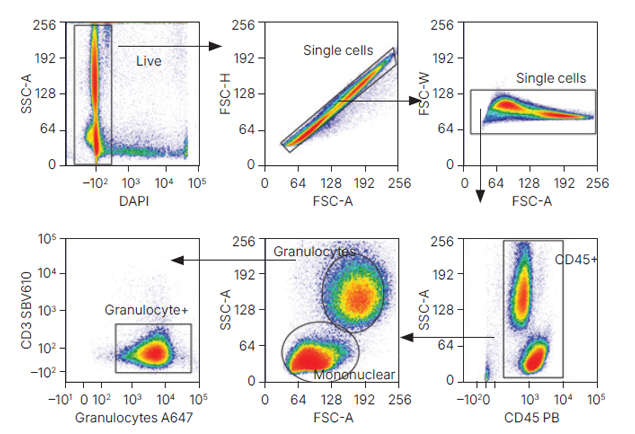
Fig. 1. Basic gating strategy. Major lymphocyte (CD3+ and CD3–), monocyte, and granulocyte populations were identified after gating on live, single CD45+ cells. A647, Alexa Fluor 647; A, area; DAPI, 4',6-diamidino-2-phenylindole; FSC, forward scatter; H, height; PB, Pacific Blue; SBV, StarBright Violet; SSC, side scatter; W, width.
Mononuclear Gating
Antibodies against CD4 and CD8 were used to identify T-cell subpopulations within the CD3-positive gate. CD8 expression differentiates naive helper T cells (CD4+ CD8–) from memory helper T cells (CD4+ CD8+). Activated helper and cytotoxic T cells were identified by CD25 expression. CD21-positive expression was used to detect mature B cells, but not all B-cell populations could be identified, as there is no pan B-cell marker. Immature B cells, which do not express CD21, were found with other cell types (Gate A, Figure 2). Within the CD3– CD21– gate, NK cells were detected by mid-level expression of CD16 and CD8a, and monocytes were detected by CD14 and CD16 expression (Figure 2).

Fig. 2. T-cell, B-cell, NK-cell, and monocyte populations in pig blood samples. The mononuclear cell population was further analyzed to identify monocytes, NK cells, CD4+ helper cells, CD8+ cytotoxic T cells, and activated T cells. FITC, fluorescein isothiocyanate; NK, natural killer; PE, phycoerythrin; SBB, StarBright Blue; SBUV, StarBright UltraViolet; SBV, StarBright Violet.
Conclusions
A ten-color immunophenotyping panel was successfully designed to identify key immune cell populations in pigs. Major observations included:
-
Simple gating strategy — we identified all major immune cell populations in porcine blood
- Cytotoxic T cells (CD3+ CD8+), naive helper T cells (CD3+ CD4+ CD8–), and memory helper T cells (CD3+ CD4+ CD8+)
- Activated helper T cells (CD3+ CD4+ CD25+) and activated cytotoxic T cells (CD3+ CD8+ CD25+)
- Mature B cells (CD3– CD21+)
- Mature B cells (CD3– CD21+)
- NK cells (CD3– CD16mid CD8αmid)
- Granulocytes (granulocyte+)
- High cell resolution — we achieved clear separation of positive and negative signals, which allowed all major populations and subpopulations to be clearly identified
- Low spillover and spread values — panel design best practices were followed, which resulted in low compensation and spreading values
- No special staining buffer required — the panel was stained in PBS + 1% BSA, a basic staining buffer
A method has been successfully developed and validated to establish a ten-color porcine immunophenotyping panel that allowed identification of multiple cell types and subsets, including NK cells, which would not be possible using a four-color panel. This panel can be modified to the specific needs of researchers. New StarBright Dye–conjugated antibodies were key to expanding the panel size, allowing for more immune cell populations to be identified in a single experiment. Visit bio-rad-antibodies.com/pig-abs for more information on the expanding porcine flow cytometry antibody range.
Appendix
Supplementary Table 1. Spillover matrix.

Values represent the amount of spillover for each fluorophore. The rows show the fluorophore, and the columns display the signal present in each detector. Colors progress from green, to white, to red as more spillover is present. Green indicates no or low spillover, whereas red indicates more spillover is present between the two fluorophores. A647, Alexa Fluor 647; DAPI, 4',6-diamidino-2-phenylindole; FITC, fluorescein isothiocyanate; PB, Pacific Blue; PE, phycoerythrin; SBB, StarBright Blue; SBUV, StarBright UltraViolet; SBV, StarBright Violet.
Supplementary Table 2. Spreading matrix.

Values indicate the spillover spreading (SS) amount for each fluorophore into all detectors. The rows show the fluorophore-donated SS, and the columns display the detector-collected SS. Colors progress from green, to white, to red as more spreading is present. 0–3 indicates no or low spreading. A647, Alexa Fluor 647; DAPI, 4',6-diamidino-2-phenylindole; FITC, fluorescein isothiocyanate; PB, Pacific Blue; PE, phycoerythrin; SBB, StarBright Blue; SBUV, StarBright UltraViolet; SBV, StarBright Violet.