Protocol: Direct Immunofluorescence Staining of Intracellular Cytokines in Whole Blood
FC9
This protocol is a rapid and simple approach to the analysis of intracellular cytokines in whole blood using directly conjugated antibodies. It allows small sample volumes to be analyzed and avoids the artifacts generated when blood is preprocessed by density gradient centrifugation to isolate peripheral blood mononuclear cells (PBMCs). A stimulation step is included in the protocol, as resting cells often require stimulation in vitro to induce cytokine production.
The cells are also treated with Brefeldin A, a protein transport inhibitor that blocks protein transport to the Golgi complex. This results in cytokine accumulation in the endoplasmic reticulum to levels that can be detected by antibodies following cell permeabilization. This protocol describes intracellular staining using Bio-Rad’s Leucoperm Reagent (catalog BUF09), which fixes cells with Reagent A and then permeabilizes them with Reagent B.
This protocol is a general staining procedure for use with Bio-Rad reagents. Specific recommendations are provided in product datasheets, and these methods should always be used in conjunction with the product and batch-specific information provided with each antibody vial. A certain level of technical skill is required for the successful design and implementation of these techniques; these are guidelines only and may need to be adjusted for particular cell types or applications.
Reagents
- Blood sample containing heparin as the anticoagulant
-
Required when stimulating whole blood:
- Cell Stimulation Reagent (with Brefeldin A) (500x) (BUF077)
- Cell culture medium, additive free
- Phosphate Buffered Saline, 10x (PBS) (BUF036A)
- PBS containing 1% bovine serum albumin (PBS/BSA)
- Leucoperm (BUF09)
- Erythrolyse Red Blood Cell Lysing Buffer (10x) (BUF04), dilute to 1x using distilled water
-
Required when staining cell surface antigens:
- Staining Buffer (BUF073)
- Blocking reagent: Human Seroblock (BUF070) or Mouse Seroblock FcR (BUF041)
- Fixable live/dead dye
- Optional: Fixation Buffer (BUF071)
Method
-
Stimulate whole blood collected in heparin as required. It is recommended to dilute whole blood 1:1 in cell culture media and treat with reagents; include unstimulated controls.
To stimulate cells, dilute 500 µL whole blood with 500 µL cell culture media. Add 2 µL Cell Stimulation Reagent (with Brefeldin A) (BUF077) to each mL of cell suspension. Incubate for 4–6 hr at 37ᵒC in a 5% CO2 atmosphere.
- Add 200 µL of the prepared cells into as many 5 mL tubes as required.
- Wash cells once in 2 mL cold (4ᵒC) PBS/BSA and discard supernatant.
- Optional: Perform staining of cell surface antigens and associated wash steps. Refer to protocol FC4 for more details.
- Resuspend cells in 100 μL room temperature (RT) Leucoperm (BUF09) Reagent A (fixation medium). Incubate for 15 min at RT.
- Add 3 mL PBS/BSA, centrifuge for 5 min at 300–400 x g, and discard supernatant.
- Add 100 μL Leucoperm (BUF09) Reagent B (permeabilization medium). Immediately add the directly conjugated antibody at the dilution determined from a titration experiment or the vendor-recommended dilution. Mix well and incubate at RT for 30–60 min while avoiding direct light.
- Add 3 mL PBS/BSA, centrifuge for 5 min at 300–400 x g, and discard supernatant.
- Resuspend in 2 mL of 1x Erythrolyse Red Blood Cell Lysing Buffer (BUF04). Incubate for 10 min at RT.
- Centrifuge at 300–400 x g for 5 min and discard supernatant.
- Wash with 2 mL PBS/BSA, centrifuge for 5 min at 300–400 x g, and discard supernatant.
- Optional: Fix cells by resuspending in 200 µL Fixation Buffer (BUF071) and incubate for 20 min at RT in the dark, centrifuge for 5 min at 300–400 x g, and discard supernatant.
- Resuspend cells in 200 μL cold (4ᵒC) PBS and store in the dark at 4ᵒC.
- Acquire samples on a flow cytometer. Analyze fixed cells within 48 hr.
Notes
- Blood samples must be collected into heparin anticoagulant tubes. Ethylenediaminetetraacetic acid (EDTA) interferes with the cell stimulation process and therefore must be avoided
- Other cell stimulation reagents and protein transport inhibitors may be more suitable for your assay. Cell Stimulation Reagent (BUF077) contains phorbol 12-myristate 13-acetate (PMA) and ionomycin to stimulate cells and Brefeldin A as the protein transport inhibitor. Other common stimulation reagents include lipopolysaccharide (LPS), phytohemagglutinin (PHA), concanavalin A (ConA), and CD3/CD28 antibodies or beads. Common protein transport inhibitors that can be used with these alternatives are Monensin (1,000x) (BUF074) and Brefeldin A (1,000x) (BUF075)
- Culturing cells in the presence of Brefeldin A for more than 12 hr should be avoided because cell viability may be affected
- An unconjugated primary antibody can also be used. Add the primary antibody and wash (as per steps 7 and 8), then repeat steps 7 and 8 using an appropriate secondary antibody. There is no requirement to add additional Leucoperm (BUF09)
- It is best practice to block Fc receptors prior to antibody staining to avoid nonspecific binding. We recommend using Bio-Rad's Human Seroblock (BUF070) for blocking human cells and Bio-Rad's Mouse Seroblock FcR (BUF041) for blocking mouse cells
- To allow gating on live cells during analysis, a viability dye staining step prior to step 5 is recommended. A fixable dye such as VivaFix 353/442 Cell Viability Assay (1351111) is required for intracellular staining
- All antibodies should be titrated prior to use to ensure the optimal concentration is used
Reference
- Sewell WA et al. (1997). Determination of intracellular cytokines by flow cytometry following whole-blood culture. J Imm Meths 209, 67–74
Flow Cytometry Resources
Support
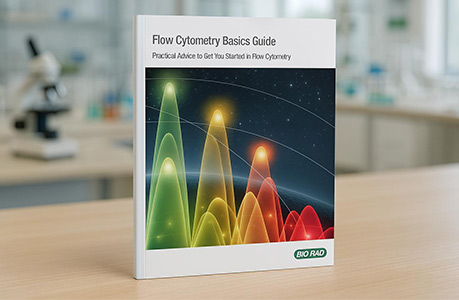
Flow Cytometry Basics Guide
Practical advice to get you started in flow cytometry
Keep up to date with recent advances by downloading our popular Flow Cytometry Basics Guide, which not only provides practical advice and best practice examples when planning multicolor experiments, but also a basic overview of all the important flow cytometry principles.
This comprehensive guide is split into nine easy-to-read chapters covering 54 pages, making this ideal for beginners wanting to gain confidence when planning experiments, and can also be used as a teaching aid.