Benefits and Pitfalls of Fixing Cells in Flow Cytometry
Overview
While cells do not have to be fixed prior to flow cytometric analysis, and it is important to note that it is sometimes not compatible, there are numerous good reasons both practical and scientific why it can be beneficial, and for intracellular staining essential. There are several fixatives suitable for flow cytometry and choosing the right one is critical as different agents react in distinct ways. In addition, optimization of their use can be critical, as can the fluorophore choice, as fixation can affect both antibody binding to antigen and the fluorophore performance.
Here we show some examples of why fixation can be beneficial, some common fixatives to use, and considerations when optimizing protocols. Finally, we show how fixation can affect fluorophore choice and why StarBright™ Dyes may be a superior option in multicolor panel building.
Why Fix Your Cells?
Preservation of Sample
The simplest reason to fix your sample is to preserve the morphology and integrity of the cell. Cellular degradation and death will affect the quality of the data obtained. Sample preparation, such as tissue dissection, can be labor-intensive and take time. Fixing samples preserves the shape and structure of the cell and halts degradation by protease and nuclease enzymatic action, ensuring high-quality data is retained. Fixation can also be a practical solution to analyze data at a convenient time or when an instrument is available for use without the risk of cell degradation.
Intracellular Staining
While the majority of flow cytometry is surface staining, probing of intracellular components such as intracellular proteins, cytokines, and phosphorylated proteins, as well as intranuclear targets such as transcription factors, is often required. To allow antibodies access to these targets, the cell must first be permeabilized. Permeabilization alone would destabilize the cell, resulting in the loss of the cytosolic components. By fixing a cell prior to permeabilization, internal structures remain intact and proteins cannot be lost from the cell.
Prevention of Antigen Redistribution
Some cell surface proteins and intracellular proteins are dynamically trafficked within cells. Internalization or receptor shedding in response to environmental changes, such as the creation of a single cell suspension, can lead to inconsistent results. Fixation will capture the physiological state of the cell by stopping these proteins from being redistributed.
Inactivation of Pathogens and Biohazards
Safety can be a major concern when handling both human and animal species samples as they could be harboring infectious agents. Fixation inactivates viruses, bacteria, and other pathogens, reducing the biohazard risk for researchers and allowing safe disposal.
Long-Term Storage and Batch Analysis
In addition to adding convenience to data analysis, fixation can also help with reproducibility. In longitudinal experiments with extended time courses, or where samples need to be stored for extended periods of time, fixation can help preserve morphology and antigen expression. This preservation can help maintain reproducibility when large numbers of samples are involved or in multicenter collaborations.
Compatibility with Downstream Applications
Fixation not only preserves cellular structure for flow cytometry but also makes samples suitable for other downstream analyses. This means that samples can be further analyzed by different techniques, such as microscopy, or processed for molecular biology applications after cell sorting, maximizing the information from precious samples.
Fixatives in Flow Cytometry
Paraformaldehyde (PFA)/Formaldehyde
Solutions of PFA or formaldehyde in water (known as formalin) are the most common fixative used in flow cytometry. It acts by reacting with the amino groups (NH2) in amino acids, forming covalent bonds and effectively cross-linking proteins and other cellular components. When used between 1 and 4% it is a mild fixative, maintaining many epitopes for antibody binding. However, masking of the epitopes can occur, leading to reduced or even no staining. Although it is a mild fixative, cells fixed this way are generally stable if kept at 4°C for several weeks, however, cells should not be stored long term in formalin solutions but should be transferred to a PBS-based buffer.
Alcohols
Ethanol and methanol are more robust fixatives that act quickly by precipitating proteins, preventing further degradation. They have the added benefit of permeabilizing membranes, making them ideal for intracellular staining, as no additional permeabilization steps are needed. Antigen epitope masking can also be a problem with alcohol-based fixatives, but this can be antibody specific, so check datasheets before staining. Cold 70–100% alcohol solutions are typically used for fixation and cells can be stored in the alcohol solution for long periods of time. Alcohol fixation is most common for cell cycle analysis.
Glutaraldehyde
Glutaraldehyde also fixes cells by cross-linking proteins via amino groups and is considered a stronger fixative than formaldehyde. Its more robust cross-linking can hinder antibody binding and is therefore more commonly used for ultrastructural preservation for electron microscopy. Another limitation of using glutaraldehyde is the increased autofluorescence that can occur.
Glyoxal
A newer, less toxic alternative to formaldehyde-based fixatives, it is a fast-acting fixative that has the benefit of not causing crosslinking of RNA to proteins and is therefore more suited to downstream applications such as RNA-seq. While there are reports of clearer staining compared to formaldehyde-based fixatives, this needs to be optimized for each experiment and cellular target.
Considerations When Using Fixatives
Safety is the first consideration when choosing a fixative. Formaldehyde-based fixatives are carcinogenic, so follow safety guidelines and consider alternatives if possible.
Protocols
Unfortunately, there is no single fixation protocol, even for intracellular staining, that fits all experiments, and considerable optimization may be required. Considerations include time, temperature, concentration, staining, and fixation order, and even combining fixatives and/or permeabilization buffers in the staining protocol. If fixation is possible, some variability with staining, particularly seen with longitudinal studies, can be reduced. Apart from sample differences, variability can arise from pipetting errors when making antibody mixes. This can be reduced by fixing all samples collected over a period of time and staining multiple samples with one mastermix. Alternatively, overnight staining, recently shown to improve reproducibility, may be an option.
Target Location and Cell Morphology
The location of the target epitope is a key consideration. Surface antigens require milder fixation (if fixing at all), whereas intracellular targets need robust fixation and permeabilization. As we have briefly mentioned, the sensitivity of the epitope structure to fixation can affect antibody binding. Increased concentration of the fixative can reduce the antigenicity, causing less antibody recognition. Antibody datasheets will inform you if there is sensitivity to fixation and which fixatives and concentrations to avoid. In the case of surface staining followed by intracellular staining, epitope sensitivity can be avoided by completing the surface staining prior to fixation for intracellular staining. If the cellular morphology is important after fixation, the choice of fixative is important, with aldehyde-based fixatives largely preferred. However, there is generally some cell shrinkage or distortion regardless of the fixative (Figure 1).
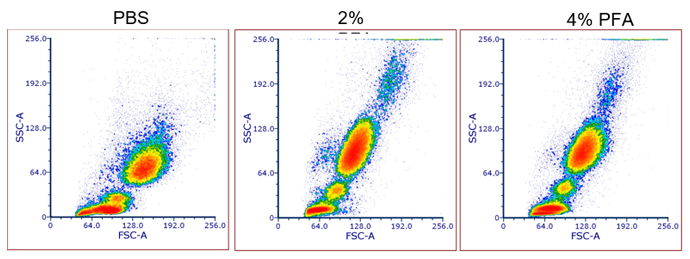
Fig. 1. Effect of fixation on cell morphology. Human peripheral blood was incubated in PBS, 2% or 4% PFA for 20 min at room temperature prior to acquisition. Minor effects on the forward and side scatter can be observed. Data were collected on a ZE5 Cell Analyzer.
Fluorophore Choice
The choice and concentration of the fixative can also have an impact on the fluorophore. Generally, the higher the concentration and the longer the fluorophore is in the fixative, the more likely a fluorophore will show reduced or altered performance after fixation. This can be a loss of signal or a change in the spectral profile, resulting in changes to compensation or unmixing compared to unfixed controls. This can lead to inconsistency of data and loss of resolution in multicolor panels. It is recommended to treat single-stain controls with the same fixative as panel-stained samples, as this will correct the spectral changes. However, a previously optimized panel may now be anything but optimal.
Small molecule fluorescent dyes, such as Alexa Fluors, tend to be more resistant to fixation, whereas larger tandem dyes and protein-based dyes can be sensitive to both PFA and alcohol-based fixatives. These include PE and APC-based tandems, where there can be loss of the tandem signal and subsequent gain of the acceptor signal. Alcohol fixation is harsher than formaldehyde fixation and therefore many more fluorophores can be affected. Any protein-based dye, such as PerCP, PE, APC, and tandems thereof, will be denatured, resulting in loss of signal and changes in spectra. In addition, dyes from a series may have different properties. For example, some but not all Brilliant Dyes and Real Dyes are sensitive to alcohol-based fixation, so checking datasheets and testing may be required prior to starting experiments.
StarBright Dyes and Fixation
StarBright Dyes, although large, can be fixed in formaldehyde-based fixatives with little or no effect on their performance. However, as we have observed some reduction in signal with concentrations of 4% or higher due to either reduced fluorescence or increased background, we recommend using a concentration of up to 2% and if higher concentrations are needed, reduce the incubation time. Representative data of the performance of StarBright Dyes from each of the five common lasers found in cytometers are shown in Figure 2. Multicolor panel–stained samples can be fixed with no loss of performance and with little or no detrimental effects on their unmixing. Read our 43-color immunophenotyping panel technote for more information on the performance of StarBright Dyes in large multicolor panels where the samples have been fixed prior to acquisition.

Fig. 2. Effect of fixation with formaldehyde-based fixative on dye performance. Human peripheral blood was single-stained with CD4 conjugated to SBUV665, SBV710, SBB580, SBY720, or SBR775. After washing, the samples were incubated in PBS, 2% or 4% PFA for 20 min at room temperature prior to acquisition. Data were collected on a ZE5 Cell Analyzer.
In addition to fixation in formaldeyde-based buffers, StarBright Dyes can tolerate fixation in alcohol-based buffers. Furthermore, the spectral profile of the dyes does not significantly change, unlike protein-based dyes such as PE and PE-tandems. A comparison of the performance of PE and StarBright Yellow 575 is shown below in Figure 3. As can be seen, not only does SBY575 maintain its fluorescence intensity when fixed, but the normalized spectrum also remains constant. In contrast, PE loses its brightness and the spectral profile changes, becoming even more excitable by the 488 nm laser. For more detail on the benefits of the entire StarBright Yellow range, look at our conference poster presented at CYTO in 2024.
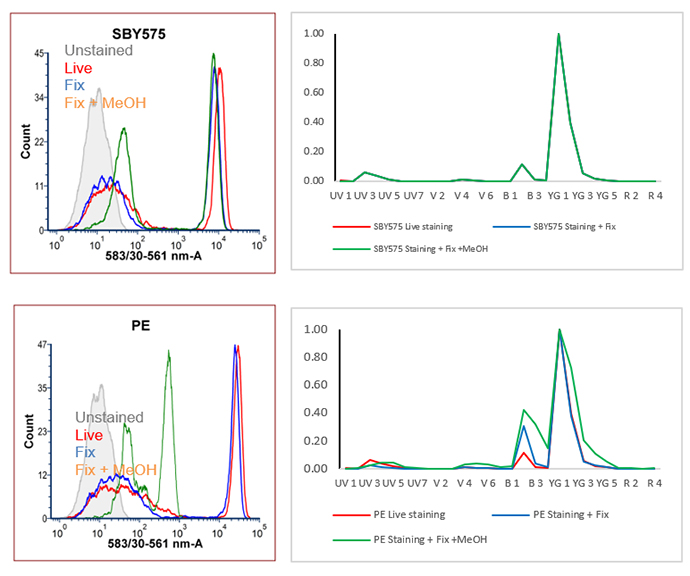
Fig. 3. Effect of fixatives on StarBright Yellow Dye–conjugated antibodies compared to PE and PE-tandems. Human PBMCs were stained with mouse anti-human CD4 and acquired on a ZE5 Cell Analyzer before fixation, after fixation in a PFA-based fixation buffer (00-8222-49, Thermo Fisher Scientific) for 15 min, and after fixation in a PFA-based fixation buffer followed by incubation in 100% MeOH for 30 min. Cells were gated on live, single cell lymphocytes. Histogram overlays and the signal from CD4-positive cells in each filter are shown.
Conclusions
Fixation can be important in flow cytometry for many reasons, such as safety, reproducibility, sample preservation, and convenience. Fixation may affect both your sample morphology and the fluorophore performance, so some optimization of the fixative and the fixation protocol may be required. StarBright Dyes have been tested using both formaldehyde- and alcohol-based fixation protocols with minimal loss of signal and maintenance of reproducible spectra, making them an ideal choice when choosing fluorophores for multicolor panel building.
Find out more about the benefits of StarBright Dyes and search for StarBright Dye–conjugated antibodies to start building bigger, better panels today.
Resources for StarBright Dyes and Flow Cytometry
Latest Resources
See the Truth in Every Band
A practical guide to western blot image integrity, documentation, and data verification.
Bio-Rad Academy — Fundamentals of Flow Cytometry
Enroll in Bio-Rad’s Fundamentals of Flow Cytometry Series, a free, online course that covers the basics of flow cytometry and experimental best practices.