
Technical Note: A 43-Color Human Immunophenotyping Panel Using StarBright™ Dye–Conjugated Antibodies
 Technical note:
A 43-Color Human Immunophenotyping Panel Incorporating StarBright™ Dye–Conjugated Antibodies Acquired on a Spectral Cytometer.
Abstract
Flow cytometry can be used to generate a large amount of information for a mixed-cell population. The development of full-spectrum cytometers has enabled larger panels to be run, thereby increasing the amount of information that can be obtained. Achieving high-quality data with highly resolved populations relies on good panel design and sample preparation.
Using a five-laser (5-L) Cytek Aurora System (Cytek Biosciences), StarBright™ Dyes (Bio-Rad Laboratories, Inc.), and other commonly available fluorophores, a large 43-color in-depth immunophenotyping panel was generated.
This panel allowed for the identification of major lymphoid lineages and their subsets in human peripheral blood. Identifying T cells, B cells, natural killer (NK) cells, and myeloid lineages, including monocytes, granulocytes, and dendritic cells, maximizes the information about the cell populations in the sample.
Introduction
Over the last decade, improvements in instrument capabilities and fluorophore availability have allowed flow cytometry to detect a larger number of cell markers. This multicolor panel expansion means increasingly complex biological questions can be explored. In-depth characterization of the immune system via the investigation of immune cell subsets provides a greater understanding of the complex mechanisms that occur in response to infections and disease. This information is invaluable in helping to develop vaccines and novel therapies. In addition, when there is a limited amount of sample available, there is a clear benefit of larger panels due to the amount of information that can be obtained from a single sample.
There are 32 StarBright Dyes excitable by five common laser lines: StarBright UltraViolet (SBUV), StarBright Violet (SBV), StarBright Blue (SBB), StarBright Yellow (SBY), and StarBright Red (SBR) Dyes. StarBright Dyes exhibit narrow excitation and emission profiles, work in all buffers, can be fixed and stored as a premix, and are conjugated to highly cited and validated immunology antibodies. Here, a 43-parameter panel, which included 22 StarBright Dyes, demonstrated the benefits of StarBright Dyes and their suitability for multiplexing. This panel was designed for surface markers only to avoid the need for permeabilization and, while not exhaustive, allowed for the detection of all the major subsets present in peripheral blood. While the panel was developed for use with peripheral blood, CD45 was included, making the panel suitable for use when analyzing tissue samples.
Materials and Methods
Staining Protocol
Human peripheral blood was treated with Red Cell Lysing Buffer (Bio-Rad, catalog BUF04) to remove red blood cells. The cells were washed in Phosphate Buffered Saline (PBS) (Thermo Fisher Scientific Inc., BR0014G) and stained with LIVE/DEAD Fixable Blue Dead Cell Stain Kit (Thermo Fisher Scientific, L23105). After washing, the blood samples were blocked in 10% human serum (Sigma-Aldrich, H4522) for 5 min at room temperature (RT), followed by incubation at RT for 1 hr with fluorescent dye–conjugated monoclonal antibodies in the presence of BD Horizon Brilliant Stain Buffer (BD Life Sciences, 563794), shown in Table 1. Following incubation, samples were washed twice in PBS + 1% bovine serum albumin (BSA) (Sigma-Aldrich, A7906). Cells were resuspended in 100 µl Fixation Buffer (Bio-Rad, BUF071) and incubated for 20 min at RT in the dark. Cells were washed in PBS and resuspended in 200 µl PBS. Cells were stored at 4ºC in the dark until acquisition the following day.
For unmixing antibody controls, cells were incubated with a single antibody, except in the case of antibodies conjugated to BV421, BV605, BV711, and BB700, in which UltraComp eBeads Compensation Beads (Thermo Fisher Scientific, 01-2222-41) were used.
For the unmixing viability control, cells were heated at 65°C for 5 min to create a dead cell population. Heated unstained cells served as the negative population.
All antibodies were titrated before use and utilized at the optimal dilution.
Panel Design
The Bio-Rad Fluorescence Spectraviewer tool incorporates a spectral analyzer view, which was used to optimize panel design and choose appropriate fluorophores. Flow cytometry best practices were followed to generate high-quality data. To identify major cell subsets in human peripheral blood, the appropriate markers were chosen based on peer-reviewed publications and used to detect the major T cell, B cell, monocyte, and granulocyte lineages. The Cytek Aurora spectral analyzer was used to acquire the data, and analysis was performed using SpectroFlo Software (Cytek Biosciences) and FSC Express 7 (De Novo Software by Dotmatics). Where possible, bright fluorophores were paired with markers with a low antigen density. For example, less abundant CD24 was detected with an antibody conjugated to SBV440, which has a relative brightness of five. Conversely, where possible, dim fluorophores were paired with markers with a high antigen density. For example, the more abundant CD8 was detected with an antibody conjugated to SBR815, which has a relative brightness of three.
The spread between fluorophores was kept to a minimum to reduce overall spreading effects that could complicate analysis, since high levels of spread can make it difficult to identify positive populations. Therefore, fluorophore pairs that exhibited spreading were used on mutually exclusive markers (markers not detecting the same cell types). For example, SBR715 was used for CD19 on B cells, whereas A647 was utilized for CD161 on NK cells. Additionally, as spreading effects are greater with a brighter signal, this impact was minimized by using a dimmer fluorophore, SBUV510 (with a relative fluorescence of two) with CD45, which is expressed on all cells of interest. Rare cells were detected with antibodies conjugated to bright fluorophores. For example, an antibody conjugated to SBUV795 (with a relative fluorescence of five) was used to identify less frequent CD10-positive eosinophils.
A high-quality sample of human peripheral blood was stained on the day the blood was drawn. This reduced the number of dead cells, which can give false positives due to nonspecific antibody binding. Additionally, a live/dead dye was included to exclude any dead cells that were in the sample during the analysis. The list of antibodies and live/dead dye used in the panel are shown in Table 1, and the spectral profiles of the fluorophores used are shown in Figure 1.
Table 1. Antibodies and live/dead dye used in the 43-parameter panel.
Fluorescence Color |
Fluorophore |
Target |
Clone |
Antibody Catalog Number* |
|---|---|---|---|---|
|
|
Viability |
LIVE/DEAD |
- |
L23105 (Thermo Fisher Scientific) |
|
SBUV400 |
CD11c |
BU15 |
||
|
SBUV445 |
HLA ABC |
W6/32 |
||
|
BUV496 |
CCR7 |
2-L1-A |
749827 (BD) |
|
|
SBUV510 |
CD45 |
F10-89-4 |
||
|
SBUV575 |
CD28 |
YTH913.12 |
||
|
SBUV605 |
HLA-DP-DQ-DR |
WR18 |
||
|
SBUV665 |
CD163 |
EDHu-1 |
||
|
SBUV740 |
CD105 |
SN6 |
||
|
SBUV795 |
CD10 |
SN5c |
||
|
|
PB |
CD63 |
H5C6 |
353011 (BioLegend, Inc.) |
|
BV421 |
CD56 |
HCD56 |
318327 (BioLegend) |
|
|
SBV440 |
CD24 |
SN3 |
||
|
SBV475 |
CD45RO |
UCHL1 |
||
|
BV510 |
IgD |
1A6-2 |
348219 (BioLegend) |
|
|
SBV570 |
CD33 |
WM53 |
||
|
BV605 |
TIGIT |
A15153G |
372711 (BioLegend) |
|
|
SBV670 |
CD40 |
LOB7/6 |
||
|
BV711 |
TCRγδ |
B6 |
331411 (BioLegend) |
|
|
SBV710 |
CD27 |
LT27 |
||
|
SBV760 |
CD38 |
AT13/5 |
||
|
SBV790 |
CD14 |
TÜK4 |
||
|
|
FITC |
CD57 |
TB01 |
MCA1305** |
|
SBB580 |
CD4 |
RPA-T4 |
||
|
SBB615 |
CD31 |
WM59 |
||
|
SBB675 |
CD195 |
HEK/1/85a |
Coming soon |
|
|
SBB700 |
CD11b |
ICRF44 |
||
|
BB700 |
PD1 |
EH12.1 |
566461 (BD) |
|
|
SBB765 |
CD62L |
FMC46 |
||
|
SBB810 |
CD3 |
UCHT1 |
||
|
|
PE |
CD16 |
DJ103c |
MCA2537PE*** |
|
SBY575 |
CD20 |
2H7 |
||
|
PE-Dazzle 594 |
CD123 |
6H6 |
306033 (BioLegend) |
|
|
PE-Cy7 |
CD127 |
A019D5 |
351319 (BioLegend) |
|
|
SBY665 |
CD25 |
MEM-181 |
||
|
SBY720 |
CD45RA |
F8-11-13 |
||
|
SBY800 |
CD2 |
LT2 |
||
|
|
APC |
TGF-β1 |
3C10 |
351708 (BioLegend) |
|
A647 |
CD161 |
B199.2 |
||
|
SBR715 |
CD19 |
LT19 |
||
|
APC-Cy7 |
CD1c |
L161 |
331519 (BioLegend) |
|
|
APC/Fire 810 |
HLA-DR |
L243 |
307673 (BioLegend) |
|
|
SBR815 |
CD8 |
LT8 |
* Antibodies are available from Bio-Rad unless otherwise marked.
** Not currently available for purchase, see MCA1305GA for purified format.
*** Not currently available for purchase, see alternative clones MCA5665PE and MCA1569PE.
APC, allophycocyanin; A647, Alexa Fluor 647; BV, Brilliant Violet; BUV, Brilliant UltraViolet; Cy7, cyanine7; FITC, fluorescein isothiocyanate; PB, Pacific Blue; PE, phycoerythrin; SBB, StarBright Blue; SBR, StarBright Red; SBUV, StarBright UltraViolet; SBV, StarBright Violet; SBY, StarBright Yellow.

Fig. 1. Spectral profiles of StarBright Dyes. Emission profiles of Mouse Anti-Human CD4 StarBright–conjugated antibodies generated on the 5-L Cytek Aurora System were split by laser line. APC, allophycocyanin; Cy7, cyanine7; FITC, fluorescein isothiocyanate; PE, phycoerythrin.
Data Collection
Samples were acquired on the 5-L Cytek Aurora System, collecting 60,000 lymphocytes for the multiplex panel and 12,000 lymphocytes or 6,000 beads for the single-stained controls.
Unmixing and Gating Strategy
Unmixing was performed using SpectroFlo Software, version 3.2.0 and unmixed data were exported for analysis in FCS Express 7 Software. Dead cells were first excluded from downstream analysis by gating on live/dead negative cells. Doublet discrimination was used to identify single cells, followed by gating on CD45+ cells. Lymphocytes, monocytes, and granulocytes, the three major cell populations, were identified based on forward scatter area (FSC-A) and side scatter area (SSC-A) gating (Figure 2). These populations were used for downstream gating strategies to identify subpopulations, as shown in Figures 3–11.
t-Distributed Stochastic Neighbor Embedding (t-SNE) Analysis
The t-SNE plots were generated from live, single CD45+ lymphocytes and show the major cell populations. Data were analyzed using FCS Express 7 Software.
Results
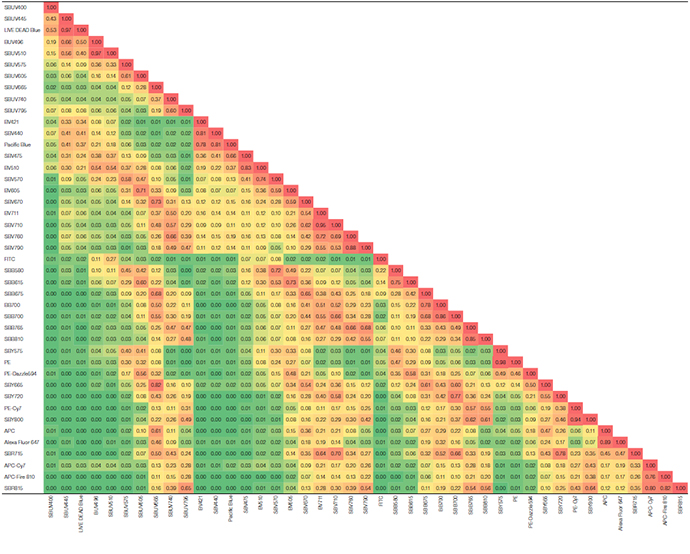
An immunophenotyping panel containing 42 fluorescently labeled antibodies and a viability dye was successfully acquired. Major T cell, B cell, NK cell, monocyte, dendritic cell, and granulocyte lineages were identified, as well as specific subsets within these lineages, as shown in Figures 2–11. The unmixing matrix with complexity scores and spreading matrices are shown in the Appendix (Supplementary Tables 1 and 2).
Basic Gating
All populations were identified utilizing a basic gating strategy to remove dead cells, doublets, and CD45-negative nonhematopoietic cells. Then, forward and side scatter were used to identify lymphocytes, mononuclear cells, monocytes, and granulocytes (Figure 2).
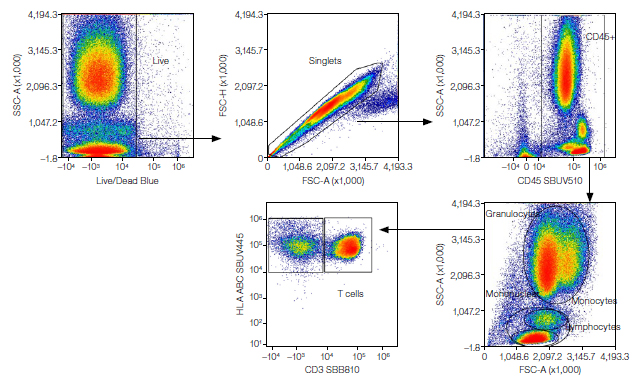
Fig. 2. Basic gating strategy to identify populations in a large-scale panel. Major lymphocyte (CD3+ and CD3–), monocyte, and granulocyte populations were identified after gating on live, single CD45+ cells. SBB, StarBright Blue; SBUV, StarBright UltraViolet; SSC, side scatter; FSC, forward scatter.
Identification of gd T, NKT, and MAIT Cells
Antibodies against TCRgd and TCRVa7.2 were used to identify gd T cells and mucosal-associated invariant T (MAIT) cells within the CD3-positive lymphocyte population. The memory status of these cells could also be determined by CD45RA, CCR7, and CD45RO expression. Furthermore, CD4-positive and CD8-positive NKT cells could be identified by their lack of TCRgd and TCRVa7.2 and by their expression of CD56, with mature CD8-positive NKT cells that were also CD57-positive (Figure 3).

Fig. 3. Identification of gd T, NKT, and MAIT cells in CD3+ lymphocytes with different memory statuses. APC, allophycocyanin; BUV, Brilliant Ultra Violet; BV, Brilliant Violet; FITC, fluorescein isothiocyanate; NKT, natural killer T cells; SBB, StarBright Blue; SBR, StarBright Red; SBUV, StarBright UltraViolet; SBV, StarBright Violet; SBY, StarBright Yellow.

Fig. 4. CD3- and CD19-negative lymphocytes were further gated on CD31, CD161, CD56, and CD16 to identify natural killer (NK) cell populations. CD62L and CD57 expression on NK subsets revealed different memory status. A647, Alexa Fluor 647; BV421, Brilliant Violet 421; FITC, fluorescein isothiocyanate; PE, phycoerythrin; SBB, StarBright Blue; SBR, StarBright Red.
NK Cell Identification
Antibodies against CD56, CD31, and CD161 in the CD3-negative lymphocytes were used to identify NK cells. The relative expression of CD16 and CD56 can determine the different types of NK cells. For instance, CD56 bright and CD16 low are proliferative and defined as cytokine producers, whereas those with lower expression of CD56 are thought to be more cytolytic. They can also be labeled as early, mature, and terminal NK cells. The expression of CD62L and CD57 within these populations is associated with maturation and possibly memory status (Figure 4).
B Cell Identification
Antibodies against CD19 and CD20 identified B cells within the CD3-negative population. The relative expression of CD27 and CD20 could identify antibody-secreting cells (ASC), memory B cells, and naïve B cells. Further analysis of IgD and CD10 within these populations allowed for the identification of atypical double negative B cells, T1/T2, and switched and unswitched memory cells, as seen in Figure 4. Possible B regulatory (B reg) cells could be identified by CD24 and CD38 expression, but IL-10 secretion would be needed to further confirm this population (Figure 5).

Fig. 5. CD3-negative lymphocytes were further analyzed to identify B cell populations, including B regulatory cells (B reg), antibody-secreting cells (ASC), naïve, double-negative B cells (DNB), T1/T2, class switched, and non-class switched memory. BV510, Brilliant Violet 510; SBB, StarBright Blue; SBR, StarBright Red; SBUV, StarBright UltraViolet; SBV, StarBright Violet; SBY, StarBright Yellow.
Monocyte Identification
Three main populations of monocytes found in peripheral blood, classical, non-classical, and intermediate, were identified by their CD14 and CD16 expression on cells within the monocyte scatter gate that were positive for CD45 and HLA-DP-DQ-DR (MHC II) expression (Figure 6).
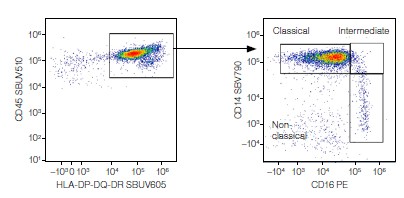
Fig. 6. CD45, HLA-DP-DQ-DR double-positive cells were further analyzed to identify classical, non-classical, and intermediate populations based on CD14 and CD16 expression. SBUV, StarBright UltraViolet; PE, phycoerythrin; SBV, StarBright Violet.
Granulocyte Identification
The three granulocyte populations were identified using the expression of various markers on cells found within the granulocyte scatter gate. CD45, CD123, and CD38 identified basophils, whereas a lack of CD3, CD14, and CD16 combined with the expression of CD10 allowed for the identification of eosinophils. Granulocytes were also found within the CD14- and CD3-negative population but were positive for CD16, CD11b, and CD33 (Figure 7).
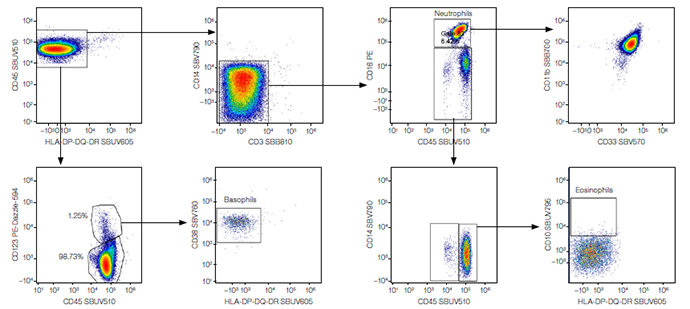
Fig. 7. Granulocytes were further analyzed to identify basophils, eosinophils, and neutrophils. PE, phycoerythrin; SBB, StarBright Blue; SBUV, StarBright UltraViolet; SBV, StarBright Violet.
T Lymphocyte Cell Identification
TCRgd T lymphocyte populations were identified as positive for CD3 but negative for TCRgd and the helper or cytotoxic T cells were identified by the expression of CD4 and CD8, respectively (Figure 8).
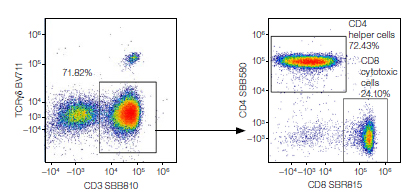
Fig. 8. Within the CD3-positive population, CD4 helper and CD8 cytotoxic cells could be identified. BV711, Brilliant Violet 711; SBB, StarBright Blue; SBR, StarBright Red.
T Helper Cell Identification
T helper cells, identified by CD4 expression, were further characterized by the expression of additional surface markers. CD45RA and CD45RO expression allowed for the identification of naïve and memory phenotypes, whereas CD57 identified effector T cells. Surface expression of CD62L, HLA-DP-DQ-DR, CD195, and CD31 also indicate various populations of naïve, memory, and activated T cells. The relative expression of CD45RA combined with CCR7 allowed for the identification of populations that can then be further subdivided into naïve, central memory, early, and terminal effector memory subsets based on CD27- and CD28- expression. An additional CD4-positive T-cell subset, regulatory T cells, were identified based on CD25 and CD127 expression, with their memory status determined using CD45RA and CD27 expression (Figure 9).
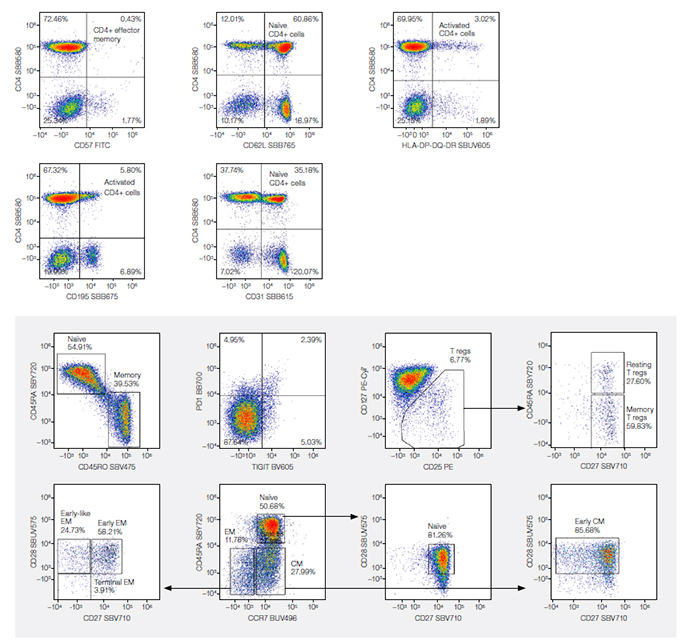
Fig. 9. CD3-positive lymphocytes were further characterized to reveal activation and memory statuses of the CD4 helper T cells. Within the CD4-positive population (gray background), more extensive characterization could be determined, including CD4-positive regulatory T cells. BV605, Brilliant Violet 605; BB700, Brilliant Blue 700; BUV496, Brilliant UltraViolet 496; CM, central memory; Cy7, cyanine7; EM, effector memory; FITC, fluorescein isothiocyanate; PE, phycoerythrin; SBB, StarBright Blue; SBUV, StarBright UltraViolet; SBV, StarBright Violet; SBY, StarBright Yellow.
T Cytotoxic Cell Identification
T cytotoxic cells identified by CD8 expression could be further characterized by the expression of many surface markers. CD45RA and CD45RO allowed for the identification of naïve and memory phenotypes, whereas CD57 identified effector T cells. Surface expression of CD62L, HLA-DP-DQ-DR, CD195, and CD31 also indicated various populations of naïve, memory, and activated T cells. The relative expression of CD45RA combined with CCR7 allowed for the identification of populations that can then be further subdivided into naïve, central memory, early, intermediate, and terminal effector memory subsets based on CD27- and CD28- expression (Figure 10).
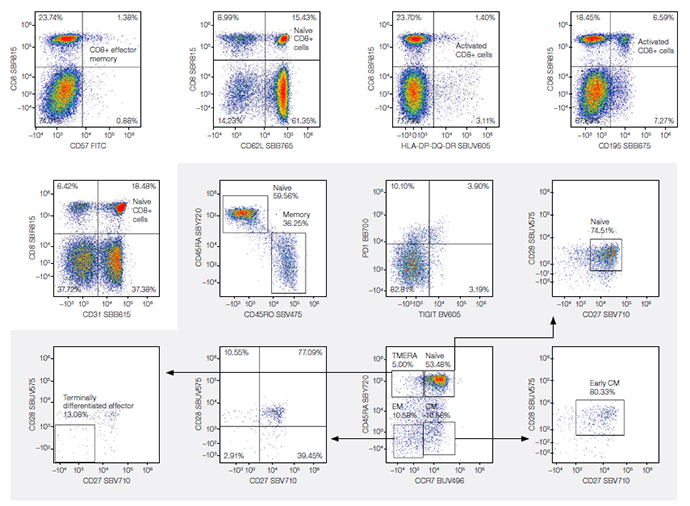
Fig. 10. CD3-positive lymphocytes were further characterized to reveal activation and memory statuses of the CD8 helper T cells. Within the CD8-positive population (gray background) more extensive characterization could be determined. BV605, Brilliant Violet 605; BB700, Brilliant Blue 700; BUV496, Brilliant UltraViolet 496; CM, central memory; EM, effector memory; TMERA, T memory effector cells re-expressing CD45RA; FITC, fluorescein isothiocyanate; SBB, StarBright Blue; SBR, StarBright Red; SBUV, StarBright UltraViolet; SBV, StarBright Violet; SBY, StarBright Yellow.
Dendritic Cell Identification
Within the mononuclear gate, various dendritic cell (DC) populations were identified. The CD56- and CD19-negative cells that were HLA-DR-positive were further subdivided into CD11c or CD123-positive to identify classical or plasmacytoid DCs. Within the CD11c-positive population, the expression of CD16 allowed for further identification of more subsets (Figure 11).
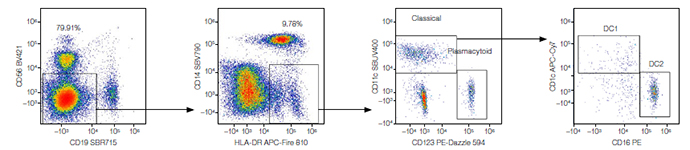
Fig. 11. CD56- and CD19-negative mononuclear cells were characterized to identify various dendritic cell populations such as classical and plasmacytoid. APC, allophycocyanin; BV421, Brilliant Violet 421; Cy7, cyanine7; PE, phycoerythrin; SBR, StarBright Red; SBUV, StarBright UltraViolet; SBV, StarBright Violet.
High Dimensional Data Reduction
A t-SNE high-dimensional reduction analysis was performed on the CD45-positive lymphocytes to show specific clusters of major lymphocyte populations (Figure 12).

Fig. 12. High-dimensional reduction. A t-SNE plot from data gated on live CD45-positive lymphocytes showing clusters of major lymphocyte populations.
Conclusions
A large 43-color immunophenotyping panel using StarBright Dyes was successfully designed and acquired on the Cytek Aurora System. While not exhaustive, the panel identified multiple cell populations present in human peripheral blood. Additional markers could still be added to further characterize subsets and identify additional cells such as innate lymphoid cells.
The panel yielded high cell resolution, and all populations were very clearly identified. All the antibodies with a bimodal signal (distinct positive and negative populations) exhibited clear separation between the two populations. Since some polymer dyes require a special buffer when multiplexing to avoid interactions, and multiple polymer dyes were used, Brilliant Buffer was used as a staining buffer. StarBright Dyes work in these special buffers, but staining can also be performed in a basic staining buffer without interactions.
The overall complexity index was 67, which is considered low for a panel of this size. Most of the values in the spreading matrix ranged from 0–5, indicating that the spread from dye a to dye b is minimal. Some values exceeded 10, where the spread is more significant and could affect resolution. The panel was designed so that these fluorophore pairs were on mutually exclusive cells, ensuring that data quality was not impacted. Finally, the panel was fixed in Bio-Rad Fixation Buffer, which is PFA-based, after staining and prior to being acquired. There was no appreciable drop in staining intensity when the samples were fixed.
Overall, StarBright Dyes are an ideal choice for inclusion in multicolor panels of any size, due to the large and comprehensive range, their brightness, and low-level spillover and spreading. Their ease of use and flexibility to work in any buffer means they can be easily inserted into existing panels without changes to established protocols.
Appendix
Suppl. Table 1. Complexity matrix. Values represent the similarity score between each fluorophore. Values below 0.99 are deemed unmixable. Colors progress from green to red as the similarity increases. APC, allophycocyanin; AXXX, Alexa Fluor; BV, Brilliant Violet; BUV, Brilliant UltraViolet; Cy7, cyanine7; FITC, fluorescein isothiocyanate; PE, phycoerythrin; SBB, StarBright Blue; SBR, StarBright Red; SBUV, StarBright UltraViolet; SBV, StarBright Violet; SBY, StarBright Yellow.
Suppl. Table 2. Spreading matrix. Values indicate the spillover spreading (SS) amount for each fluorophore into all detectors. The rows show the fluorophore-donated SS, whereas the columns display the detector-collected SS. Colors progress from white to red as more spreading is present. White indicates no or very low spreading and red indicates more spreading is present. APC, allophycocyanin; AXXX, Alexa Fluor; BV, Brilliant Violet; BUV, Brilliant UltraViolet; Cy7, cyanine7; FITC, fluorescein isothiocyanate; PE, phycoerythrin; SBB, StarBright Blue; SBR, StarBright Red; SBUV, StarBright UltraViolet; SBV, StarBright Violet; SBY, StarBright Yellow.
