
Anti His Tag Antibody
Ideal Tools for Monitoring Protein Purification Progress
Our selection of conjugated anti-His tag antibodies saves you time by removing the need for a secondary antibody.
Like the MBP (maltose binding protein) and GST tag, the His tag is a small epitope tag consisting of between six to nine histidine residues, which is cloned into an expression vector upstream or downstream of a gene of interest. The vector is then introduced into an expression system such as bacteria, yeast or insect cells. The result is the expression of a recombinant protein carrying a polyhistidine tag at its N- or C-terminus.
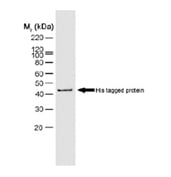
Western blot of His tagged protein probed with Mouse anti Histidine tag antibody, clone AD1.1.10 (MCA1396) visualized with Rabbit anti Mouse IgG:HRP (STAR13B)
In order to purify the recombinant protein immobilized metal affinity chromatography (IMAC) is performed. This technique is based on the fact that a cord of histidine residues binds to immobilized metals such as Nickel.
Anti-histidine antibodies can be used to monitor the progress of purification and the fraction containing the recombinant protein by western blotting, and to verify that no proteolytic degradation of the recombinant protein is taking place.
Did You Know?
- Our anti-His tag antibody portfolio has been tested in ELISA, flow cytometry, immunofluorescence and immunoprecipitation
- Clone AD1.1.10 has been successfully used in 12 papers
- Anti-His tag antibodies are available directly conjugated to HRP and AP - making the use of secondary antibodies in Western blotting redundant
- For all your multicolor flow needs anti-His tag antibodies are available conjugated to a large selection of Alexa Fluor®, DyLight® and conventional dyes
- Clone ABD2.2.20 has been used extensively in ELISA for the data generated to characterise anti-idiotypic antibodies.
His tag antibodies
| Description | Target | Format | Clone | Applications | Citations | Code |
|---|
Be the First to Receive Updates on Products and Resources
You'll receive regular communications featuring free lab resources such as application guides, posters, mini-reviews, protocols, practical tips, webinar invitations, special offers, and updates on new research tools and products.
You'll also get our specialist newsletters—including Fab Fragments, Flow. Sorted., and RiVETing—along with news on the latest antibody innovations, such as TrailBlazer™ Antibodies and StarBright™ Dyes.
During sign-up, you can choose your areas of interest so you only receive content relevant to your research, and you can unsubscribe at any time.
