
Technical Note: Stable Premixed Cocktails to Increase Reproducibility and Save Time in Longitudinal Flow Cytometry Assays
Stable Premixed Cocktails to Increase Reproducibility and Save Time in Longitudinal Flow Cytometry Assays
 Technical Note: Stable Premixed Cocktails to Increase Reproducibility and Save Time in Longitudinal Flow Cytometry Assays
Flow cytometry experiments, often conducted over an extended period with the same multiplex panel, require consistent staining. While preparing a fresh master mix for each longitudinal study is best practice, it can be time-consuming. Premixing and storing master mixes for ready use offers significant time savings and high reproducibility.
This study demonstrates that antibodies conjugated to StarBright™ Dyes are ideal for creating premixed antibody cocktails for both conventional and spectral flow cytometry. StarBright Dye–conjugated antibodies can also be premixed with selected traditional fluorophores for panel expansion. When stored at 4°C, the premixed master mixes remain stable for up to 12 months, detecting the same populations and producing data comparable to freshly prepared panels.
Introduction
Staining multiple samples with the same antibody panel can lead to inconsistent data and consume considerable time. Pipetting errors may lead to incorrect antibody volumes or missed antibodies, affecting the reliability of sample comparisons. A convenient solution to this problem is using a master mix containing enough of each antibody in the panel to stain all experimental samples, saving time and improving reproducibility.
In longitudinal studies, where samples are stained with the same panel over extended periods, a master mix must be prepared at the start of each experiment. A better alternative is to use a premixed cocktail — a master mix that is stored and ready-to-use for routine staining of the same panel over days, weeks, or even months. Premixed cocktails offer all the advantages of a master mix and more. They ensure greater consistency and reproducibility across time points and save time. This time saving allows staining to begin when samples are fresher (reducing the impact of sample arrival time) and leads to quicker results.
Selecting antibodies for a premixed cocktail requires careful consideration. Choosing stable fluorophores and combinations that avoid unwanted dye interactions, which can distort the staining results, is essential. Incorrect fluorophore selection can impair cell resolution or prevent accurate compensation/unmixing due to different fluorophore spectra in the master mix compared to the single-stained controls used for analysis.
This study aimed to determine if StarBright Dyes, previously shown to remain stable in a premixed cocktail for up to 6 months, would produce comparable results to a freshly prepared panel after extended storage of up to 12 months. This long-term stability as a premixed cocktail would render them ideal for long-term studies. Additionally, to expand the panel size and provide more options, we have incorporated traditional fluorophores — FITC, PE, and Alexa Fluor 700 — into the example panel.
Data were acquired on a ZE5 Cell Analyzer, a conventional flow cytometer from Bio-Rad. Additionally, a more stringent test was performed with a spectral cytometer, the Cytek Aurora System, with a 3 month premixed cocktail consisting solely of StarBright Dyes. High-quality data from full spectrum flow cytometers rely on precise unmixing; any differences in the spectra between the fluorophores used in the full panel and single stained controls will result in unmixing errors, leading to false positives and unreliable data.
Materials and Methods
Staining Protocol for Samples Acquired on a ZE5 Cell Analyzer: A Conventional Cytometer
Human peripheral blood was treated with Red Cell Lysing Buffer (Bio-Rad Laboratories, Inc., catalog BUF04) to remove red blood cells. Samples were blocked in 10% human serum for 5 min at room temperature (RT), then incubated for 1 hr at RT with antibodies from the premixed cocktail or a freshly made panel. For compensation controls, cells were incubated with a single antibody. Following incubation, samples were washed three times in phosphate buffered saline + 1% bovine serum albumin (PBS/BSA) and resuspended in 200 µl of PBS/BSA. Five minutes before acquisition, PureBlu DAPI (Bio-Rad, 1351303) was added according to the manufacturer’s instructions. All antibodies were titrated to determine the optimal dilution for the experimental conditions and used accordingly.
Staining Protocol for Samples Acquired on a 5-Laser Cytek Aurora System: A Full Spectrum Cytometer
The previously described staining protocol was used, except that cells were fixed and stained with a fixable live/dead dye, instead of DAPI, which is not fixable. Prior to the blocking step, cells were washed in PBS and incubated with VivaFix 649/660 (Bio-Rad, 1351118) for 30 min at RT. Cells were then washed once in PBS/ BSA, blocked, stained with antibodies, and washed again. After the final wash step, cells were resuspended in Fixation Buffer (Bio-Rad, BUF071) for 30 min at RT, pelleted, and resuspended in 200 µl of PBS. Cells were stored at 4ºC and protected from light, until acquisition 24 hr later.
Multiplex Panels
Antibodies used in the 12 month premixed cocktail acquired on the ZE5 Cell Analyzer are shown in Table 1, and for the 3 month premixed cocktail acquired on the Cytek Aurora System in Table 2. The premixed cocktail was made and stored at 4ºC protected from light, until required. The antibodies were not diluted with additional buffer in the cocktail to avoid reducing antibody stability by diluting carrier proteins and detergents. Cells were stained with the premixed cocktail or a panel made fresh on the day of staining.
Table 1. Antibodies used for a 12 month panel acquired on a ZE5 Cell Analyzer. Antibody panel for the premixed cocktail and fresh panel comparison.
Marker |
Fluorophore |
Bio-Rad Catalog |
|---|---|---|
|
CD14 |
SBUV400 |
|
|
CD33 |
SBUV740 |
|
|
CD8 |
SBV440 |
|
|
CD3 |
SBV610 |
|
|
CD4 |
FITC |
|
|
CD45RA |
SBB580 |
|
|
CD16 |
PE |
|
|
CD45RO |
SBY720 |
|
|
CD19 |
SBR670 |
|
|
CD45 |
A700 |
A700, Alexa Fluor 700; PE, phycoerythrin; FITC, fluorescein; SBB, StarBright Blue; SBR, StarBright Red; SBUV, StarBright UltraViolet; SBV, StarBright Violet; SBY, StarBright Yellow.
Table 2. Antibodies used for a 3 month panel acquired on a full spectrum cytometer. Antibody panel for the premixed cocktail and fresh panel comparison.
Target |
Fluorophore |
Bio-Rad Catalog |
|---|---|---|
|
CD14 |
SBUV400 |
|
|
CD45RA |
SBUV665 |
|
|
CD19 |
SBV440 |
|
|
CD45RO |
SBV610 |
|
|
CD4 |
SBB580 |
|
|
CD33 |
SBB675 |
|
|
CD8 |
SBB810 |
|
|
CD20 |
SBY575 |
|
|
CD3 |
SBY720 |
SBB, StarBright Blue; SBUV, StarBright UltraViolet; SBV, StarBright Violet; SBY, StarBright Yellow.
Data Collection
Cells stained with a premixed cocktail or fresh panel were acquired on a 5-L ZE5 Cell Analyzer with UV option A with a 355 nm laser upgrade (Bio-Rad, 12014135) or a 5-L Cytek Aurora System (Cytek Biosciences). A total of 150,000 cells were acquired for the multiplex panel and 60,000 for the single-stained controls. At each time point, cells from the same donor were stained with the premixed cocktail and a fresh panel in the same 96-well plate, ensuring consistency in staining conditions (for example, incubation time and washing) for accurate comparison of the panels.
Gating Strategy
Analysis of data acquired from the ZE5 Cell Analyzer was performed using FCS Express 7 Software (DeNovo Software by Dotmatics). Data acquired from the Cytek Aurora System were unmixed using SpectroFlo (Cytek Biosciences), and the unmixed data were analyzed further in FCS Express 7 Software. Dead cells were first excluded from downstream analysis by gating on cells that were DAPI/VivaFix negative. Doublet discrimination was used to identify single cells, followed by gating on two cell populations — lymphocytes and monocytes — based on forward scatter area (FSC-A) and side scatter area (SSC-A).
Results
StarBright Dye–Conjugated Antibodies and Traditional Fluorophores in a 12 Month Premixed Panel Acquired on a Conventional Flow Cytometer
The premixed cocktail was prepared on day 0, and samples were taken out at 1, 3, 6, and 12 month intervals. Human peripheral blood was stained with the premixed cocktail and a fresh panel at each time point. Figures 1 and 2 show the data from the 12 month time point. The spillover and spillover spreading matrixes for the panel are shown in Suppl. Tables 1 and 2 and data from the time course in Suppl. Figure 1. There was little variation at each time point between the two panels. The percentages are within expected ranges of variation, with no strong interactions between the fluorophores present. Note that, as different donors were used at each time point, percentages can only be compared within each time point due to normal variation between donors.
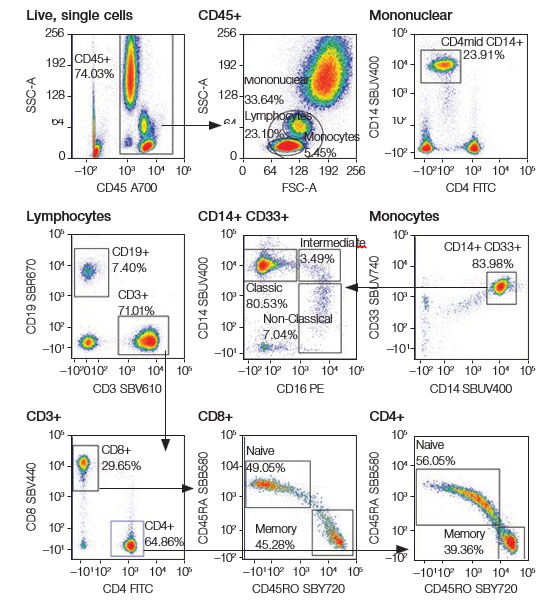
Fig. 1. Immunophenotyping data from human peripheral blood stained with a fresh panel on a conventional flow cytometer.
Human blood was stained with a fresh multiplex panel. Cells were gated on live single cells (not shown) prior to the gating strategy shown. Data were acquired on a ZE5 Cell Analyzer. A700, Alexa Fluor 700; PE, phycoerythrin; FITC, fluorescein; SBB, StarBright Blue; SBR, StarBright Red; SBUV, StarBright UltraViolet; SBV, StarBright Violet; SBY, StarBright Yellow.
StarBright Dye–Conjugated Antibodies in a 3 Month Premixed Panel in Spectral Flow Cytometry
A 3 month premixed cocktail containing only antibodies conjugated to StarBright Dyes was compared to a fresh panel on a spectral flow cytometer, a 5-L Cytek Aurora System. Figures 3 and 4 show the data from the fresh and premixed panel, the complexity and spillover spreading matrices are shown in Suppl. Tables 3 and 4. The data are very similar between the two panels, with no staining artifacts present due to fluorescent dye interactions and percentages within normal levels of variation.
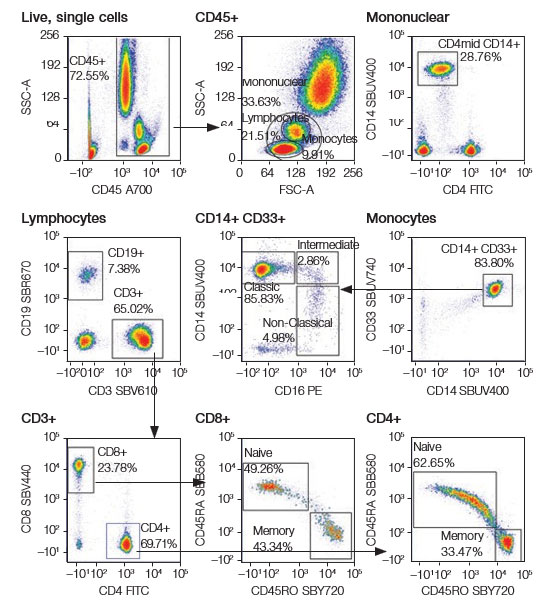
Fig. 2. Immunophenotyping data from human peripheral blood stained with a 12 month premixed cocktail on a conventional flow cytometer. Human blood was stained with a multiplex panel stored for 12 months at 4ºC. Cells were gated on live single cells (not shown) prior to the gating strategy shown. Data were acquired on a ZE5 Cell Analyzer. A700, Alexa Fluor 700; PE, phycoerythrin; FITC, fluorescein; SBB, StarBright Blue; SBR, StarBright Red; SBUV, StarBright UltraViolet; SBV, StarBright Violet; SBY, StarBright Yellow.
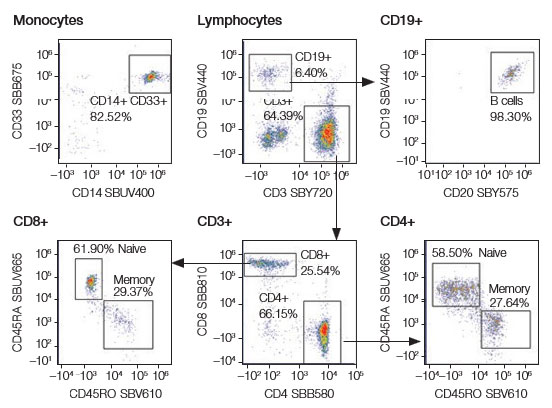
Fig 3. Immunophenotyping data from human peripheral blood stained with a fresh panel on a spectral flow cytometer. Human blood was stained with a multiplex panel. Cells were gated on live single cells, and lymphocytes and monocytes (not shown), prior to the gating strategy shown. Data were acquired on a Cytek Aurora System. SBB, StarBright Blue; SBUV, StarBright UltraViolet; SBV, StarBright Violet; SBY, StarBright Yellow.

Fig 4. Immunophenotyping data from human peripheral blood stained with a 3 month old panel on a spectral flow cytometer. Human blood was stained with a multiplex panel. Cells were gated on live single cells, and lymphocytes and monocytes (not shown), prior to the gating strategy shown. Data were acquired on a Cytek Aurora System. SBB, StarBright Blue; SBUV, StarBright UltraViolet; SBV, StarBright Violet; SBY, StarBright Yellow.
Conclusion
Antibodies conjugated to StarBright Dyes are suitable for use as premixed cocktails to stain cells acquired on a conventional or spectral flow cytometer. We demonstrated no significant variation in the data obtained from a premixed panel stored for up to 12 months at 4oC compared to a fresh cocktail with similar percentages. Furthermore, no staining artifacts were observed, such as dye-to-dye interactions in the premixed cocktail. The premixed cocktail also did not require the use of a special staining buffer to prevent such artifacts at any point.
While StarBright Dyes can be premixed and stored, it is recommended that new premixed panels containing other fluorophores be tested before use to ensure no unexpected interactions are present. For panels containing antibodies conjugated to fluorophores that cannot be stored for an extended period or require a special buffer, a premix can still be made, but with the omission of those unsuitable for storage in a premixed cocktail. These additional antibodies can be added at the point of staining. This process would reduce the time to generate large panels and improve reproducibility even when not all antibodies can be stored.
The brightness of StarBright Dyes and their narrow excitation and emission profiles, compatibility with all buffers and fixatives, and ability to create premixed cocktails make them an ideal choice for multiplex panels of any size and protocol. Premixing your master mixes for multiplex panels is more convenient, saves significant time, and improves consistency without affecting the final data.
Appendix
Suppl. Table 1. ZE5 Cell Analyzer spillover matrix.

Values represent the amount of spillover for each fluorophore. The rows show the fluorophore, and the columns display the signal present in each detector. Colors progress from green to white to red as more spillover is present. Green indicates no or very low spillover, whereas red shows greater spillover between the two fluorophores. A700, Alexa Fluor 700; DAPI, 4',6-diamidino-2-phenylindole; PE, phycoerythrin; FITC, fluorescein; SBB, StarBright Blue; SBR, StarBright Red; SBUV, StarBright UltraViolet; SBV, StarBright Violet; SBY, StarBright Yellow.
Suppl. Table 2. ZE5 Cell Analyzer spreading matrix.

Values indicate the amount of spillover spreading (SS) for each fluorophore into all detectors. The rows show the fluorophore-donated SS, and the columns display the detector- collected SS. Colors progress from green to white to red as more spreading is present. Green indicates no or very low spreading, whereas red notes more spreading is present. 0–3 indicates no or very low spreading. A700, Alexa Fluor 700; DAPI, 4',6-diamidino-2-phenylindole; PE, phycoerythrin; FITC, fluorescein; SBB, StarBright Blue; SBR, StarBright Red; SBUV, StarBright UltraViolet; SBV, StarBright Violet; SBY, StarBright Yellow.
Suppl. Table 3. Spectral cytometer complexity matrix.
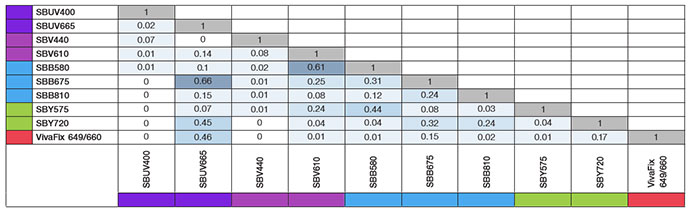
Values indicate the similarity scores between the two fluorophores. Colors progress from white to blue to grey as the fluorophores become more similar. White indicates distinct spectral profiles, whereas grey notes identical profiles. The matrix has an overall complexity index of 3.56. SBB, StarBright Blue; SBUV, StarBright UltraViolet; SBV, StarBright Violet; SBY, StarBright Yellow.
Suppl. Table 4. Spectral cytometer spreading matrix.
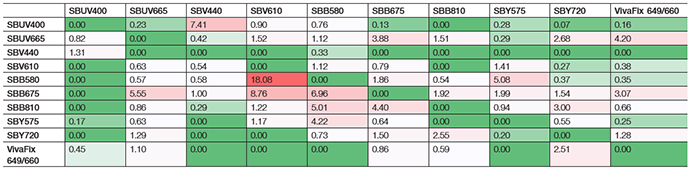
Values indicate the amount of spillover spreading (SS) for each fluorophore into other fluorophores. The rows show the fluorophore-donated SS, and the columns display the detector-collected SS. Colors progress from green to white to red as more spreading is present. 0–5 indicates no or very low spreading, 5–10 some spreading, and above 10 spreading present, requiring careful panel design to avoid poor cell resolution. SBB, StarBright Blue; SBUV, StarBright UltraViolet; SBV, StarBright Violet; SBY, StarBright Yellow.

Suppl. Fig 1. Dot plots from 12 month premixing time course. Human peripheral blood was stained with a panel premixed for 1, 3, 6, or 12 months and compared to a fresh panel. Cells were gated on live, single cells. A, CD19 SBR670 and CD3 SBV610 gated on lymphocytes; B, CD8 SBV440 and CD4 FITC gated on CD3+ lymphocytes; C, CD45RA SBB580 and CD45RO SBY720 gated on CD4+ CD3+ lymphocytes. Data were acquired on a ZE5 Cell Analyzer. FITC, fluorescein; SBB, StarBright Blue; SBR, StarBright Red; SBV, StarBright Violet; SBY, StarBright Yellow.