
Fc Blocking in Flow Cytometry
Author: Mike Blundell | Reviewer: Chloe Fenton
What Are Fc Blocking Controls in Flow Cytometry?
Fc receptors are found on monocytes, macrophages, dendritic cells, and B cells. As the name suggests they bind antibodies via their constant Fc domain rather than the antigen-specific Fab domain.
This type of binding can lead to false positives and meaningless data. In order to prevent this type of binding, Fc blocking reagents (e.g., Human Fc Seroblock and Murine Fc Seroblock) have been developed which, when added to a staining protocol, can ensure that only antigen-specific binding is observed.
Example of Fc Blocking in Flow Cytometry
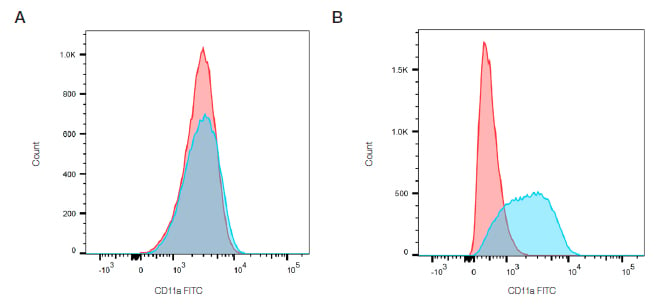
Fig. 21. Fc blocking. THP-1 cells stained with Mouse Anti-Human CD11a (blue) or Mouse IgG2a Isotype Control (MCA929F) (red) in the absence (A) and presence (B) of Human Seroblock (BUF070A)
Why Are Fc Blocking Controls Important?
- Reduce nonspecific antibody binding caused by Fc receptors
- Improve signal-to-noise ratio in flow cytometry data
- Ensure staining reflects true antigen-specific interactions
- Prevent false-positive populations caused by Fc-mediated binding
When Should Fc Blocking Be Used?
Fc blocking is particularly important when working with samples that contain cells expressing Fc receptors or where background staining may interfere with data interpretation.
- Monocytes and macrophages
- Dendritic cells
- B cells and NK cells
- Primary immune cells and whole blood samples
- Multicolor flow cytometry panels
How to Use Fc Blocking Reagents
- Prepare your cell suspension.
- Add an appropriate Fc blocking reagent for the sample species.
- Incubate according to protocol.
- Proceed with antibody staining.
Using the correct species-specific Fc blocking reagent is essential to ensure effective blocking of Fc receptors and accurate staining results.
Limitations of Fc Blocking Controls
- Does not account for spectral overlap between fluorophores
- Does not define gating boundaries
- Does not measure autofluorescence
Fc blocking controls should be used alongside other controls such as unstained, isotype, and fluorescence minus one (FMO) controls to ensure accurate data interpretation.
Fc Blocking Controls vs. Other Flow Cytometry Controls
Fc blocking controls prevent nonspecific antibody binding, while other controls measure or address different aspects of flow cytometry data.
- Unstained controls: measure autofluorescence and baseline signal
- Isotype controls: assess nonspecific antibody binding
- FMO controls: define gating boundaries in multicolor panels
- Compensation controls: correct for fluorescence spillover
Frequently Asked Questions
What is Fc blocking in flow cytometry?
Fc blocking is used to prevent antibodies from binding nonspecifically to Fc receptors on immune cells, ensuring that staining reflects antigen-specific interactions.
Why is Fc blocking important?
Fc receptors can bind antibodies independently of antigen specificity, leading to false-positive results and increased background signal. Fc blocking reduces these effects.
When should I use Fc blocking controls?
Fc blocking should be used when working with Fc receptor–expressing cells such as monocytes, macrophages, dendritic cells, B cells, and NK cells.
Do Fc blocking controls replace isotype controls?
No. Fc blocking prevents nonspecific binding, while isotype controls assess the level of nonspecific antibody interactions.
Can Fc blocking eliminate all background signal?
No. Fc blocking reduces nonspecific binding caused by Fc receptors but does not eliminate autofluorescence or spectral overlap.
Flow Cytometry Basics Guide Download
Get your own copy to peruse at your leisure
Download our updated Flow Cytometry Basics Guide to have practical advice, best practice examples, and a basic overview of all the important flow cytometry principles in one handy location.

Resources
Bio-Rad is committed to helping you succeed in Flow Cytometry by sharing knowledge and best practices from our experts. Below are some extremely useful resources to enhance your journey of discovery and support your success.