
Unstained Controls in Flow Cytometry
Author: Mike Blundell | Reviewer: Chloe Fenton
One of the first things to identify in flow cytometry is your cell population. This can be done by its forward and side scatter characteristics or using side scatter plus a marker such as CD45 for cell population identification. After this you need to determine the location of the negative population. To do this you should always use an unstained sample. This will allow you to determine the level of background fluorescence or autofluorescence and set your voltages and negative gates appropriately.
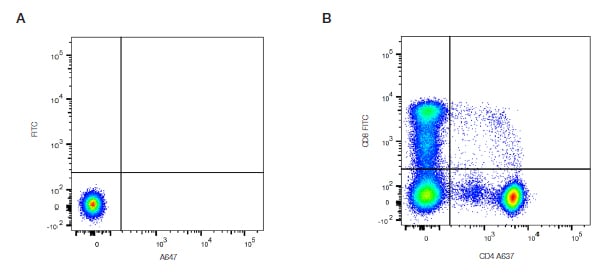
Fig. 19. Unstained controls. Unstained lymphocytes (A) are used to determine the background autofluorescence to set the negative population allowing cells stained with CD4 (MCA1267A647) and CD8 (MCA1226F) to be visualized (B).
Which Flow Cytometry Control Should I Use?
Different flow cytometry controls answer different analytical questions. Understanding the role of each control helps ensure accurate background assessment, correct gate placement, and reliable interpretation of multicolor data.
Below is a brief summary of controls that can be used in flow cytometry. More detailed information on controls can be found in the following chapters.
| Control type | What it measures | Primary purpose | When to use | What it does not tell you |
|---|---|---|---|---|
| Unstained control | Baseline autofluorescence and detector background | Establishes the lowest possible signal level in each fluorescence channel | Always include, particularly when assessing background signal, scatter properties, or inherent cellular autofluorescence | Does not control for nonspecific antibody binding or fluorophore spillover |
| Isotype control | Nonspecific antibody binding | Assesses background signal caused by antibody binding unrelated to antigen specificity | When evaluating whether staining is due to nonspecific interactions under identical antibody and fluorophore conditions | Does not account for spectral spillover or spreading error from other fluorophores |
| FMO (fluorescence minus one) control | Spillover and spread from all fluorophores except one | Defines accurate positive/negative boundaries in multicolor flow cytometry panels | Essential for multicolor experiments where fluorophore emission spectra overlap | Does not measure true autofluorescence or nonspecific antibody binding |
| Compensation controls | Spectral overlap (fluorescence spillover) from individual fluorophores | Enable calculation and correction of fluorescence spillover between detectors | Required in multicolor experiments using multiple fluorophores to ensure accurate signal separation | Does not define gating boundaries or measure nonspecific antibody binding |
| Biological controls | Expected biological expression (positive or negative populations) | Validates that staining patterns reflect true biological signal rather than technical artefact | When confirming marker expression, experimental conditions, or assay validity using known positive or negative samples | Does not correct for spectral overlap or distinguish nonspecific antibody binding |
Flow Cytometry Basics Guide Download
Get your own copy to peruse at your leisure
Download our updated Flow Cytometry Basics Guide to have practical advice, best practice examples, and a basic overview of all the important flow cytometry principles in one handy location.

Resources
Bio-Rad is committed to helping you succeed in Flow Cytometry by sharing knowledge and best practices from our experts. Below are some extremely useful resources to enhance your journey of discovery and support your success.