
ELISA: Procedure
Overview
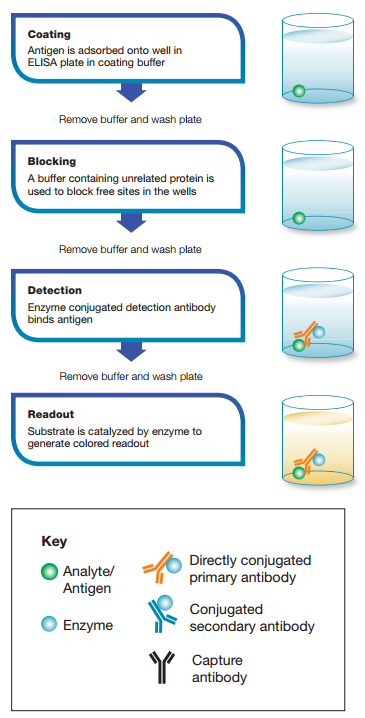
ELISAs begin with a coating step, where the first layer, either an antigen or an antibody, is adsorbed to a well in an ELISA plate. Coating is followed by blocking and detection steps as shown in the simple schematic diagram below.
Since the assay uses surface binding for separation, several washes are repeated between each ELISA step to remove unbound materials. During this process it is essential that excess liquid is removed in order to prevent the dilution of the solutions added in the next stage. For greatest consistency specialized plate washers are used.
ELISAs can be quite complex, including various intervening steps and the ability to measure protein concentrations in heterogeneous samples such as blood. The most complex and varying step in the overall process is detection, where multiple layers of antibodies can be used to amplify signal.
ELISA Steps
Be the First to Receive Updates on Products and Resources
You'll receive regular communications featuring free lab resources such as application guides, posters, mini-reviews, protocols, practical tips, webinar invitations, special offers, and updates on new research tools and products.
You'll also get our specialist newsletters—including Fab Fragments, Flow. Sorted., and RiVETing—along with news on the latest antibody innovations, such as TrailBlazer™ Antibodies and StarBright™ Dyes.
During sign-up, you can choose your areas of interest so you only receive content relevant to your research, and you can unsubscribe at any time.
