
Fluorescent Secondary Antibodies for Western Blotting
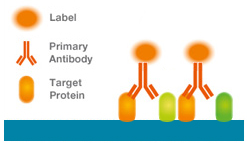
Fig. 1. Fluorescently conjugated primary antibody bound to the target protein.
Enhancing Signal Detection with Fluorescent Secondary Antibodies
Fluorescent western blotting (WB) uses an antibody conjugated to a fluorescent molecule.
The antibody detects and binds to the target protein immobilized on the blotting membrane.
This antibody-protein binding is then visualized by detecting the light emitted by the fluorescent molecule after it has been exposed to an excitation source.
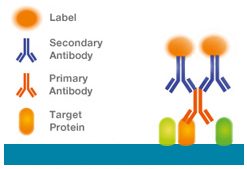
Fig. 2. Multiple fluorescently conjugated secondary antibody bound to the primary antibody target protein complex.
Fluorescently conjugated primary antibodies can be used in WB, however, it is more common to use fluorescently conjugated secondary antibodies as they increase the fluorescent signal, improving signal visualization.
Multiple fluorescent secondary antibodies detect and bind to a primary antibody, increasing the amount of emitted light due to the presence of more fluorescent molecules on the protein-primary antibody and secondary antibodies complex.
Bio-Rad’s range of fluorescent secondary antibodies provides optimum quality and flexibility for the design of your WB experiment.
 StarBright™ Dye Secondary Antibodies
To achieve exceptional brightness in fluorescent WB, Goat Anti-Mouse IgG and Goat Anti-Rabbit IgG antibodies have been conjugated to Bio-Rad’s unique StarBright Dyes. StarBright Blue 700 and 520 are bright and stable with narrow excitation and emission, making them ideal for clear and clean single-target or multiplex fluorescent WB detection of several proteins in combination with other fluorophores.
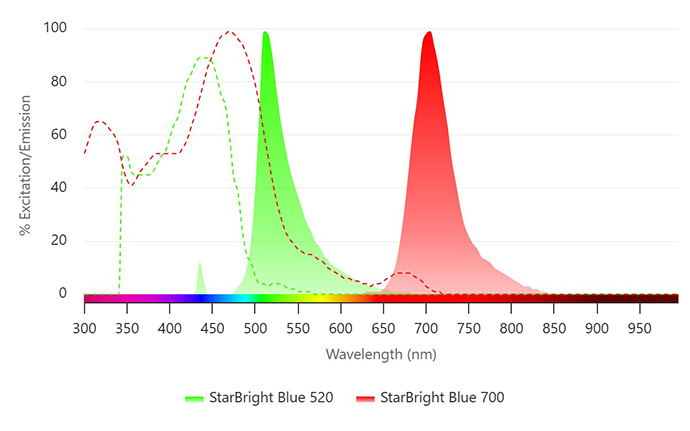
Fig. 3. Spectral profile of StarBright Blue 700 and StarBright Blue 520. Excitation (dashed line) and emission (solid color) profiles shown.
The Advantages of StarBright Dye Secondary Antibodies Over Chemiluminescence
Chemiluminescence is a popular traditional method for WB detection. The blot is probed with a primary antibody followed by a horseradish peroxidase (HRP)-conjugated secondary antibody, after which the blot is incubated with a luminol-based detection solution that, upon a chemical reaction, generates light. There are many advantages that fluorescent WB has over chemiluminescence.
- The fluorescent detection method takes less time having one less step as it does not require incubation with a detection solution, view protocol
- The signal from fluorescent WB is relative to the amount of target protein-antibody complex, whereas the signal detected by chemiluminescence can be variable
- A second protein can be detected simultaneously with the first protein, whereas in chemiluminescence the blot has to be stripped and reprobed, risking loss of the target protein during the stripping process, increasing the time spent and cost to run another experiment
- The resultant fluorescent WB blot is stable, you can store it in the fridge and image it later, also once imaged and dried, the blot can be stored for a year in the dark
- Fluorescent WB enables the detection of lower levels of protein after a shorter exposure time with minimal background compared to chemiluminescence (Figure 4)

Fig. 4. Western blots of anti-actin beta using different secondaries for detection. Western blot analysis of HeLa lysates at decreasing dilutions (1.5 x serial dilutions) were probed with Anti-Actin Beta (VMA00048) and detected with A, Goat Anti-Mouse IgG SBB700 (12004158) B, Goat Anti-Mouse IgG SBB520 (12005866) C, Goat Anti-Mouse IgG HRP (STAR117P) or D, Goat Anti-Mouse IgG Dylight 800 (STAR117D800GA).
Benefits of StarBright Dye Secondary Antibodies
- Highly sensitive detection – 2–4–fold lower detection limit compared to traditional fluorophores
- Short exposure times – seconds vs. minutes
- Low background as the antibodies have been cross-absorbed
- Stable blots
- Multiplexing options
- Compatible with other fluorescently labeled antibodies and with Bio-Rad’s Stain-Free Gels
Table 1. The StarBright Blue Secondary Antibody range.
Description |
Excitation |
Emission |
Pack Size |
Catalog |
|---|---|---|---|---|
|
Goat Anti-Mouse IgG StarBright Blue 700 |
440–470 nm |
700 nm |
400 µl |
|
|
Goat Anti-Mouse IgG StarBright Blue 700 |
440–470 nm |
700 nm |
80 µl |
|
|
Goat Anti-Rabbit IgG StarBright Blue 700 |
440–470 nm |
700 nm |
400 µl |
|
|
Goat Anti-Rabbit IgG StarBright Blue 700 |
440–470 nm |
700 nm |
80 µl |
|
|
Goat Anti-Mouse IgG StarBright Blue 520 |
440-–470 nm |
520 nm |
400 µl |
|
|
Goat Anti-Mouse IgG StarBright Blue 520 |
440–470 nm |
520 nm |
80 µl |
|
|
Goat Anti-Rabbit IgG StarBright Blue 520 |
440–470 nm |
520 nm |
400 µl |
|
|
Goat Anti-Rabbit IgG StarBright Blue 520 |
440–470 nm |
520 nm |
80 µl |
 TrailBlazer™ Tag and StarBright Dye Label Kits
Label your antibody of choice with a StarBright Dye using TrailBlazer Tag and StarBright Dye Label Kits. These TrailBlazer Kits use the innovative technologies of SpyTag, SpyCatcher, and StarBright Dyes, allowing you to generate your own high-quality labeled antibodies.
In fluorescent western blotting, you can expect bright, highly sensitive fluorescent detection with short exposure times when using your TrailBlazer Kit StarBright Dye–labeled antibody.
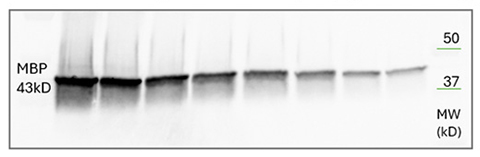
Fig. 5. Western blot of Goat Anti-Mouse IgG SBB700 Kit–labeled secondary. Western blot analysis of HeLa lysate spiked with decreasing amounts of maltose binding protein (MBP), starting at 20 ng with a 2x serial dilution. Probed with Mouse Anti-Human MBP. Detected with A) Goat Anti-Mouse IgG labeled to StarBright Blue 700 using TrailBlazer Tag (12020038) and StarBright Blue 700 Label Kit (12020040) at 1:1,300, visualized on the ChemiDocTM MP Imaging System.
Isotype-Specific Fluorescently Conjugated Secondary Antibodies
Whether doing single or multiplex WB, difficulties can be encountered due to high background and cross-reactivity leading to false positives. Isotype-specific secondary antibodies only detect the specific isotype of their target primary antibody. For instance, rat anti-mouse IgG2a will only detect a mouse antibody with an isotype of IgG2a and not a mouse antibody with an isotype of IgG1.
Without the risk of cross-reactive binding to off-target primary antibodies, false positives and high background staining can be avoided, making these isotype-specific antibodies ideal when building multiplex panels by increasing the secondary-primary antibody options.
Table 2. Anti-mouse isotype targets and fluorophores.
Target Isotype |
Fluorophore |
Catalog |
|---|---|---|
|
IgG1 |
DyLight488 |
|
|
IgG1 |
DyLight650 |
|
|
IgG1 |
RPE |
|
|
IgG2a |
DyLight550 |
|
|
IgG2a |
DyLight650 |
|
|
IgG2b |
DyLight650 |
Visit the isotype specific webpage to learn more about their benefits in different applications and discover non-fluorescent options.
Cross-Adsorbed Fluorescently Conjugated Secondary Antibodies
Cross-adsorbed antibodies only recognize the host species or the isotype of the target primary antibody. The undesired cross-reactivity from a pool of secondary antibodies is removed by an affinity chromatography column, which immobilizes undesired cross-reactive antibodies. Visit the cross-adsorbed secondary antibodies webpage for more details on how these antibodies are generated and their benefits.
Along with the fluorescent benefits that this type of antibody brings, they also minimize nonspecific background and false positive signals.
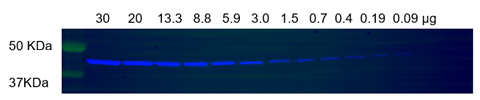
Fig. 6. Western blot of actin beta detected using an anti-mouse secondary antibody cross-adsorbed against bovine, goat, human, rabbit, and rat. Western blot analysis of HeLa lysates at decreasing dilutions (1.5x serial dilutions) were probed with Anti-Actin Beta (VMA00048) and detected with Goat Anti-Mouse IgG SBB520 (12005866). Visualized on the ChemiDoc GO Imaging System.
Fluorescent Secondary Antibody Range
Use the filter table below to find the right fluorescent secondary antibody for your WB.
Available Antibodies
| Description | Target | Format | Clone | Applications | Citations | Code |
|---|
Latest Resources
See the Truth in Every Band
A practical guide to western blot image integrity, documentation, and data verification.
Bio-Rad Academy — Fundamentals of Flow Cytometry
Enroll in Bio-Rad’s Fundamentals of Flow Cytometry Series, a free, online course that covers the basics of flow cytometry and experimental best practices.