StarBright Dyes for Spectral Flow Cytometry
Overview
The advance of full spectrum cytometry has resulted in the creation of more intricate multiplexing panels. However, the shortage of new dyes tailored for spectral instruments poses challenges in optimizing and broadening its application. Bio-Rad is enhancing its line of 32 StarBright™ Dyes suitable for both spectral and conventional flow cytometry by introducing additional dyes, specifically developed on a spectral flow cytometry instrument. Available on a wide range of human and mouse markers and streptavidin, these dyes increase flexibility and choice when panel building.
Like all StarBright Dyes, these new additions do not require any special staining buffer, can be fixed without losing signal strength, and can be stored long-term as a premixed panel, offering flexibility for both panel design and future expansion. More information on all StarBright Dyes, normalized spectra, comparison overlays, and spectra of most common dyes can be obtained using our spectraviewer.
Spectral StarBright UltraViolet Dyes
Table 1. Spectral StarBright UltraViolet Dye range.
StarBright Dye |
Max Ex, nm |
Max Em, nm |
Brightness (1–5) |
5-L Cytek Aurora Primary Channel |
5-L Sony ID7000 Primary Channel |
|---|---|---|---|---|---|
|
StarBright UltraViolet 540 Dye |
338 |
540 |
2 |
UV8 |
UV7 |
|
StarBright UltraViolet 700 Dye |
340 |
700 |
4 |
UV13 |
UV21 |
|
StarBright UltraViolet 770 Dye |
340 |
765 |
4 |
UV15 |
UV28 |
StarBright UltraViolet 540
SBUV540 is a unique dye with no comparison dye that emits at a similar wavelength when excited by the 355 nm laser. This dye has a unique peak emission in channel UV8 (5-L Cytek Aurora) or UV7 (5-L Sony ID7000), minimal secondary peaks, and has similarity scores of 0.65 and 0.61 (5-L Cytek Aurora) or 0.64 and 0.49 (5-L Sony ID7000) with SBUV510 and SBUV575, respectively.

Fig. 1. StarBright UltraViolet Dye spectra. Normalized spectral profile of SBUV540,on a Cytek Aurora.
StarBright UltraViolet 700
SBUV700 has a unique peak emission in channel UV13 (5-L Cytek Aurora) or UV21 (5-L Sony ID7000) and has similarity scores of 0.65 and 0.64 (5-L Cytek Aurora) or 0.17 and 0.18 (5-L Sony ID7000) with SBUV665 and SBUV740, respectively, with low levels of spreading.
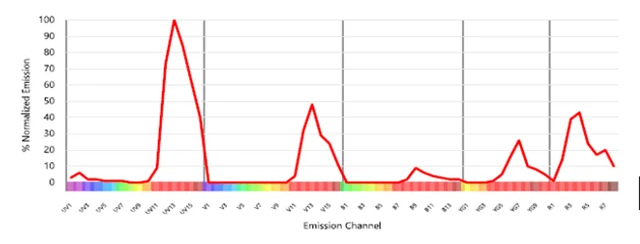
Fig. 2. StarBright UltraViolet Dye spectra. Normalized spectral profile of SBUV700 on a Cytek Aurora.
StarBright UltraViolet 770
SBUV770 has a unique peak emission in channel UV15 (5-L Cytek Aurora) or UV28 (5-L Sony ID7000), and although it has high similarity scores of 0.85 and 0.89 (5-L Cytek Aurora) or 0.83 and 0.83 (5-L Sony ID7000) with SBUV740 and SBUV795, respectively, it can be easily unmixed.
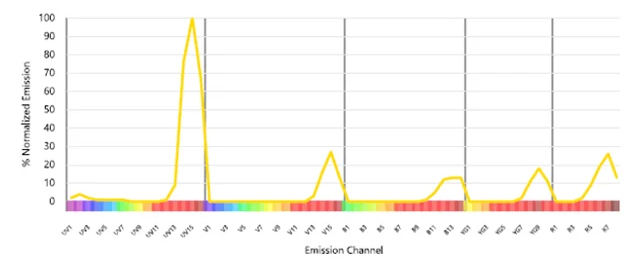
Fig. 3. StarBright UltraViolet Dye spectra. Normalized spectral profile of SBUV770 on a Cytek Aurora.
Spectral StarBright Violet Dyes
Table 2. Spectral StarBright Violet Dye range.
StarBright Dye |
Max Ex, nm |
Max Em, nm |
Brightness (1–5) |
5-L Cytek Aurora Primary Channel |
5-L Sony ID7000 Primary Channel |
|---|---|---|---|---|---|
|
StarBright Violet 535 Dye |
402 |
540 |
4 |
V7 |
V7 |
StarBright Violet 535
Excitable by the violet 405 nm laser and emitting at 540 nm, StarBright Violet 535 (SBV535) Dye is detected in channel V7 with minimal spread into other channels. This makes it a perfect replacement for Brilliant Violet 510 in spectral flow cytometry as it has a narrow emission, has low levels of cross-laser excitation, and is brighter. SBV535 has similarity scores of 0.73 and 0.68 (5-L Cytek Aurora) or 0.64 and 0.65 (5-L Sony ID7000) with SBV515 and SBV570, respectively, with low levels of spreading.
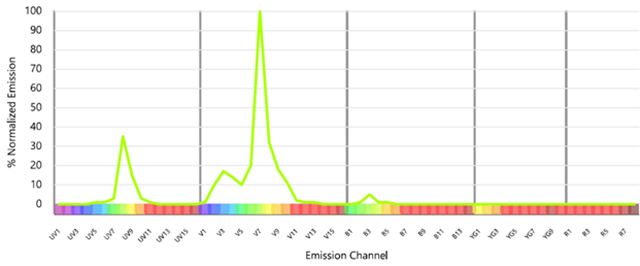
Fig. 4. StarBright Violet Dye spectra. Normalized spectral profile of SBV535 on a Cytek Aurora.
Spectral StarBright Dye Performance Data
Spectral StarBright Dyes are bright enough (Figures 5 and 6) to allow detection of rare populations with the usability for common immune lineages (Figure 7). Their compatibility with all 32 existing StarBright Dyes and other common fluorophores, low similarity scores to other StarBright Dyes (Figures 8 and 9), and minimal spreading (Figures 10 and 11) mean these new dyes are perfect for enhancing current spectral panels and provide greater flexibility when assembling panels of any dimension. For more information on their use in large spectral panels of over 30 markers on the Cytek Aurora and Sony ID7000, visit our conference poster page.

Fig. 5. Stain index of Spectral StarBright UltraViolet Dyes. Peripheral blood was stained with CD4 conjugated to each StarBright Dye, and the stain index was obtained to determine relative brightness on the A. Cytek Aurora and B. Sony ID7000.

Fig. 6. Stain index of Spectral StarBright Violet Dyes. Peripheral blood was stained with CD4 conjugated to each StarBright Dye, and the stain index was obtained to determine relative brightness on the A. Cytek Aurora and B. Sony ID7000.

Fig. 7. Performance of Spectral SBUV and SBV Dyes. Staining of two different peripheral blood samples with CD4SBUV540 (MCA1267SBUV540), CD8SBUV700 (MCA1226SBUV700), CD3SBUV770 (MCA463SBUV770), CD19SBV535 (MCA1940SBV535), and CD62LSBB675 (MCA1076SBB675) to identify B cells, T cells, and effector memory T cells on both the A. 5-L Cytek Aurora and B. 5-L Sony ID7000. Bio-Rad gratefully acknowledges the assistance of Jamie Evans, Flow Cytometry Core Facility Manager, Division of Medicine, Rayne Building, UCL, for providing access and assistance with their ID7000.

Fig. 8. Similarity scores of Spectral UltraViolet StarBright Dyes. Similarity scores of StarBright UltraViolet Dyes on A. 5-L Cytek Aurora and B. 5-L Sony ID7000.
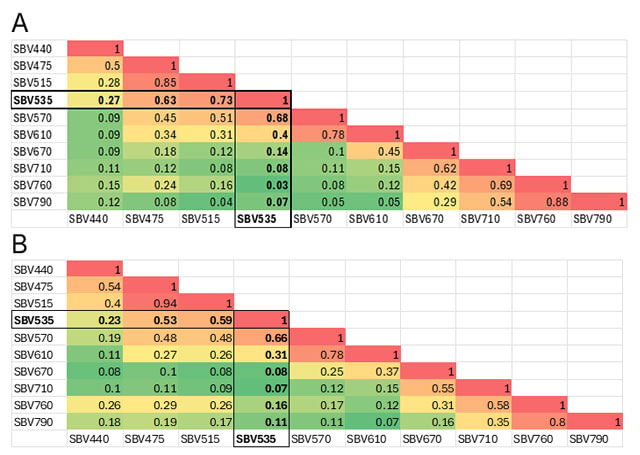
Fig. 9. Similarity scores of Spectral StarBright Dyes. Similarity scores of StarBright Violet Dyes on A. 5-L Cytek Aurora and B. 5-L Sony ID7000.

Fig. 10. Spreading of Spectral StarBright UltraViolet Dyes. Data were generated on the Cytek Aurora using SpectroFlo software.
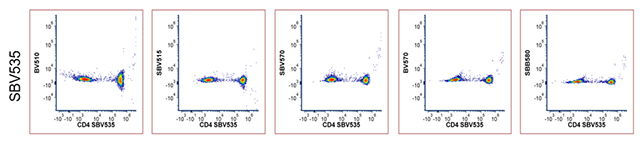
Fig. 11. Spreading of Spectral StarBright Violet Dyes.
Data were generated on the Cytek Aurora using SpectroFlo software.
StarBright Spectral Flow Cytometry Dye Range
| Description | Target | Format | Clone | Applications | Citations | Code |
|---|
Associated Reading
For more information on how the StarBright Dye range can fit into your flow cytometry experiments, please take a look at our StarBright Dyes page.
For more information on how these products can improve the effectiveness of your flow cytometry experiments, please take a look at our flow cytometry explained knowledge hub. Alternatively, feel free to explore the associated resource links below, for more in-depth information about each cited topic. If you are interested in learning the fundamentals of this application, please view our flow cytometry basics guide.
Resources for Flow Cytometry
Latest Resources
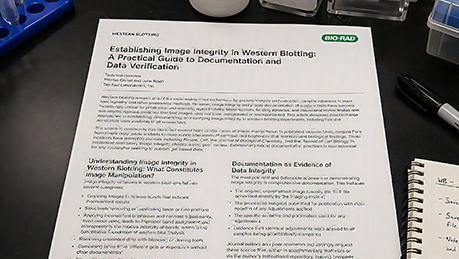
See the Truth in Every Band
A practical guide to western blot image integrity, documentation, and data verification.
Bio-Rad Academy — Fundamentals of Flow Cytometry
Enroll in Bio-Rad’s Fundamentals of Flow Cytometry Series, a free, online course that covers the basics of flow cytometry and experimental best practices.