Protocol: Preparation of Tissue Culture Cell Lines for Flow Cytometry
FC1
Cells used for flow cytometry experiments must be in a single-cell suspension; therefore, the most straightforward samples to prepare are fresh nonadherent tissue culture cell lines. This protocol describes methods for preparing nonadherent cells as well as adherent tissue culture cell lines and frozen cells.
For cells derived from other sources, refer to Bio-Rad’s protocol FC2 for the preparation of peripheral blood mononuclear cells and protocol FC3 for the preparation of cells from a variety of tissue sources including thymus, spleen, and bone marrow as well as for peritoneal macrophages.
A certain level of technical skill is required for the successful design and implementation of these techniques; these are guidelines only and may need to be adjusted for particular cell types or applications.
Reagents
- Phosphate Buffered Saline, 10x (PBS) (BUF036A)
- PBS containing 1% bovine serum albumin (PBS/BSA)
- 1x Accutase solution or 0.25% trypsin
- Cell culture medium
- Blocking reagent: Mouse Seroblock FcR (BUF041) or Human Seroblock (BUF070)
Method
Preparation of Cells Stored in Liquid Nitrogen
1. Carefully remove cells from liquid nitrogen storage.
2. Thaw cells rapidly in a 37°C water bath.
3. Resuspend cells in 10 mL cold PBS/BSA and transfer to a 15 mL conical centrifuge tube.
4. Centrifuge at 300–400 g for 5 min at 4°C and discard supernatant.
5. Resuspend cells in cold (4°C) PBS/BSA and adjust cell concentration to 1 x 10⁷ cells/mL.
Note: Higher viability can be obtained by allowing the cells to recover in cell culture medium overnight.
Preparation of Tissue Culture Cell Lines in Suspension
1. Decant cells from tissue culture flask into 15 mL conical centrifuge tube(s).
2. Centrifuge at 300–400 x g for 5 min at room temperature (RT) and discard supernatant.
3. Resuspend cells in 10 mL RT PBS/BSA.
4. Centrifuge at 300–400 x g for 5 min at RT and discard supernatant.
5. Resuspend cells in cold (4°C) PBS/BSA and adjust cell concentration to 1 x 10⁷ cells/mL.
Preparation of Adherent Tissue Culture Cell Lines
1. Harvest cells by enzymatic release using 1x Accutase solution or 0.25% trypsin, then quench with cell culture medium containing serum.
Note: Epitopes may be cleaved when using the enzymatic digestion method. Cells can also be harvested by gently scraping them into cell culture medium.
a. Remove the cell culture medium and eliminate residual serum by rinsing cell monolayers with sterile, RT PBS.
b. Slowly add 1x Accutase solution or 0.25% trypsin to cover the cell monolayer.
c. Incubate at 37°C for up to 10 min.
d. After incubation, gently tap the flask, and the cells will detach.
e. Add cell culture medium and resuspend the cells by gently pipetting.
2. Transfer cells to a 15 mL or 50 mL conical centrifuge tube, centrifuge at 300–400 x g for 5 min at RT, and discard supernatant.
3. Resuspend cells in fresh, RT PBS/BSA to wash off any remaining cell debris and proteins.
4. Centrifuge at 300–400 x g for 5 min at RT and discard supernatant.
5. Resuspend pellet in cold (4°C) PBS/BSA and adjust cell concentration to 1 x 10⁷ cells/mL.
Notes
- Ensure you prepare enough cells for your experiment. Typically, 106 cells are used for each flow cytometry sample
- To ensure that cells are in a single-cell suspension and to remove debris, pass samples through a 40 μm cell strainer just prior to counting
- Count cells using a hemocytometer or an automated cell counter such as the Bio-Rad TC20 Automated Cell Counter (1450102)
- It is best practice to block Fc receptors prior to antibody staining to avoid nonspecific binding. We recommend using Bio-Rad's Human Seroblock (BUF070) for blocking human cells and Bio-Rad's Mouse Seroblock FcR (BUF041) for blocking mouse cells
Flow Cytometry Resources
- View all flow cytometry antibodies
- Controls for flow cytometry
- Multicolor flow panel design
- Flow supporting reagents
Support
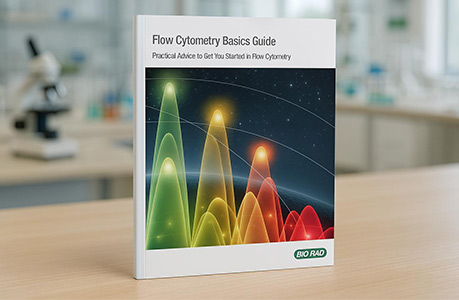
Flow Cytometry Basics Guide
Practical advice to get you started in flow cytometry
Keep up to date with recent advances by downloading our popular Flow Cytometry Basics Guide, which not only provides practical advice and best practice examples when planning multicolor experiments, but also a basic overview of all the important flow cytometry principles.
This comprehensive guide is split into nine easy-to-read chapters covering 54 pages, making this ideal for beginners wanting to gain confidence when planning experiments, and can also be used as a teaching aid.