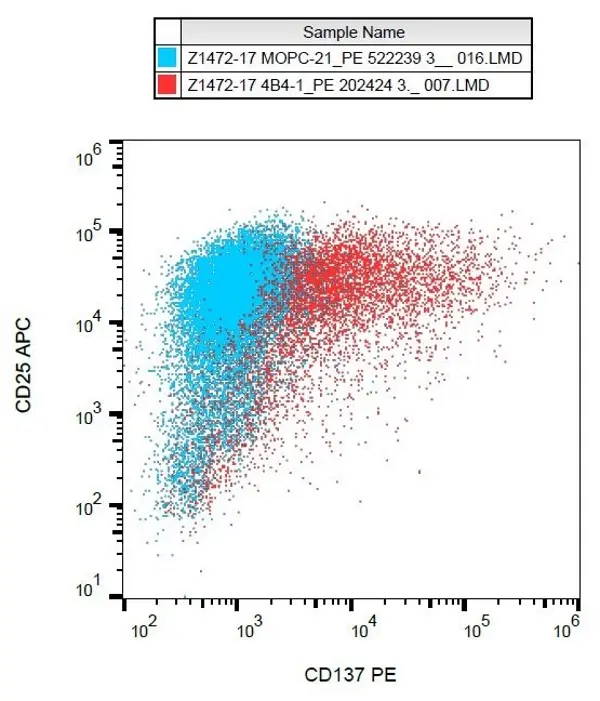
CD137 antibody | 4B4-1
Mouse anti Human CD137:APC
- Product Type
- Monoclonal Antibody
- Clone
- 4B4-1
- Isotype
- IgG1
- Specificity
- CD137
 Antibody Quality and Performance Guarantee


Filter by Application:
F Reset| Mouse anti Human CD137, clone 4B4-1 recognizes CD137. CD137 (also known as 4-1BB ligand receptor or TNFRSF9) is a type I transmembrane glycoprotein of the Tumor Necrosis Factor receptor family that is expressed on activated T and NK cells, dendritic cells, myeloid cells and at the surface of some non-lymphoid cells under specific conditions (Schwarz et al. 1995). CD137 acts as a receptor for 4-1BB ligand, expressed on activated macrophages, activated B cells, hematopoietic stem cells and myeloid progenitor cells (Pollock et al. 1994) and for some proteins of the extracellular matrix (Chalupny et al. 1992). The interaction between CD137 and 4-1BBL acts as a co-stimulatory signal for the activation, expansion and survival of T cells (Wen et al. 2002). CD137 signaling is involved in the generation of CD8+ T cells and enhance their cytotoxic activity (Shuford et al. 1997). Because of its ability to promote the anti-tumorigenic activity of cytotoxic T cells, CD137 is the target of several cancer immune therapies, such as the agonist anti-CD137 Urelumab (Segal et al. 2017) and Utomilumab (Chester et al. 2018). CD137 also binds to the adaptor proteins TRAF1, 2 and 3 to promote NF-kappaB activation (Jang et al. 1998). Mouse anti-human CD137, clone 4B4-1 has been reported to immunoprecipitate a homodimeric protein of 32kDa under reducing conditions and 85kDa under non-reducing conditions (Garni-Wagner et al. 1996). |
- Target Species
- Human
- Species Cross-Reactivity
-
Target Species Cross Reactivity Primate - N.B. Antibody reactivity and working conditions may vary between species.
- Product Form
- Purified IgG conjugated to Allophycocyanin (APC) - liquid
- Preparation
- Purified IgG prepared by affinity chromatography on Protein A from tissue culture supernatant
- Buffer Solution
- Phosphate buffered saline
- Preservative Stabilisers
- <0.1% Sodium Azide (NaN3)
0.2% Bovine Serum Albumin - Immunogen
- Recombinant human CD137 ectodomain
- Purity
- >95% by SDS PAGE
- Max Ex/Em
-
Fluorophore Excitation Max (nm) Emission Max (nm) APC 650 661 - Regulatory
- For research purposes only
- Guarantee
- Guaranteed for 12 months from the date of despatch or until the date of expiry, whichever comes first. Please see label for expiry date.
This product is shipped at ambient temperature.
Store at +4°C. DO NOT FREEZE.
This product should be stored undiluted. This product is photosensitive and should be protected from light.
Store at +4°C. DO NOT FREEZE.
This product should be stored undiluted. This product is photosensitive and should be protected from light.
This product has been reported to work in the following applications. This information is derived from testing within our laboratories, peer-reviewed publications or personal communications from the originators. Please refer to references indicated for further information. For general protocol recommendations, please visit the antibody protocols page.
| Application Name | Verified | Min Dilution | Max Dilution |
|---|---|---|---|
| Flow Cytometry |  |
Neat |
Where this product has not been tested for use in a particular technique this does not necessarily exclude its use in such procedures. Suggested working dilutions are given as a guide only. It is recommended that the user titrates the product for use in their own system using appropriate negative/positive controls.
- Flow Cytometry
- Use 10ul of the undiluted reagent to label 1x10⁶ cells in 100ul
How to Use the Spectraviewer
Watch the Tool Tutorial Video ▸- Start by selecting the application you are interested in, with the option to select an instrument from the drop down menu or create a customized instrument
- Select the fluorophores or fluorescent proteins you want to include in your panel to check compatibility
- Select the lasers and filters you wish to include
- Select combined or multi-laser view to visualize the spectra
| Description | Product Code | Applications | Pack Size | List Price | Your Price | Quantity | |
|---|---|---|---|---|---|---|---|
| Mouse IgG1 Negative Control:APC | MCA928APC | F | 100 Tests | Log in | |||
| List Price | Your Price | ||||||
| Log in | |||||||
| Description | Mouse IgG1 Negative Control:APC | ||||||
Further Reading
-
Chalupny, N.J. et al. (1992) T-cell activation molecule 4-1BB binds to extracellular matrix proteins.
Proc Natl Acad Sci U S A. 89 (21): 10360-4. -
Pollok, K.E. et al. (1994) 4-1BB T-cell antigen binds to mature B cells and macrophages, and costimulates anti-mu-primed splenic B cells.
Eur J Immunol. 24 (2): 367-74. -
Schwarz, H. et al. (1995) ILA, the human 4-1BB homologue, is inducible in lymphoid and other cell lineages.
Blood. 85 (4): 1043-52. -
Garni-wagner, B.A. et al. (1996) 4-1BB is expressed on CD45RAhiROhi transitional T cell in humans.
Cell Immunol. 169 (1): 91-8. -
Shuford, W.W. et al. (1997) 4-1BB costimulatory signals preferentially induce CD8+ T cell proliferation and lead to the amplification in vivo of cytotoxic T cell responses.
J Exp Med. 186 (1): 47-55. -
Wen, T. et al. (2002) 4-1BB ligand-mediated costimulation of human T cells induces CD4 and CD8 T cell expansion, cytokine production, and the development of cytolytic effector function.
J Immunol. 168 (10): 4897-906. -
Segal, N.H. et al. (2017) Results from an Integrated Safety Analysis of Urelumab, an Agonist Anti-CD137 Monoclonal Antibody.
Clin Cancer Res. 23 (8): 1929-1936. -
Chester, C. et al. (2018) Immunotherapy targeting 4-1BB: mechanistic rationale, clinical results, and future strategies.
Blood. 131 (1): 49-57.
- Synonyms
- TNFRSF9
- UniProt
- Q07011
- Entrez Gene
- TNFRSF9
- GO Terms
- GO:0004872 receptor activity
- GO:0005887 integral to plasma membrane
- GO:0006917 induction of apoptosis
- GO:0008285 negative regulation of cell proliferation
MCA6117APC
 149838
163817
169981
149838
163817
169981
If you cannot find the batch/lot you are looking for please contact our technical support team for assistance.
View more products with CD137 specificity
Please Note: All Products are "FOR RESEARCH PURPOSES ONLY"
View all Anti-Human ProductsAlways be the first to know.
When we launch new products and resources to help you achieve more in the lab.
Yes, sign me up