
Technical Note: 10-Color Canine Immunophenotyping Panel Featuring StarBright™ Dye—Conjugated Antibodies
 Technical Note:
10-Color Canine Immunophenotyping Panel Featuring StarBright™ Dye–Conjugated Antibodies
Abstract
Dogs are highly valued as companion and working animals but remain susceptible to multiple diseases, including cancer and inflammatory conditions, with far fewer treatment options than humans. Understanding their immune system can help diagnose disease and guide the most appropriate treatments.
Immunophenotyping by flow cytometry provides an accurate profile of immune status, supporting research aimed at improving treatments, particularly when dogs serve as models of human diseases. This technical note presents a validated 10-color immunophenotyping panel to identify canine T-cell subsets, B cells, natural killer (NK) cells, monocytes, and granulocytes, incorporating new canine StarBright Dye–conjugated antibodies.
Introduction
Immunophenotyping using flow cytometry provides information on immune status, aiding disease diagnosis, guiding treatment options, and assessing treatment effectiveness. In veterinary medicine, immunophenotyping of blood samples to detect aberrant immune cell populations is used for the diagnosis of canine leukemia (Sánchez-Solé et al. 2022).
Currently, flow cytometry panel sizes for dogs are relatively small, typically limited to eight colors, restricting the number of immune cell subsets that can be identified in a single assay. Expanded panels are needed to obtain more detailed immunological profiles and to identify more distinct cell populations. Identifying these immune populations may be critical for accurate diagnosis and determining disease progression and prognosis.
To expand panel size, anti-canine flow antibodies must be conjugated to a wider selection of fluorophores beyond phycoerythrin (PE) and fluorescein isothiocyanate (FITC). Bio-Rad has an expanded portfolio of fluorophore-conjugated anti-dog antibodies, including StarBright Dyes. This study presents a validated 10-color panel designed to identify multiple canine immune cell types, including T cells, B cells, NK cells, monocytes, and granulocytes. This panel enables the high-resolution detection of key cell populations not identifiable with smaller panels and can serve as a backbone for further panel expansion.
Materials and Methods
Panel Design
For optimal results, panel design best practices should be followed to generate high-quality data. Bio-Radʼs Multicolor Panel Builder and Fluorescence Spectraviewer tools were used in panel design.
- Markers were selected to identify T cells, B cells, NK cells, monocytes, and granulocytes. Antibodies detecting these markers were raised against canine antigens or showed species cross-reactivity. The anti-human CD14 clone TUK4 is the most published cross-reactive antibody in veterinary immunophenotyping
- The samples were acquired on a five-laser (5-L) ZE5 Cell Analyzer (Bio-Rad Laboratories, Inc., 12014135) with UV option A. Bio-Radʼs Multicolor Panel Builder and Fluorescence Spectraviewer helped select suitable fluorophores based on their excitation and emission wavelengths
- The panel was designed to minimize spillover and spread by distributing fluorophores across the 5 lasers and detectors of the ZE5 Cell Analyzer. Supplementary Tables 1 and 2 show spillover and spread
- To reduce spreading effects, fluorophore pairs with higher spread were placed on mutually exclusive cells to enable clear population identification. The largest spread in the panel was between StarBright Violet 670 (SBV670) and StarBright Blue 675 (SBB675) Dyes; although minimal (value of 2.9), these fluorophores were nevertheless used to detect antigens expressed on different cell types — CD4+ T helper cells and NK cells
- Heparinized fresh blood was stored at 4°C before use. A live/dead dye, 4ʼ6-diamidino-2-phenylindole (DAPI), was included to eliminate any dead cells, which could result in false-positive signals due to nonspecific binding
The list of antibodies and live/dead dye used in the panel is shown in Table 1.
Table 1. Antibodies and viability dye in the canine multiplex panel.
Target |
Fluorophore |
ZE5 Cell Analyzer Target Laser: Filter |
Bio-Rad Catalog |
|---|---|---|---|
|
MHCII |
SBUV400 |
355: 387/11 |
|
|
Viability dye |
DAPI |
355: 509/25 |
|
|
CD5 |
PB |
405: 460/22 |
|
|
CD4 |
SBV670 |
405: 670/30 |
|
|
CD3 |
FITC |
488: 525/35 |
|
|
CD14 |
SBB675 |
488: 692/80 |
|
|
CD21 |
PE |
561: 583/30 |
|
|
CD18 |
PE-Cy7 |
561: 750LP |
|
|
CD94 |
A647 |
640: 670/30 |
|
|
CD8 |
A700 |
640: 720/60 |
* Conjugated to PE-Cy7 using a LYNX Rapid PE-Cy7 Antibody Conjugation Kit (Bio-Rad, LNK114PECY7).
** Cross-reactive antibodies.
A647, Alexa Fluor 647; A700, Alexa Fluor 700; Cy7, cyanine 7; DAPI, 4ʼ6-diamidino-2-phenylindole; FITC, fluorescein isothiocyanate; MHC, major histocompatibility complex; PB, Pacific Blue; PE, phycoerythrin; SBB, StarBright Blue; SBUV, StarBright UltraViolet; SBV, StarBright Violet.
Staining Protocol and Data Collection
Canine peripheral blood was treated with Red Cell Lysing Buffer (Bio-Rad, BUF04) to remove red blood cells. White blood cells were then blocked in 10% canine serum for 5 min at room temperature (RT), followed by incubation for 1 hr at RT with the fluorescent dye–conjugated monoclonal antibodies shown in Table 1. After incubation, samples were washed three times in phosphate buffered saline (PBS) with 1% bovine serum albumin (BSA) (PBS/BSA) and resuspended in 200 µL PBS/BSA. PUREBLU DAPI (Bio-Rad, 1351303) was added 5 min prior to acquisition.
For compensation controls, UltraComp eBeads Compensation Beads (ThermoFisher Scientific Inc., 01- 2222-41) were incubated with a single antibody, and cells were incubated with PUREBLU DAPI. All antibodies were titrated before use and used at the optimal dilution.
Samples were acquired on a 5-L ZE5 Cell Analyzer with UV option A. A total of 150,000 cells were acquired for the multiplex panel, and 30,000 beads or cells for single-stained controls.
Gating Strategy
Analysis was performed using FCS Express 7 (De Novo Software by Dotmatics). Dead cells were first excluded from downstream analysis by gating on DAPI-negative cells. Doublet discrimination was used to identify single cells. The major cell populations — lymphocytes, monocytes, and granulocytes — were identified based on forward scatter area (FSC-A) and side scatter area (SSC-A). Additional cell populations were identified using downstream gating strategies, as shown in Figure 2.
Results
An immunophenotyping panel was developed to identify T-cell, B-cell, NK-cell, monocyte, and granulocyte lineages. Within the T-cell lineage, CD4+ T helper and CD8+ cytotoxic subsets were also clearly identified (Figures 1 and 2). The spillover and spreading matrices for the panel are shown in Appendix Tables 1 and 2.
Basic Gating
All populations were identified using a basic gating strategy to first remove dead cells and doublets. Then, forward and side scatter (FSC and SSC) were used to identify mononuclear cells and granulocytes (Figure 1).
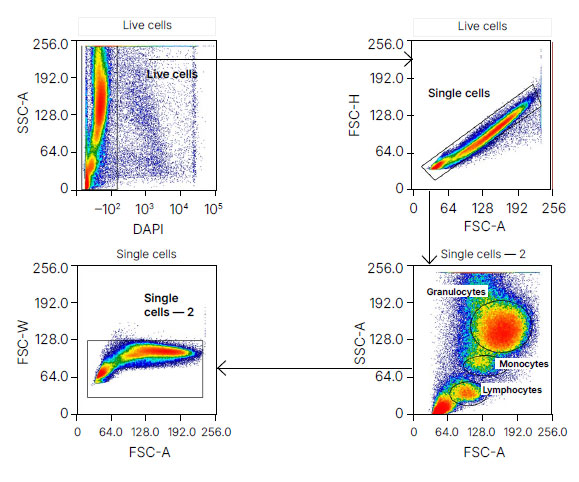
Fig. 1. Basic gating strategy.
The mononuclear cell population was identified after gating on live, single cells. A, area; DAPI, 4ʼ6-diamidino-2-phenylindole; FSC, forward scatter; H, height; SSC, side scatter; W, width.
Lymphocyte, Monocyte, and Granulocyte Gating
Downstream of the lymphocyte gate, antibodies against CD4 and CD8 were used to identify T-cell subpopulations within the major histocompatibility complex (MHC) II-positive, CD5-positive, CD3-positive populations (MHCII+CD3+CD5+). As CD4 and CD8 are also expressed on other immune cell types in dogs (Table 2), gating was first performed on the pan-T cell markers CD3 and CD5 before identifying these subpopulations.
Within the lymphocyte gate, CD21 was used to detect B cells and CD94 to detect NK cells (Figure 2).
Monocytes were initially gated using FSC/SSC parameters, and their identity was confirmed by MHC II and CD14/CD18 expression. Similarly, granulocytes were identified using FSC/SSC parameters and CD4/CD18 expression (Figure 2).
Table 2. CD4 and CD8 expression in canine peripheral blood.
| CD4 expression | CD8 expression | |
|---|---|---|
| Cytotoxic T cells | X | ✅ |
| Helper T cells | ✅ | X |
| B cells | X | X |
| NK cells | X | Some subsets |
| Monocytes | Some subsets | Some subsets |
| Neutrophils | ✅ | X |
| DCs | Some subsets | Some subsets |
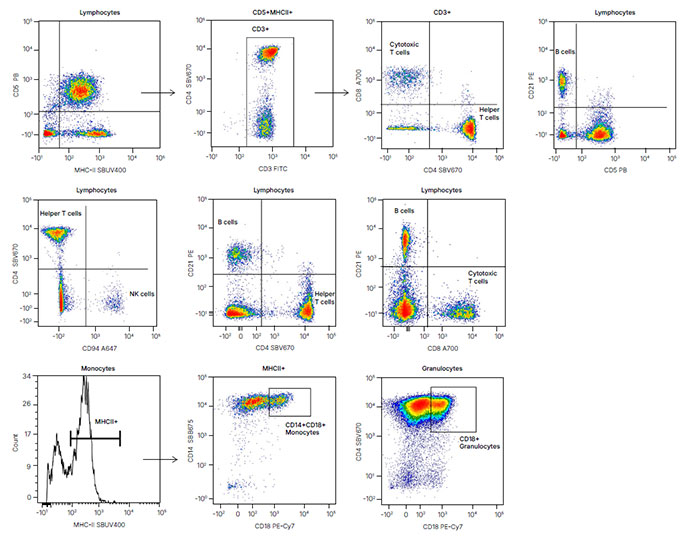
Fig. 2. T-cell, B-cell, NK-cell, monocyte, and granulocyte populations. The cells were further analyzed to identify CD4+ helper T cells, CD8+ cytotoxic T cells, B cells, NK cells, monocytes, and granulocytes. A647, Alexa Fluor 647; A700, Alexa Fluor 700; Cy7, cyanine 7; FITC, fluorescein isothiocyanate; MHC, major histocompatibility complex; NK, natural killer; PB, Pacific Blue; PE, phycoerythrin; SBB, StarBright Blue; SBUV, StarBright UltraViolet; SBV, StarBright Violet.
Conclusions
A 10-color immunophenotyping panel was successfully designed to identify key immune cell populations in dogs. Major observations included:
- Simple gating strategy — all major immune cell populations in canine blood were identified, along with their marker expression profiles, including cytotoxic T cells (MHCII+CD5+CD3+CD8+), T helper cells (MHCII+CD5+CD3+CD4+), B cells (CD5–CD21+), NK cells (CD94+), monocytes (MHCII+CD14+), and granulocytes (CD18+)
- Low spillover and spread values — adherence to panel design best practices resulted in very low compensation and spreading values (see Appendix). This led to high cell resolution and a clear separation of positive and negative signals, allowing all major populations and subpopulations to be clearly identified
- No special staining buffer required — staining in the basic staining buffer PBS with 1% BSA eliminated the need for additional staining buffers, reducing cost while fitting into existing workflows
This new 10-color canine immunophenotyping panel enables the identification of six distinct immune cell types. In addition, the inclusion of CD18 (β2 integrin), expressed on most leukocytes, allows the detection of canine leukocyte adhesion deficiency (CLAD), as the loss of CD18 expression is a hallmark of the disease in this population.
The incorporation of StarBright Dye–conjugated antibodies was key to success, allowing the identification of additional immune cell populations in a single experiment. StarBright Dyes also allowed for the consolidation of multiple smaller panels into one, removing the need for separate runs when, for example, an initial lymphocyte panel did not provide sufficient data for a diagnosis. This single panel provides a deeper understanding of the immune system, aiding in diagnosis and disease monitoring. Finally, the use of directly conjugated antibodies eliminated the need for secondary antibodies, enabling a single-step process that reduced time and removed potential cross-reactivity, ensuring more reliable results.
Visit bio-rad-antibodies.com/dog-canine-antibodies for more information on the expanding canine flow antibody range.
Appendix
Supplementary Table 1. Spillover matrix.
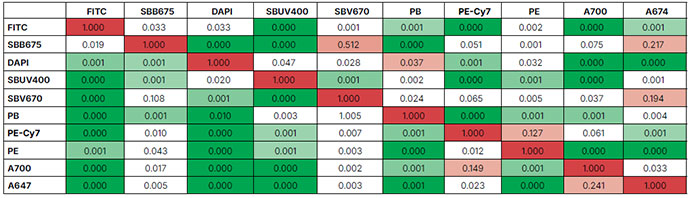
Values represent the amount of spillover for each fluorophore. The rows show the fluorophore, and the columns display the signal present in each detector. Colors progress from green to white to red as more spillover is present. Green indicates no or very low spillover, whereas red indicates more spillover is present between the two fluorophores. A647, Alexa Fluor 647; A700, Alexa Fluor 700; Cy7, cyanine 7; DAPI, 4ʼ6-diamidino-2-phenylindole; FITC, fluorescein isothiocyanate; PB, Pacific Blue; PE, phycoerythrin; SBB, StarBright Blue; SBUV, StarBright UltraViolet; SBV, StarBright Violet.
Supplementary Table 2. Spreading matrix.
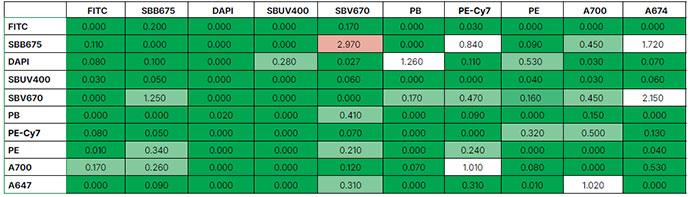
Values indicate the spillover spreading (SS) amount for each fluorophore into all detectors. The rows show the fluorophore-donated SS, and the columns display the detector-collected SS. Colors progress from green to white to red as more spreading is present. 0–3 indicates no or very low spreading. A647, Alexa Fluor 647; A700, Alexa Fluor 700; Cy7, cyanine 7; DAPI, 4ʼ6-diamidino-2-phenylindole; FITC, fluorescein isothiocyanate; PB, Pacific Blue; PE, phycoerythrin; SBB, StarBright Blue; SBUV, StarBright UltraViolet; SBV, StarBright Violet.
Reference
- Sánchez-Solé R et al. (2022). The use of flow cytometry for diagnosis and immunophenotyping in chronic lymphocytic leukemia in a dog: clinical case report. Open Vet J 12, 868–876.
Visit bio-rad-antibodies.com/dog-canine-antibodies for more information.