Chapter 3: Immunodetection
Overview
After blotting, the target protein will be detected using appropriately matched and labeled antibodies . The typical immunodetection stage involves a few basic steps:
- Blocking - The blot containing the transferred protein bands is incubated with a protein or detergent solution which covers the entire surface so that antibodies do not bind non-specifically to the membrane.
- Antibody incubation - Labeled antibody binds to the target protein band present on the blot in a one-step or two-step procedure.
- Detection with substrate - The label attached to the antibody, usually an enzyme such as HrP (Horseradish Peroxidase), is detected using a substrate which produces a visible signal corresponding to the position of the target protein.
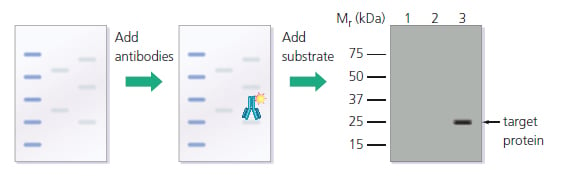
Fig.10. Immunodetection Overview. The Western blot is blocked, incubated with antibodies, and treated with substrate to make the target protein visible . Wash steps are carried out between incubations to remove excess unbound material and to minimize non-specific signal on the immunoblot.
Popular Resources
Generate Western Blot Data You Can Trust
Best practices for image documentation, integrity, and verification.
TidyBlot Western Blot Detection Reagent:HRP
TidyBlot Reagent:HRP is a western blotting detection reagent that specifically binds to native (non-reduced) antibodies.