
StarBright Dyes in Single Molecule Flow Cytometry
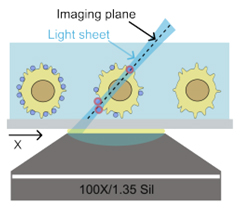
Fig. 1. Schematic of the smFC system integrating oblique light-sheet illumination/detection and enabling volumetric imaging.
Overview
Traditional flow cytometry is powerful for high-throughput analysis of cell populations but is limited in sensitivity due to cellular autofluorescence and ensemble fluorescence detection, making it unable to detect proteins present at fewer than roughly 100–1,000 molecules per cell.
This limitation prevents the identification of rare proteins and weak signaling events that are important in biology and medicine.
A new technique, single molecule flow cytometry (smFC) (Rahmani et al. 2025), utilizes the exceptional brightness, photostability, and large Stokes shift of StarBright™ Dyes to significantly advance the sensitivity of flow cytometry for detecting and quantifying low-abundance membrane proteins on cells.

Fig. 2.
smFC enables quantification of low-abundance c-kit expression on TNBC cells. smFC histogram showing c-kit detection on MDA-MB-468 cells, revealing a subpopulation with detectable surface expression. Bars are shifted for visual interpretation. The insets show representative images of a control (no primary) cell and SBB700/c-kit-labeled cells. Scale bar = 10 µm.
Images taken from Rahmani et al. 2025.
Using smFC, StarBright Dyes allow:
• Detection of labeled membrane proteins with digital precision, far below the detection limit of standard flow cytometry
• Quantification of the distribution of the c-kit membrane receptor on triple-negative breast cancer (TNBC) cells, improving characterization
• Identification of rare biomarkers and precise quantification of low-abundance, targetable surface molecules as novel biotherapeutic targets
• Reliable single molecule counting
Find out more about StarBright Dyes in other applications such as microscopy, flow cytometry, and western blot.
-
StarBright Dyes
If you are interested in purchasing StarBright Dyes that have not been conjugated to an antibody, simply complete and submit a short form and a member of our team will respond to your inquiry. -
StarBright Dye–Conjugated Antibodies
If you have a question about StarBright Dye–conjugated antibodies, simply complete and submit a short form and a member of our team will respond to your inquiry. -
StarBright Dyes — Collaboration
If you are interested in StarBright Dyes and have an idea for a collaborative project, simply complete our short form and a member of our team will respond.