
StarBright Dyes in Microscopy
Introduction
StarBright™ Dyes are a range of superior fluorophores that are bright, fixable, and have narrow emission profiles that do not require a special buffer when staining. We have shown StarBright Dyes give excellent staining in conventional and spectral flow cytometry in panels of any size. However, the stability of StarBright Dyes and the narrow emission profiles also make them excellent dyes for use in fluorescent imaging applications such as wide field microscopy, confocal microscopy, and spatial biology.
Furthermore, TrailBlazer™ Tag and StarBright Dye Label Kits allow you to label any antibody to generate your own high-quality primary or secondary conjugates, expanding multiplexing capabilities with StarBright Dyes.
StarBright Dyes Tested
Tables 1 and 2 list the StarBright Dyes that have been tested so far, which have given positive results in either widefield or confocal techniques using primary or secondary antibodies in single-color experiments.
StarBright Dyes are also suitable for multiplexing, but it will depend on the other fluorophores in the panel, the markers being stained, and the microscope configuration. Figure 1 shows representative StarBright Violet 670 staining, allowing identification of CD3 T cells in a cryosection of human lymph node, and shows compatibility with Alexa 647 and DAPI, common fluorophores and dyes used in microscopy.
Table 1. Widefield microscopy.
Excitation Max |
StarBright Dyes |
||
|---|---|---|---|
|
355 nm |
|
|
|
|
405 nm |
|
||
|
488 nm |
|||
|
561 nm |
|
|
|
Table 2. Confocal microscopy.
Excitation Max |
StarBright Dye |
||||
|---|---|---|---|---|---|
|
405 nm |
|||||
|
488 nm |
|
|
|||
|
561 nm |
|
|
|
|
|
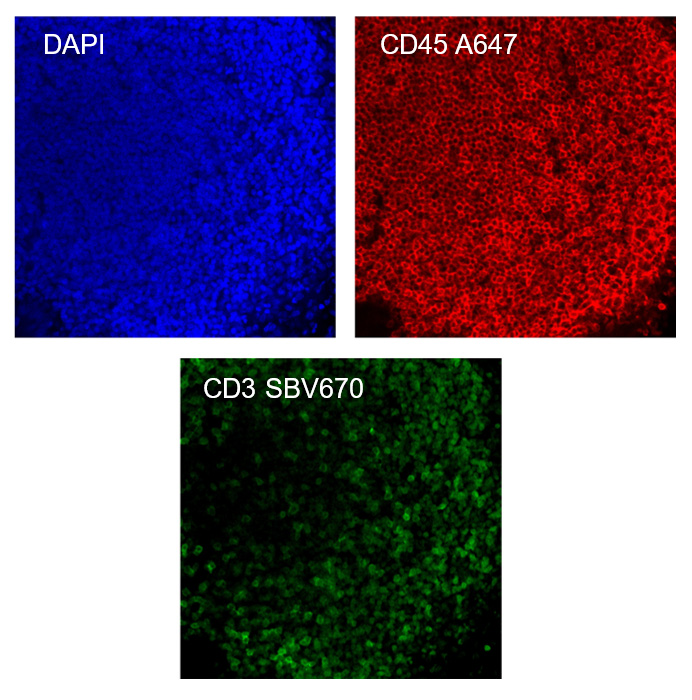
Fig. 1. StarBright Violet 670 can be used in imaging. Human lymph node cryosections stained with CD45A647 (red), CD3SBV670 (green), and DAPI (blue) to identify T cells within a follicle using confocal fluorescence microscopy.
Stability of StarBright Dyes
Not all bright dyes used in flow cytometry, such as PE and PE-tandems, are suitable for use in microscopy as they are easily bleached. The stability of StarBright Dyes increases the choice of dyes available, particularly those dyes excitable by wavelengths of 488–561 nm as it takes longer to bleach StarBright Dyes. Figure 2 shows an example of the stability of SBY605 compared to PE-Dazzle 594 when used to stain PBMCs with CD3.
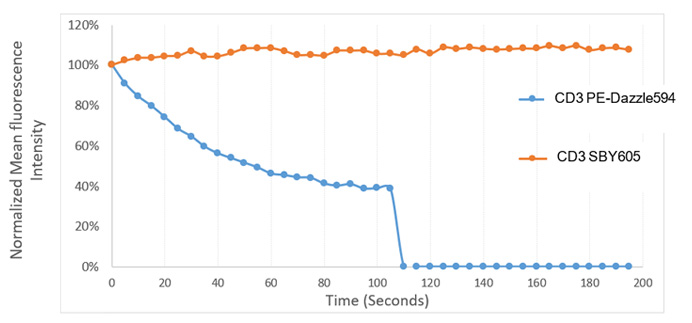
Fig. 2. StarBright Yellow 605 stability. Human PBMCs were stained for 1 hr at room temperature and mounted in PBS containing 0.03% NaN3 prior to imaging. Images were taken every 5 seconds on a Nikon Ti confocal microscope, and the mean fluorescence intensity was measured and compared to the initial intensity.
Mounting media can also be very important in microscopy, as it can help preserve the fluorescent signal for analysis at a later date. We stained PBMCs with CD3 SBY605 (MCA463SBY605) and mounted in various specialized mounting media or PBS (see table 3), and compared the staining after 1 week stored at 4°C. As can be observed in Figure 3, there was little or no reduction in the signal intensity after storage for 1 week, regardless of the mounting media used.
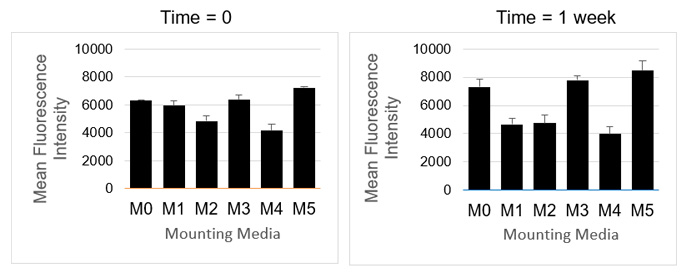
Fig. 3. StarBright Yellow 605 is compatible with multiple mounting media. Human PBMCs were stained for 1 hr at room temperature and mounted in various mounting media. Images were taken immediately or after 1 week of storage at 4°C and the mean fluorescence intensity was measured.
Table 3. Mounting media used in Figure 3.
Number |
Mounting Media |
|---|---|
|
M0 |
0.03% NaN3 PBS |
|
M1 |
Thermo Fisher — ProLong Diamond |
|
M2 |
Thermo Fisher — SlowFade Diamond |
|
M3 |
Thermo Fisher — Fluoromount-G |
|
M4 |
Vector Lab — Vibrance |
|
M5 |
Bio-Rad — Mounting Media |
Multiplexing StarBright Dyes
StarBright Dyes require no special buffer for multiplexing with each other in flow cytometry, so to confirm compatibility in microscopy, we stained PBMCs for 1 hr at room temperature in PBS containing 1% BSA with multiple StarBright Dye–conjugated antibodies and imaged using confocal microscopy. We chose three StarBright Dyes that have distinct emission profiles with limited spillover into neighboring channels to avoid signal interference. As can be seen in Figure 4, we could identify CD4 and CD8 positive T cells in the PBMCs.
As with all multiplex panels, careful experimental setup is required, such as the choice of fluorescent dyes and which antigens are to be detected to reduce signal bleedthrough into other channels. Of note, use of spectral unmixing, detector narrowing, and careful staining to ensure fluorophores with bleedthrough are on mutually exclusive antigens is required for optimizing any multiplex staining.
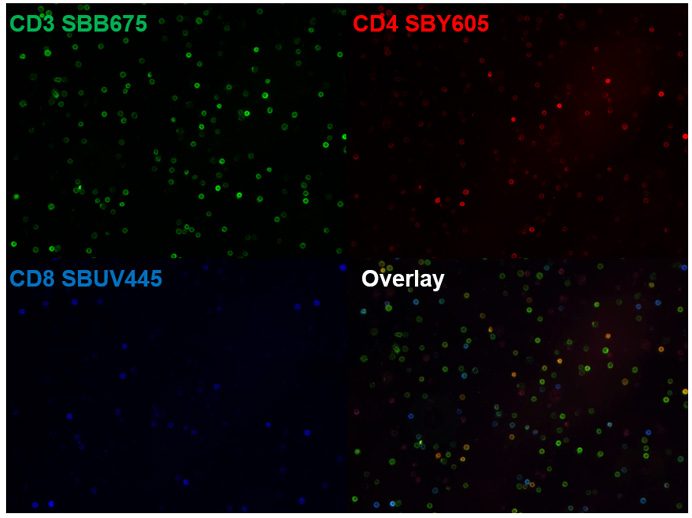
Fig. 4. StarBright Dyes can be multiplexed in microscopy. Human PBMCs were stained for 1 hr at room temperature with CD3 SBB675, CD4 SBY605, and CD8 SBUV445 and mounted in Bio-Rad Mounting Media (30403). Images were taken with a Nikon Ti confocal microscope at 20x magnification.
Antibody Compatibility
Staining of samples for flow cytometry is usually performed on live cells. However, many tissue samples for microscopy are paraffin-embedded and FFPE tissue requires antigen retrieval. Not all antibodies are able to bind this non-native form of the antigen.
Use the handy search table below to find immunofluorescence (IF) and FFPE-compatible antibodies. This table allows you to find antibodies that are conjugated to StarBright Dyes and those that are able to be conjugated using the TrailBlazer Antibody Labeling Kit.
IF and FFPE Compatible Antibodies
| Description | Target | Format | Clone | Applications | Citations | Code |
|---|
Biotin-Labeled Antibodies for Signal Amplification
While secondary antibodies are an effective form of signal amplification for multicolor applications, biotinylated antibodies are also an effective solution. We have streptavidin available conjugated to all StarBright Dyes, allowing easy incorporation of any biotinylated antibody into multicolor or single staining experiments.
Antibody Labeling Kit
If we don’t have the antibody you are looking for conjugated to StarBright Dyes, you are missing a vital antibody, or require signal amplification by using secondary antibodies, the TrailBlazer Antibody Labeling Kit is available. Using this robust and stable kit, you can label any antibody of choice with any StarBright Dye in just a few steps with minimal hands-on time.
Microscopy Publication
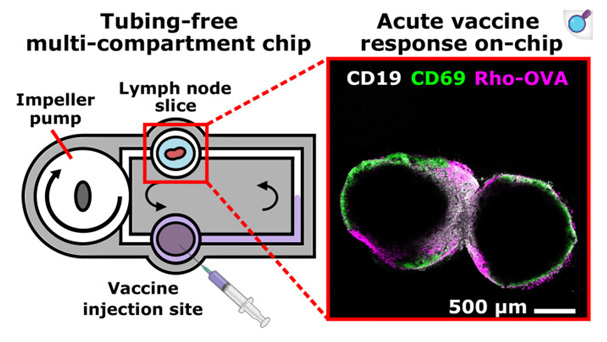
Using CD19SBV670 (MCA1439SBV670), murine B cells were able to be identified in a multi-organ-on-chip system where a model of the acute response to vaccination in murine lymph node slices could be investigated. Antigen drainage and processing, early markers of activation, and changes in gene expression were all measured.
A 3D-printed multi-compartment organ-on-chip platform with a tubing-free pump models communication with the lymph node (Cook et al. 2025).
Summary
StarBright Dyes are a new range of bright, stable, and flexible dyes that can be added to almost any multiplexing antibody panel. Although designed for flow cytometry, they have been tested in various microscopy platforms with fantastic results as bright and stable dyes that can be easily multiplexed.
The StarBright Dye range will add choice and flexibility to microscopy staining. Being large and fixable and with the availability of a conjugation kit, almost any antibody can be labeled with any color to give more choice, simplify panel building, and allow bigger multiplex panels to be built.
Find out more about StarBright Dyes in other applications such as microscopy, flow cytometry, and western blot.
-
StarBright Dyes
If you are interested in purchasing StarBright Dyes that have not been conjugated to an antibody, simply complete and submit a short form and a member of our team will respond to your inquiry. -
StarBright Dye–Conjugated Antibodies
If you have a question about StarBright Dye–conjugated antibodies, simply complete and submit a short form and a member of our team will respond to your inquiry. -
StarBright Dyes — Collaboration
If you are interested in StarBright Dyes and have an idea for a collaborative project, simply complete our short form and a member of our team will respond.