
Flow Cytometry Guide: Intracellular Antigens
Overview
Staining intracellular antigens like cytokines can be difficult because antibody-based probes cannot pass easily through the plasma membrane into the interior of the cell. In order to accomplish this, cells should first be fixed in suspension and then permeabilized before adding the fluorophore. This allows probes to access intracellular structures while leaving the morphological scatter characteristics of the cells intact. Octylphenol ethoxylate is one example of a permeabilization reagent (Figure 18). There are also many commercial kits available today that provide the reagents to carry out these crucial steps, for example, Leucoperm™.
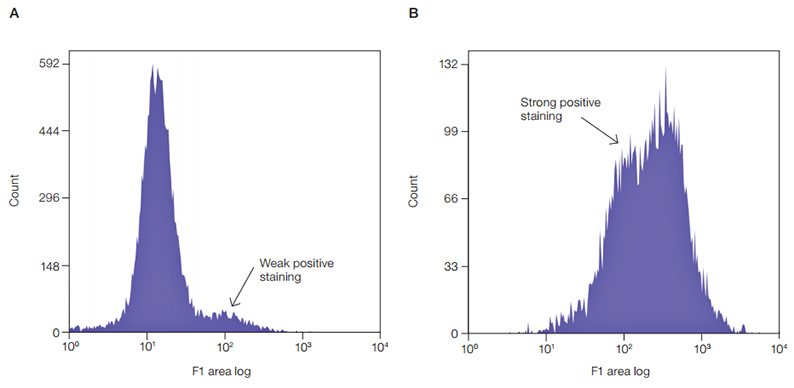
Fig. 18. 0.1% octylphenol ethoxylate used in conjunction with phalloidin, which recognizes and binds to filamentous actin. A, before treatment of cells; B, after fixation and permeabilization. Notice how distinctive the positive dataset becomes. FL, fluorescence.
Popular Resources

Blog: Sample Preparation in Flow Cytometry — Tips & Tricks
In this blog, we provide tips and advice on generating a high-quality sample for flow cytometry.
Quick Guide: How to Implement an Effective Flow Cytometry Gating Strategy
Download this quick guide to learn how to develop effective flow cytometry gating strategies, avoid common pitfalls such as false positives and missed rare populations, and generate reliable, reproducible data through a systematic approach to panel design and analysis.