
Flow Cytometry for Immunology Research and Immune Profiling
Flow Cytometry in Immunology Research
Flow cytometry is a foundational technology for building an understanding of the immune system. It is the gold standard technology for identifying and quantifying cell subsets in a heterogeneous mixture of cells, such as that found in the blood, a technique known as immunophenotyping, largely due to the degree of multiplexing that can be achieved and the speed at which data can be acquired.
Already know what you're looking for?
These advantages have allowed researchers to quantify cell populations with subtle and unique phenotypes that exist at tens or hundredths of a percentage of the total cellular population.
Recent advances in flow cytometry have accelerated complex immunophenotyping, enabling deeper insights into immune system function. This article highlights how researchers use tools like the ZE5 Cell Analyzer to enhance our understanding of immunity and drive new therapeutic development.
New Webinar
Advance Vaccine Development with T-Cell-Driven Immunity
How Understanding T Cells Could Prevent Future Pandemics
Advancing High-Parameter Immunophenotyping
Expanding Immunophenotyping Capabilities with Advanced Instrumentation
 Immunophenotyping remains a primary application underpinning the prominent role of flow cytometry in immunology research. The development of advanced high-parameter flow cytometry instruments has enabled researchers to significantly enhance both the breadth and depth of their immunophenotyping panels, leading to unprecedented discoveries. StarBright™ Dyes support this progress by offering a wider selection of fluorophores, delivering outstanding brightness, and allowing for efficient premixing—all of which contribute to improved assay efficiency and reproducibility.
Complex immunophenotyping often involves the identification and quantification of phenotypes that are uncommon, making up less than one percent of the overall cellular content. To measure these cell types accurately requires the acquisition of a large number of cells in order to capture a significant number of rare cell types. This increases the length of time needed to acquire data from each sample and can result in lengthy read times if a large number of samples are analysed.
Improving Speed and Throughput with the ZE5 Cell Analyzer
The ZE5 Cell Analyzer solves this problem with an industry-leading acquisition rate of 100,000 events per second, meaning that even rare phenotypes can be reliably measured in just a few seconds. Additionally, the ZE5 Cell Analyzer comes equipped with a high-throughput sampling mode that speeds up transition between samples.
The combined result of high acquisition speed and fast sample transition allows the ZE5 Cell Analyzer to perform complex immunophenotyping faster than any other instrument.
High-Parameter Panel Design and Marker Coverage
To test this capability, we developed a 27-color immunophenotyping panel using StarBright Dyes.
Target |
ZE5 Cell Analyzer Target Laser: Filter |
Fluorophore |
Antibody Catalog Number* |
|---|---|---|---|
|
HLA DP DQ DR |
355: 387/11 |
SBUV400 |
|
|
CD20 |
355: 509/24 |
SBUV510 |
|
|
CD33 |
355: 577/15 |
SBUV575 |
|
|
Live/dead |
355: 615/24 |
PI |
|
|
CD163 |
355: 670/30 |
SBUV665 |
|
|
CD28 |
355: 747/33 |
SBUV740 |
|
|
CD62L |
355: 780LP |
SBUV795 |
|
|
CD56 |
405: 420/10 |
BV421 |
BioLegend, #318327 |
|
CD24 |
405: 460/22 |
SBV440 |
|
|
CD45RA |
405: 525/50 |
SBV515 |
|
|
CD45RO |
405: 615/24 |
SBV610 |
|
|
CD40 |
405: 670/30 |
SBV670 |
|
|
CD2 |
405: 720/50 |
SBV710 |
|
|
CD14 |
405: 750LP |
SBV790 |
|
|
CD57 |
488: 525/35 |
FITC |
|
|
CD3 |
488: 593/52 |
SBB580 |
|
|
CD11b |
488: 692/80 |
SBB700 |
|
|
HLA ABC |
488: 750LP |
SBB810 |
|
|
CD10 |
561: 583/30 |
SBY575 |
|
|
CD4 |
561: 615/24 |
SBY605 |
|
|
CD45 |
561: 670/30 |
SBY665 |
|
|
CD27 |
561: 720/60 |
SBY720 |
|
|
CD38 |
561: 750/LP |
SBY800 |
|
|
CD16 |
640: 670/30 |
A647 |
|
|
CD31 |
640: 720/60 |
A700 |
MCA1738A700 |
|
CD19 |
640: 775/50 |
SBR775 |
|
|
CD8 |
640: 800LP |
SBR815 |
* Antibodies are available from Bio-Rad unless otherwise noted.
A647, Alexa Fluor 647; A700, Alexa Fluor 700; BV, Brilliant Violet; FITC, fluorescein isothiocyanate; PI, propidium iodide; SBB, StarBright Blue; SBR, StarBright Red; SBUV, StarBright UltraViolet; SBV, StarBright Violet; SBY, StarBright Yellow.
Performance and Reproducibility of High-Throughput Acquisition
Samples acquired in normal and high-throughput mode revealed a high level of reproducibility across all subpopulations examined. These data confirm the utility of the ZE5 Cell Analyzer for analysis of high-parameter data in high-throughput mode and demonstrate that high-parameter immunophenotyping data can be collected at speeds more commonly associated with lower-parameter screening assays.
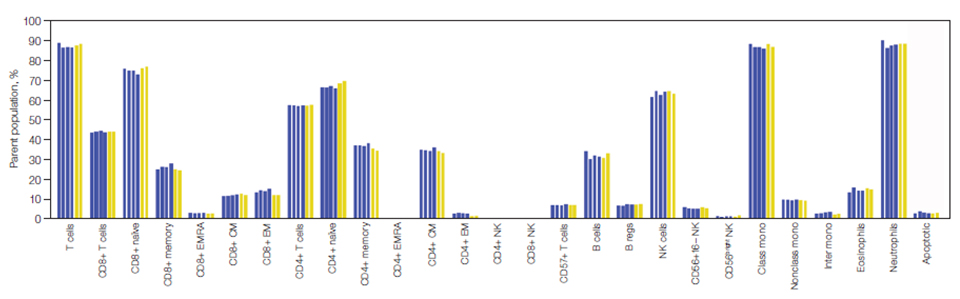
Comparison of data acquired in standard and high-throughput mode on the ZE5 Cell Analyzer. Cell lineages are expressed as a percentage of their parent cell population. Each bar represents an individual replicate collected in high-throughput mode ( ■ ) and standard mode ( ■ ). B regs, regulatory B cells; class mono, classical monocytes; CM, central memory T cells; EM, effector memory T cells; EMRA, terminally differentiated effector memory cell re-expressing CD45RA T cells; Inter mono, intermediate monocytes; NK, natural killer cells; NKT, natural killer T cells nonclass mono, nonclassical monocytes.
Read the full application note
Applications of Flow Cytometry in Immunology Research
Case Study: T Cell Responses in Betacoronavirus Research
The global research community has been using the ZE5 Cell Analyzer to power their immunology research and publish cutting-edge articles in some of the most prestigious journals.
Highly conserved betacoronavirus sequences are broadly recognized by human T cells →
Pereira Neto et al. (2025).
Cell 188, 5653–5665.e12.
Pereira Neto et al. sought to establish a strategy for the development of vaccines that confer broad immunity to betacoronaviruses, such as severe acute respiratory syndrome coronavirus (SARS-CoV), Middle East respiratory syndrome (MERS), and SARS-CoV-2. By combining epitome mapping with sequence conservation analysis and an activation-induced marker flow cytometry assay, they demonstrated T-cell cross-reactivity for multiple betacoronavirus subgenera, laying the groundwork for a multi-antigen vaccine strategy for a broad spectrum of betacoronaviruses.
Here flow cytometry was used to assess T-cell activation, measured by the expression of specific activation markers. Using this technique, the authors found that T cell epitope regions (CTERs) of the SARS-CoV-2 proteome within the spike protein elicited less response than non-spike CTERs, confirming that spike CTER regions do not encompass most of the immunogenicity. Spike CTER regions consistently elicited T cell responses that recognize multiple viruses, leading the authors to suggest that betacoronaviruses may promote T cell cross-reactivity in individuals exposed to SARS-CoV-2.
Case Study: Immunotherapy and Nanoparticle-Induced Immune Responses
Self-assembled STING-activating coordination nanoparticles for cancer immunotherapy and vaccine applications →
Sun et al. (2024).
ACS Nano18, 10439–10453.
The cGAS-STING pathway plays a crucial role in innate immune activation against cancer and infections. Sun et al. developed an immunostimulatory system for stimulator of interferon genes (STING) agonists utilizing a coordination nanoparticle composed of a crystal structure of cyclic dinucleotides, zinc, and manganese. They demonstrated robust antitumor efficacy in mice and showed that the nanoparticle elicited strong cellular and humoral immune responses that neutralized SARS-CoV-2.
Flow cytometry was used extensively throughout this study, most notably to assess the antitumor immune response of nanoparticles by the measurement of CD8+ T-cell responses, which showed a greater than 2-fold increase in the number of infiltrating CD8+ T-cells in the nanoparticle-treated group compared to controls. Flow cytometry was also used to demonstrate significant expansion of NK cells as well as high NK-cell activation in tumor-draining lymph nodes.
On-Demand
Metalloimmunotherapy as a Novel Approach to Cancer Treatment
Learn How Leveraging the Immune-Modulating Functions of Metal Ions Promotes a STING-Mediated Immune Response.

A synthetic metastatic niche reveals antitumor neutrophils drive breast cancer metastatic dormancy in the lungs →
Wang et al. (2023).
Nat Commun14, 4790.
The formation of secondary tumors is a crucial factor influencing the survival rate of breast cancer patients. Colonization of a distant organ begins at a metastatic niche, but its progression is strongly influenced by the nature of the metastatic niche itself, leading tumor cells to proliferate or become dormant. Using synthetic biomaterial scaffolds to mimic metastatic organs, Wang et al. make the case for neutrophils as key mediators in regulating metastasis and identify osteopontin and decorin as proteins with great immunotherapeutic potential to drive breast cancer metastatic dormancy.
Flow cytometry was used extensively throughout this study. The presence of tumor cells expressing fluorescent proteins in tissue and the metastatic niche was confirmed following injection in a metastatic model. Flow cytometry was also used for the phenotypic characterization, quantification, and analysis of activation and polarization markers of immune cells in synthetic scaffolds and tissue of mice. By labeling neutrophils with a fluorescent dye, the authors were able to track the migration of an N1 neutrophil subset and show that they accumulated at metastatic niches that expressed a specific chemokine profile.
Flow Immunophenotyping Tools & Services
Building new immunophenotyping panels can be challenging. We have developed a range of resources that can help you get the most out of your flow cytometer regardless of manufacturer or configuration.
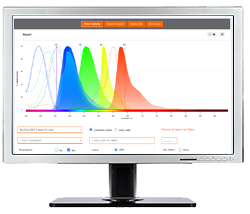
Spectraviewer
Check fluorophore compatibility and avoid excessive cross-laser excitation and compensation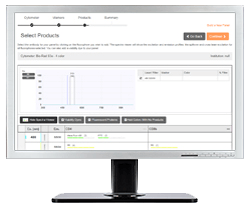
Panel Builder
Design the right panel for your instrument quickly and easily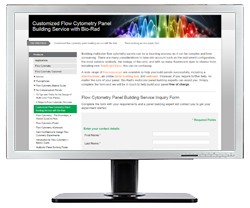
Custom Free Flow Cytometry Panel Building Service
Don’t know where to start? Get in touch and we will be happy to design a custom panel specific to your needsDriving Immunology Research Forward with Flow Cytometry
Flow cytometry and immunophenotyping are synonymous with immunology research. With the power of the ZE5 Cell Analyzer and StarBright Dyes, you can get brighter, better, and faster flow cytometry data and take your immunology research to the next level.
If you would like to speak to a flow cytometry specialist, contact us today.
Learn what flow cytometry brings to the field of immunology. Read about groundbreaking immunology research and how new flow cytometry dyes and instrumentation can improve your immunology research.