StarBright Dyes
Bright Reagents for Bright Ideas
Bio-Rad’s innovative StarBright™ Dyes have been specifically designed to fit seamlessly into your multicolor panels.
Their exceptional brightness, narrow excitation and emission characteristics, and compatibility with different buffers help you effortlessly address common assay challenges and build bigger, better panels with ease.
Discover the vast range of StarBright Dyes across each laser line or explore our collection of resources created to support you in getting the most out of your experiments.

StarBright Dye Range
Discover the vast range of StarBright Dyes for accurate target detection across laser lines and species.
StarBright Dye Benefits
StarBright Dyes address common challenges in multicolor assays, helping you get more from your experiments.
StarBright Dye Inquiry Forms
Ready to enhance your experiments? Fill out an inquiry form to learn more about StarBright Dyes.
StarBright Dye Range
Bio-Rad offers a range of StarBright Dyes, excitable by ultraviolet, violet, blue, yellow/green, and red lasers, conjugated to highly cited immunophenotyping targets in various species, including humans and mice.
Designed for exceptional brightness, minimal spectral overlap, and optimal resolution, they ensure high-quality staining and reliable performance across flow cytometers and buffers, enabling researchers to expand panel complexity without compromising data quality.
Exceptional Brightness
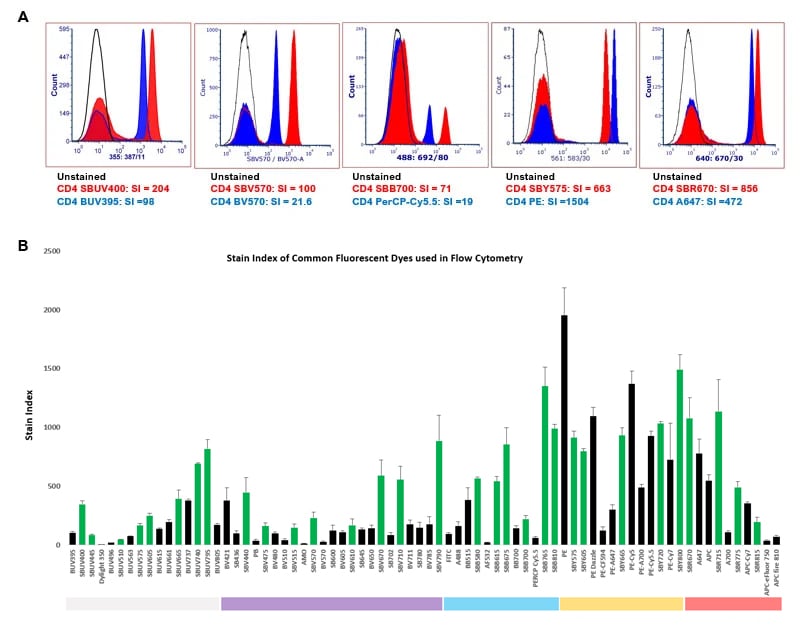
Designed to be as bright, or brighter than competitor dyes. The exceptional brightness of StarBright Dyes allows detection of rare and low antigen density populations with excellent separation of positive from negative populations.
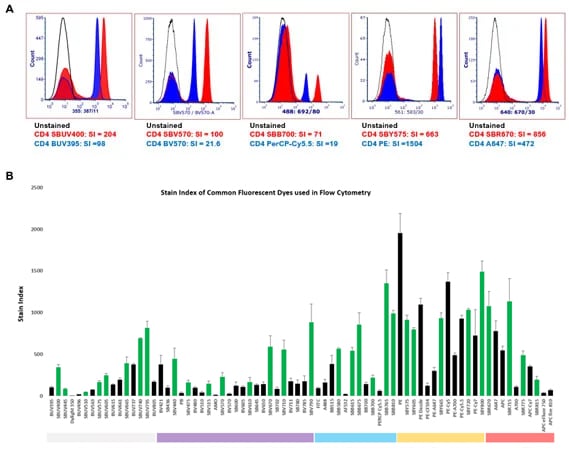

Fig. 1. StarBright Dyes are designed to be brighter than competitor dyes. A, examples of CD4 staining for 355 nm, 405 nm, 488 nm, 561 nm, and 640 nm excitable StarBright Dyes compared to competitors. B, stain index of human peripheral blood stained with various StarBright, Brilliant Violet, Super Bright, and other common dyes conjugated to CD4 (MCA1267). Data is the average of 3-4 donors generated on the ZE5 Cell Analyzer.
Narrow Excitation and Emission
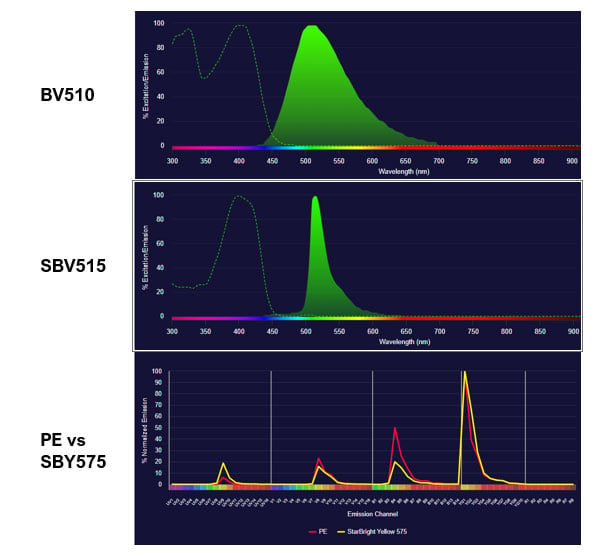
Reduced excitation by other common laser lines with narrow emission spectra to minimize spillover and spreading make StarBright Dyes an ideal choice for inclusion in multicolor panels. Use our Spectraviewer, which now also includes a spectral analyzer view, to find the right StarBright Dye for your experiment.
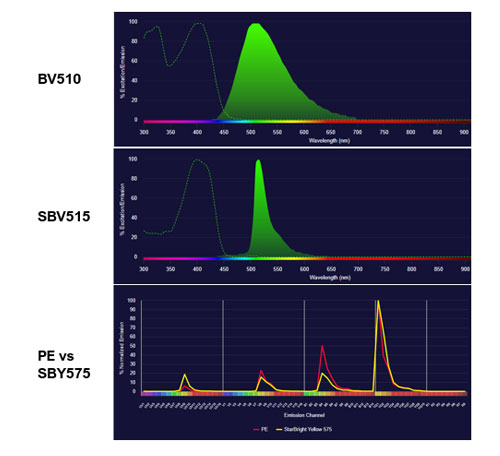
Fig. 2. Examples of improved spectral characteristics of StarBright Dyes. Reduced excitation by the 355 nm laser and narrower emission for StarBright Violet 515 Dye compared to Brilliant Violet 510. Spectral analyzer view showing reduced excitation of StarBright Yellow 575 Dye (yellow) by the 488 nm laser compared with PE (red).
Flexible to Work in All Buffers
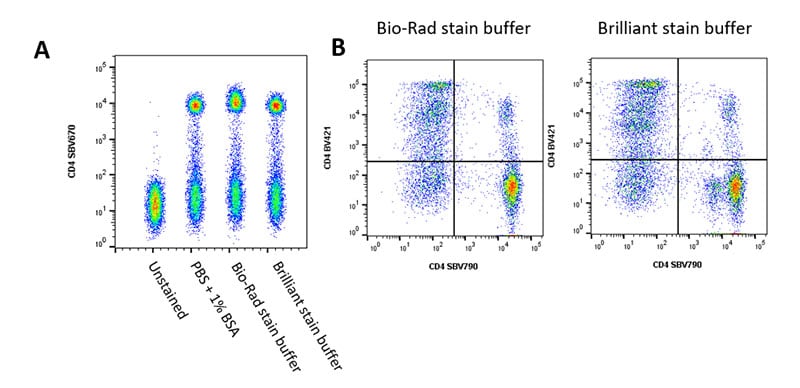
StarBright Dyes have no drop in performance regardless of the staining buffer, and do not require a special staining buffer when multiplexing with each other. However, if special buffers are required due to the presence of multiple polymer dyes in your panel, the flexibility of StarBright Dyes means you will still achieve bright, reliable staining.
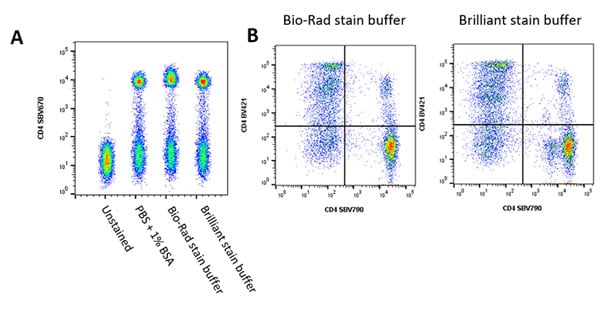
Fig. 3. Examples of staining of human peripheral blood in different buffers. A, no change in CD4 staining (MCA1267SBV670) is observed, regardless of the buffer. B, StarBright Dyes, in this case CD4SBV790 (MCA1267SBV790), work well in both Bio-Rad Staining Buffer or Brilliant Staining Buffer with one Brilliant Violet Dye. Data generated on the ZE5 Cell Analyzer.
Compatible with All Instruments and Reagents
Designed for multiplexing using the ZE5 Cell Analyzer, StarBright Dyes are suitable for cell analysis or cell sorting on any instrument with the appropriate lasers and filters. StarBright Dyes are compatible with all fluorescently-labeled antibodies and can even be added to premixed cocktails without the need for experimental changes. Furthermore, their unique spectra make them ideal for incorporating into spectral flow cytometry panels with novel dye combinations now possible.
Below are thumbnails of posters which show examples of high parameter panels in conventional and full spectrum flow cytometry. These, along with other useful flow cytometry posters, can be downloaded for your own use.
The Use of New StarBright Dyes in Spectral Flow Cytometry
27-color spectral panel built using StarBright Dyes and a spectral flow cytometer.

Consistent Staining
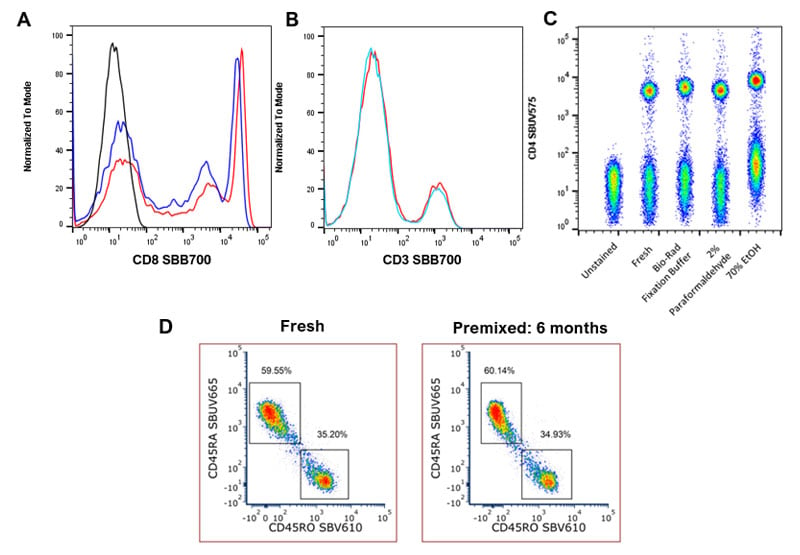
Designed with minimum lot-to-lot variability, StarBright Dyes give the same level of staining and population identification regardless of the batch. Unlike some polymer and other dyes, they are not traditional tandem dyes and therefore exhibit less cross-laser excitation, emitted by the donor and acceptors in tandem dyes, due to insufficient FRET. They are resistant to photobleaching, stable without loss of performance over time, and can be fixed in paraformaldehyde or alcohol-based fixatives with no drop in signal or change in their spectral characteristics. Conveniently, they can even be premixed and stored at 4oC for up to six months without loss of performance for use at a later date. To help you get consistently reproducible results, refer to the StarBright Dyes staining protocol.
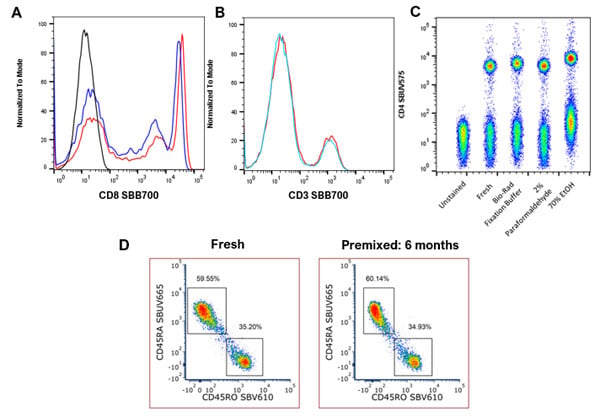
Fig. 4. StarBright Dyes — consistent, stable, fixable, and premixable. StarBright Dyes show consistent results regardless of the lot. A, multiple batches were used to stain peripheral blood mononuclear cells with CD8SBB700 (MCA1226SBB700), and the results overlaid on a histogram. B, stability and within-lot reproducibility confirmed by staining murine peripheral blood with CD3SBB700 (MCA500SBB700) from two different vials of the same lot, one of which was freshly opened and the other opened and stored for over 15 months at 4ºC. C, fixation in Bio-Rad Fixation Buffer, 2% PFA in PBS or 70% EtOH does not result in loss of signal. D, comparison of staining of human blood with a fresh or premixed StarBright Dye panel stored at 4ºC for up to six months. Data generated on the ZE5 Cell Analyzer.
On Common Immunophenotyping Targets
StarBright Dyes are available directly conjugated to antibodies validated for flow cytometry to detect human and mouse targets, and streptavidin for binding to biotinylated antibodies. These antibodies are well-known clones which are highly cited, giving you confidence in your experiments.
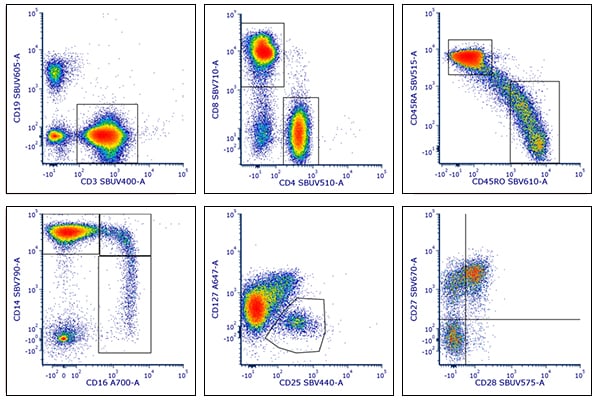
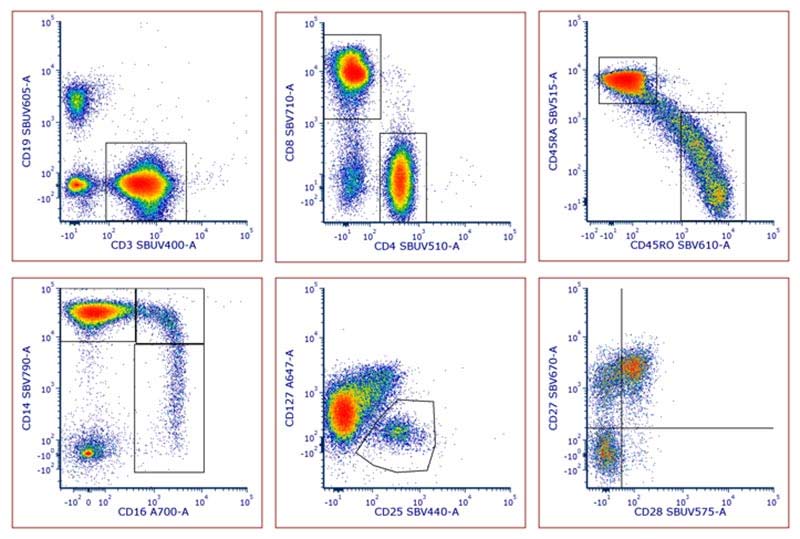
Fig. 5. Examples of staining of common immunophenotyping markers using StarBright Dyes. Human peripheral blood was stained for CD3 (MCA463SBUV400), CD19 (MCA1940SBUV605), CD4 (MCA1267SBUV510), CD8 (MCA1226SBV710), CD25 (MCA2127SBV440), and CD127 (HCA145A647) to identify B and T lymphocytes and T helper, T cytotoxic cells, and T regulatory cells within the T cell population. Classical, intermediate, and nonclassical monocytes were identified using CD14 (MCA16568SBV790) and CD16 (MCA2537A700). Further characterization of the T helper cells was obtained from CD45RA (MCA88SBV515) and CD45RO (MCA461SBV610) to identify naïve and memory cells, and the co-stimulation marker expression on T regulatory cells was measured by CD27 (MCA755SBV670) and CD28 (MCA709SBUV575) levels. Data generated on the ZE5 Cell Analyzer.
StarBright Dye Applications
Conventional Flow
StarBright Dyes are superior dyes designed using the ZE5 Cell Analyzer with features that make flow cytometry easier.
Explore the range of 32 StarBright Dyes, suitable for use on conventional flow cytometers and excitable by the five common lasers. StarBright Dyes give reproducible results in any experiment and have been proven in panels up to 27 colors on the ZE5 Cell Analyzer. See how these antibodies could improve your flow cytometry experiments.
Search all StarBright Dye–conjugated antibodies
Complete range of StarBright Dyes suitable for conventional flow cytometry.
Spectral Flow
StarBright Dyes have been shown to be excellent in full spectrum flow cytometry. With unique spectra, and now the release of novel dyes designed using full spectrum instruments StarBright Dyes offer increased flexibility and choice when panel building and allow creation of large panels of over 40 markers.
Explore the benefits of StarBright Dyes in full spectrum flow, find out more about our new range of spectral specific dyes now available.
Search all StarBright Dye–conjugated antibodies
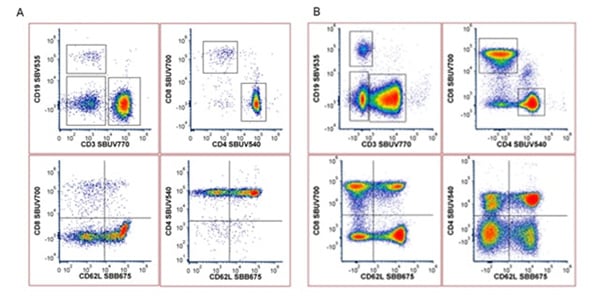
Performance of Spectral SBUV and SBV Dyes. Staining of two different peripheral blood samples with CD4SBUV540 (MCA1267SBUV540), CD8SBUV700 (MCA1226SBUV700), CD3SBUV770 (MCA463SBUV770), CD19SBV535 (MCA1940SBV535), and CD62LSBB675 (MCA1076SBB675) to identify B cells, T cells, and effector memory T cells on both the A. 5-L Cytek Aurora and B. 5-L Sony ID7000. Bio-Rad gratefully acknowledges the assistance of Jamie Evans, Flow Cytometry Core Facility Manager, Division of Medicine, Rayne Building, UCL, for providing access and assistance with their ID7000.
Microscopy
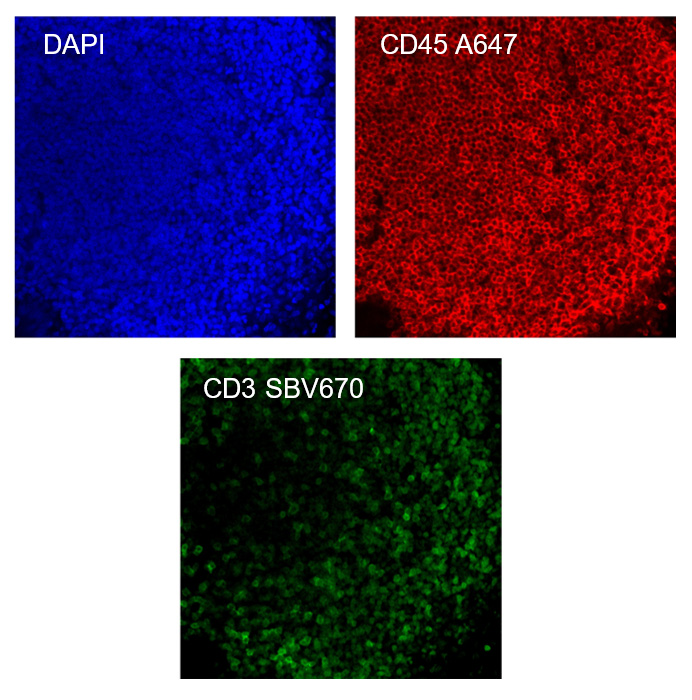
The stability of StarBright Dyes and their narrow emission profiles makes them excellent dyes for use in fluorescent imaging applications such as wide field microscopy and confocal microscopy.
Find a StarBright Dye for your next experiment
Droplet Assays
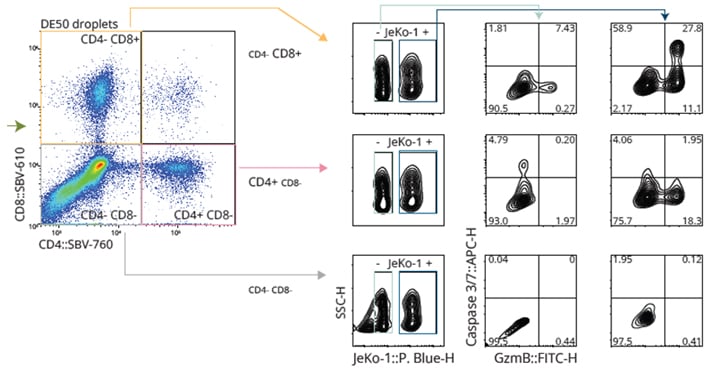
Using Xdrop® single-cell technology from Samplix, and StarBright Dyes, CAR T cells and CD19-expressing target cells can be co-encapsulated in double-emulsion droplets and cytotoxic activity at single-cell resolution can be quantified.
Staining CAR T cells with markers to identify cytotoxic and helper T cells, such as CD4SBV760 and CD8SBV610, allows more detailed information to be obtained.
Single Molecule Flow
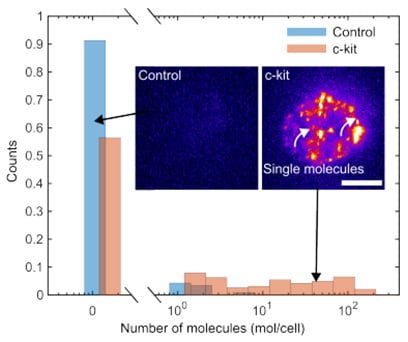
Single-molecule flow cytometry (smFC) uses oblique plane microscopy with microfluidics to achieve optical sectioning and photon collection efficiencies suitable for single-molecule detection on flowing cells.
This technique, requiring very bright fluorescent dyes such as StarBright Dyes, overcomes the sensitivity limit of conventional flow, allowing detection of low-abundance proteins and weak signaling events with biological importance and therapeutic potential.
IBEX
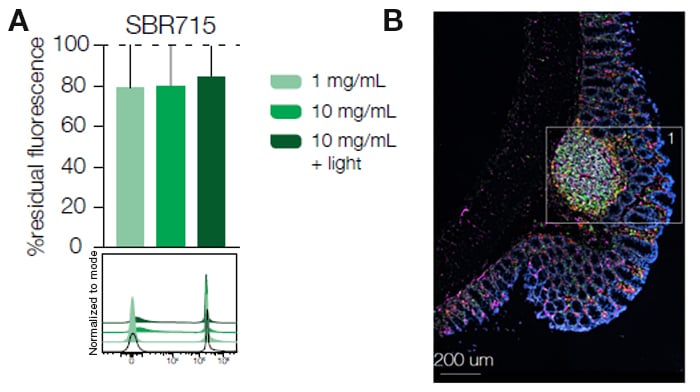
IBEX (iterative bleaching extends multiplexity) is a cost-effective and accessible high-content imaging technique using commercially available reagents and microscopes for spatial phenotyping in both animal and human tissues.
Not only are StarBright Dye–conjugated antibodies ideal for use in this technique, the stability of some StarBright Dyes when samples are iteratively bleached make them ideal as a fiducial to allow sample alignment of each cycle of staining.
Find out more
See How Bio-Rad’s StarBright Dyes Offer Exceptional Brightness and Easy Integration into Your Flow Cytometry Experiments for Improved Immunophenotyping Results
Latest Resources

Webinar: Insights from the IMMPROVE Consortium: Standardized High-Dimensional Flow Cytometry
Join the webinar led by Oliver Burton to gain insights into the effective design of a standardized, high-dimensional spectral flow cytometry platform with up to 77 markers and 53 colors, and learn how to address the challenges of instrument variability and user experience across multiple sites.
Benefits and Pitfalls of Fixing Cells in Flow Cytometry
Discover how StarBright Dyes display minimal signal loss and reproducible spectra under both formaldehyde- and alcohol-based fixation protocols, making them an ideal choice for multicolor panel building
Tech Note: Measure Multiple Parameters in Stimulated PBMCs
Integrating the measurement of multiple parameters in flow saves time and maximizes the information obtained from each sample. We describe a validated method to simultaneously measure cell proliferation, viability, activation status, and immunophenotype.- StarBright Dyes If you are interested in purchasing StarBright Dyes that have not been conjugated to an antibody, simply complete and submit a short form and a member of our team will respond to your inquiry.
- StarBright Dye–Conjugated Antibodies If you have a question about StarBright Dye–conjugated antibodies, simply complete and submit a short form and a member of our team will respond to your inquiry.
- StarBright Dyes — Collaboration If you are interested in StarBright Dyes and have an idea for a collaborative project, simply complete our short form and a member of our team will respond.
Stay Updated with Our Flow. Sorted. Newsletter
Sign up for our monthly dedicated flow cytometry newsletter and stay ahead with the latest product updates, expert insights, and valuable resources — delivered straight to your inbox. Designed to help you achieve more with confidence, our newsletter gives you access to:
- Free, practical resources including technical notes, posters, and expert tips
- Proven troubleshooting guidance to help solve real-world challenges
- Early access to innovative products and powerful new online tools
-
Exclusive invitations to upcoming webinars and training events