
CAR T-Cell Therapy — Driving the Future of Cancer Treatment
- Sep 16, 2025
- 3 min read
- Sindhu Nair, PhD
Chimeric antigen receptor (CAR) T-cell therapy has recently been making headlines and hailed as a potential panacea for conditions spanning from cancers to autoimmune diseases. Cancer care is increasingly shifting toward a more personalized approach that involves tailoring therapies to an individual cancer type and its molecular characteristics. Immunotherapy involves harnessing an individual’s immune system to fight cancer, offering several advantages over traditional chemotherapies, which follow a one-size-fits-all approach.
Rapid advances in CAR T-cell engineering have allowed it to become an established therapy for hematologic malignancies (Cappell and Kochenderfer 2023). However, CAR T-cell therapy has not found much success in solid tumors owing to tumor heterogeneity, immunosuppressive microenvironments, and poor T cell infiltration. In this article, we discuss a recent pioneering study from China that used CAR T-cell therapy in a subset of gastric cancer patients (Qi et al. 2025).
How Does CAR T-Cell Therapy Work?
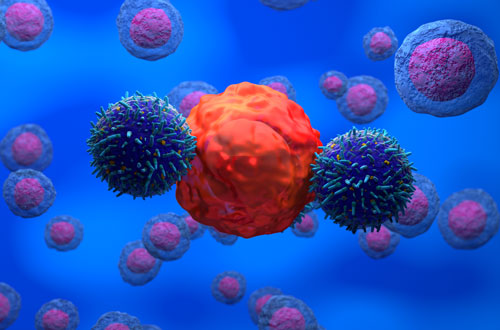
CAR T-cell therapy involves T cells that are genetically engineered to express chimeric antigen receptors on their surface, specific to antigens present in a tumor. CD19, for example, is a tumor-specific antigen found in most lymphomas and leukemias. T cells are extracted from patient blood samples, engineered in the lab, expanded, and then reinfused into the patient. These CAR T cells recognize and bind to the corresponding antigen on the tumor cells’ surface and trigger a cytotoxic effect, killing cancer cells. Currently, six CAR T-cell therapies are FDA-approved, including four targeting CD19 and two targeting BCMA, a member of the tumor necrosis family, highly expressed in multiple myelomas (Brudno et al. 2024).
CAR T-Cell Therapy in Solid Tumors
Compared to hematological malignancies, solid tumors are harder to target due to the absence of tumor-specific antigens and the presence of antigen heterogeneity within tumors. Additionally, CAR T cells have to infiltrate a hostile tumor microenvironment that is immunosuppressive and utilizes mechanisms to evade detection by CAR-T cells. Unlike hematologic malignancies, which frequently share similar antigen profiles, for example, the expression of CD19, solid tumors do not share a common antigen that can be targeted (Chen 2024).
Recently, the first randomized phase 2 clinical trial of CAR T-cell therapy in solid tumors was conducted in China (Qi et al. 2025). In this trial, CAR T cells, called satricabtagene autoleucel (satri-cel), were engineered to target claudin-18 isoform 2 (CLDN18.2), which is highly expressed in gastric cancers. Eligible patients were aged 18–75 and were unresponsive to at least two previous conventional chemotherapy regimens. 156 patients were randomized into the treatment group receiving satri-cel (final n=88) or a control group receiving conventional chemotherapy (final n=48). Satri-cel was administered three times during the study period.
Satri-cel treatment was associated with meaningful increases in both progression-free and overall survival. Progression-free survival in the satri-cel group was 40% longer than the control group (3.25 months vs. 1.77 months), while overall survival was about 30% longer in the satri-cel–treated group (7.92 months vs. 5.49 months). However, 95% of patients in the satri-cel group experienced cytokine release syndrome, a frequent side effect of CAR T-cell therapy, along with other adverse events. But experts agree that side effects associated with CAR T-cell therapy are quite common but generally manageable, with the benefits outweighing the risks.
Promising results have also been reported in glioblastoma, a deadly brain cancer, associated with dismal prognosis and an average life expectancy of 12–18 months post-diagnosis. A group at the University of Pennsylvania used a dual targeting strategy in which CAR T cells were designed to target both epidermal growth factor receptor (EGFR) and interleukin-13 receptor alpha 2 (IL13Rα2). 11 of the 13 patients (85%) who received the therapy experienced significant tumor shrinkage (Bagley 2025). CAR T-cell treatment also increased the number of tumor-infiltrating lymphocytes in some patients.
Solid tumors constitute approximately 90% of all cancers. With rapid advances in technology, CAR T-cell therapy in solid tumors is progressing along a promising path. In 2024, 1,580 CAR T cell clinical trials were registered on ClinicalTrials.gov targeting lung, breast, head and neck, gastric, liver, pancreas, colorectal, ovarian, and brain cancer. Additionally, efforts are being made to enhance the effectiveness of CAR T-cell therapy, including the use of dual/multi-targeting CAR T cells as well as combination therapies with immune checkpoint blockade.
Overall, results from this clinical trial highlight the promising potential of CAR T cells in treating solid tumors. Combined with emerging data from clinical trials, it has the potential to revolutionize cancer treatment.
Interested in Developing CAR T Cells?
Our custom HuCAL monoclonal antibody generation services can provide the highly specialized antibody reagents required for the development of CAR T cells.
References
Bagley SJ et al. (2025). Intracerebroventricular bivalent CAR T cells targeting EGFR and IL-13Rα2 in recurrent glioblastoma: a phase 1 trial. Nat Med 31, 2778–2787.
Brudno JN et al. (2024). CAR T Cells and T-Cell Therapies for Cancer: A Translational Science Review. JAMA 332, 1924–1935.
Cappell KM and Kochenderfer JN (2023). Long-term outcomes following CAR T cell therapy: what we know so far. Nat Rev Clin Oncol 20, 359–371.
Chen T et al. (2024). Current challenges and therapeutic advances of CAR-T cell therapy for solid tumors. Cancer Cell Int 24, 133.
Qi C et al. (2025). Claudin-18 isoform 2-specific CAR T-cell therapy (satri-cel) versus treatment of physician's choice for previously treated advanced gastric or gastro-oesophageal junction cancer (CT041-ST-01): a randomised, open-label, phase 2 trial. Lancet, 405, 2049–2060.