

Can Neural Stem Cell Activation Slow the Aging Process?
- May 16, 2025
- 4 min read
- Bio-Rad
Aging brings a natural decline in cognitive abilities and an increased risk of developing neurogenerative diseases. Neural stem cells (NSCs) are responsible for generating new neurons and are key to brain development and function. However, with age, their activation becomes compromised, contributing to disease and dysfunction. Understanding the biology of NSCs could open the door to novel therapeutic strategies against neurodegenerative diseases — or perhaps even slow down the brain’s aging process.
In this blog, we explore the pivotal role of NSCs and how recent studies are leveraging CRISPR-Cas9 (CRISPR) gene editing to identify age-related mechanisms, offering new insights into the potential to rejuvenate brain function and ameliorate disease.
What Are Neural Stem Cells?
The adult human brain contains over 80 billion neurons, forming the basis of our cognitive and motor abilities via the central nervous system. These neurons originate from NSCs during a developmental process called neurogenesis. During neurogenesis, NSCs undergo symmetric proliferative or neurogenic division, and asymmetric neurogenic division to produce progenitor cells that differentiate into neurons, astrocytes, and oligodendrocytes — the building blocks of the brain (Zhao et al. 2018). NSCs can therefore be seen as “factories” that manufacture neurons, expanding the brain’s neuronal capacity and repairing damage.
In adults, quiescent (inactivated) NSCs mainly reside in specific brain regions: the subventricular zone and dentate gyrus. Upon activation, these NSCs create progenitor cells that migrate to distal neuroanatomical regions before differentiating and maturing into neurons (Figure 1).
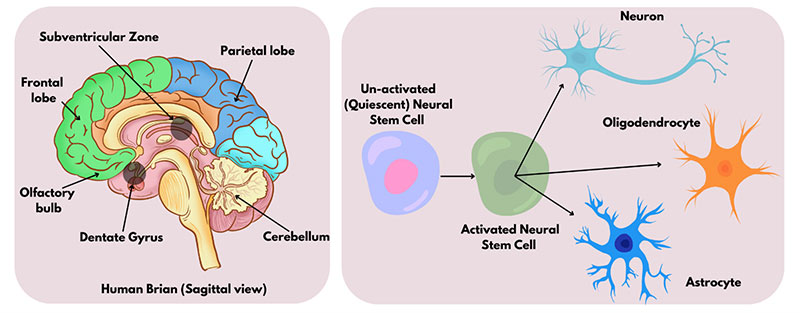
Fig. 1. NSCs reside within the dentate gyrus and subventricular zone of adult human brains. Quiescent NSCs can become activated, maturing into either neurons, oligodendrocytes, or astrocytes.
Although neurogenesis mainly occurs during early development and cortical expansion, studies now show that new neurons can still be generated during adulthood — a concept that was once widely disputed (Zhao et al. 2018, Navarro et al. 2020).
Neural Stem Cells and Aging: A Decline in Repair and Renewal
With that said, there is one large caveat to this… aging.
Aging is an inevitable biological process that involves a gradual deterioration of molecular, cellular, and physiological functions, leading to an increased risk of developing age-related diseases (Jothi and Kulka 2024). This is especially evident when it comes to the nervous system, where age-related changes lead to a well-documented decline in neuronal function and an increased risk of neurodegenerative diseases (Zhi-Xia et al. 2025).
Research shows that NSC activation becomes impaired with age, potentially contributing to reduced neurogenesis and cognitive decline. Several factors, including altered cell signaling and extracellular matrix cues, increased protein aggregation, changes in mitochondrial biology, chronic inflammation, and epigenetic alterations, are cited as potential drivers of this impairment (Zhao et al. 2018, Navarro et al. 2020). These factors are thought to lead to a reduction in NSC volume, proliferation, and neurogenesis, which also correlates with decreased cognitive function and increased neurodegeneration.
Consequently, as we get older, we have a reduced ability to repair damage and expand cortical capabilities. But, could breakthroughs in genetic editing help hack the system and restore power to these neuronal factories?
How CRISPR Can Fight the Inevitable: Identifying Age-Related Mechanisms
Recent studies suggest that we may be able to rejuvenate NSCs using CRISPR, a tool that earned the 2020 Nobel Prize in Chemistry. CRISPR allows for the precise manipulation of specific DNA sequences via Cas9 enzymes, enabling researchers to introduce mutations, delete entire regions of DNA, or correct genetic errors in host cells. This tool has paved the way for overcoming longstanding barriers in studying the impact of aging in NSCs (Ruetz et al. 2024), including:
- Difficulties in replicating age-related phenotypes in cell models
- Challenges in reliably distinguishing between cellular and organismal aging
- Limited scalability for genetic screens in mammalian models
- Insufficient data generation from high-throughput studies
Using CRISPR, a study recently published in Nature addressed obstacles associated with generating scalable high-throughput in vitro and in vivo genetic screens to identify genes that regulate NSC activation during aging (Ruetz et al. 2024, Jothi and Kulka 2024). In this study, Ruetz and colleagues conducted genome-wide CRISPR knock-out screens in primary NSC cultures taken from the subventricular region of both young and old mice expressing Cas9, alongside a library of single guide RNAs targeting over 23,000 gene-encoding proteins, to disrupt and therefore identify genes involved in neural stem cell activation.
The influence of CRISPR-induced gene knockouts was assessed by inducing the activation of quiescent NSCs, observing activation levels, and sequencing cells to interpret differences. NSC changes were also observed in vivo by the introduction of single guide RNA-expressing lentiviruses through subventricular injections.
One Less Candy a Day Keeps the Doctor Away?
As a result of genome-wide CRISPR knock-out screens, researchers identified over 300 genes that, when knocked out, restored the inhibited activation of aged NSCs; with most genes involved in the organization of cilia — small structures in the brain involved in sensing signals and regulating the cell cycle — and glucose import. Additionally, by establishing a scalable in vivo CRISPR screening platform, this study also uncovered 24 gene knockouts capable of boosting neuronal production through NSC activation in aged brains.
One of the most interesting findings of this study revealed that the knockout of insulin-sensitive GLUT4 (Slc2a4) transporters led to increased NSC activation and production of new neurons in aged brains. Moreover, old inactivated NSCs were also found to harbor increased glucose uptake, which when reversed, resulted in an improved ability for aged NSCs to activate.
Overall, their findings position glucose metabolism as a central mechanism behind aging, aligning with previous studies linking age-related neurodegeneration to glucose metabolism (Frolich et al. 1998, Schlotterer et al. 2009, Poisa-Beiro et al. 2020). Increased sugar uptake might therefore contribute to age-related decline in stem cell activation and risk of dysfunction.
So, could cutting back on those sugary treats help us to improve our brain aging and healthspan?
With the emergence of innovative genetic tools, researchers now have the power to investigate cellular changes and biological processes at increasingly large scales. These advances can play a role in understanding how NSCs (among other cells) age and identify therapeutic targets to delay or improve age-related dysfunction, enhance brain repair, and perhaps even slow the aging process itself. The prospect of rejuvenating NSCs brings us closer to unlocking the mysteries of brain aging and developing innovative treatments for neurodegenerative diseases.
Interested in Studying Neural Stem Cells for Yourself?
Bio-Rad offers a broad collection of antibodies against common markers associated with neural stem cells.
References
Frolich L et al. (1998). Brain insulin and insulin receptors in aging and sporadic Alzheimer’s disease. J Neural Transm 105, 423–438.
Jothi D and Kulka L (2024). Strategies for modeling aging and age-related diseases. NPJ Aging 10, 32.
Navarro N et al. (2020). Aging and rejuvenation of neural stem cells and their niches. Cell Stem Cell 227, 202–223.
Poisa-Beiro L (2020). Glycogen accumulation, central carbon metabolism, and aging of hematopoietic stem and progenitor cells. Scientific Reports 10, 11597.
Ruetz TJ et al. (2024). CRISPR-Cas9 screens reveal regulators of ageing in neural stem cells. Nature 634, 1150–1159.
Schlotterer A (2009). C. elegans as model for the study of high glucose-mediated life span reduction. Diabetes 58, 2450–2456.
Zhao X and Moore D (2018). Neural stem cells: developmental mechanisms and disease modeling. Cell Tissue Res 371, 1–6.
Zhi-Xia Li and Jing-Dong JH (2025). Neural stem cells in aging. Translational Medicine of Aging 9, 9–14.